Go deep, move fast, or say no: prioritizing SaaS partnership opportunities
A partnership prioritization framework for B2B SaaS. Triage every inbound into three lanes, score it, match it to real capacity, and ship the few that matter.
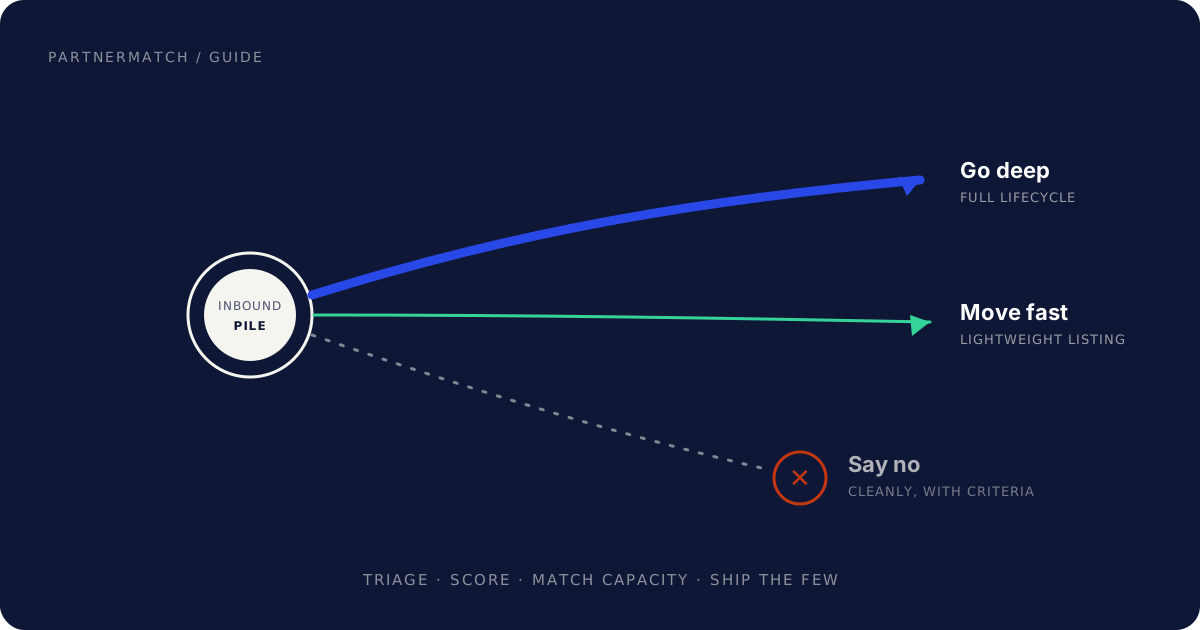
Open the partnerships inbox of any growing B2B SaaS company and you will find the same pile: a partner manager who pinged you on LinkedIn, a conference intro your CEO promised to follow up on, an investor connect to a portfolio company, and three customers asking for the same connector. None of it is sorted. All of it gets a meeting. And a quarter later, nothing has shipped.
That is a partnership prioritization problem, not an interest problem. You have no shortage of opportunities. You have a shortage of a system for deciding which ones get your engineering weeks, which get a lightweight listing, and which get a polite no. This post gives you that system: a three-lane triage, a scorecard that makes the triage repeatable, and the capacity math that keeps you honest.
The 60-second version
If you only read one section, read this one:
- Everything inbound is ambiguous until you sort it. Without a system, every opportunity gets a meeting and nothing ships.
- Triage into three lanes: go deep, move fast, or say no. Most opportunities are not deep, and that is the point.
- Go deep means full lifecycle investment: scope, build, launch, maintain. Reserve it for the few that earn it.
- Move fast means lightweight: a directory listing or a shallow integration that costs days, not engineering weeks.
- Say no with stated criteria, not silence. A clean no protects the relationship better than a slow maybe.
- Score on five dimensions: customer pull, distribution upside, build cost, strategic fit, and partner readiness.
- Respect capacity. A seed to Series B startup runs one to two deep partnerships per quarter. The rest must be fast-lane or no.
- Give every opportunity a next step and a date, or close it. Revisit the closed pile quarterly.
Why partnership prioritization breaks down at this stage
Partnership opportunities do not arrive labeled. They arrive as warm noise.
A partner manager pings you because their quarterly goal is ecosystem activity. A founder you met at a conference offers an intro because it costs them nothing. An investor forwards a portfolio connect because that is what investors do. A customer asks for an integration because the alternative is copying data by hand. Each of these feels like progress. None of them tells you whether the work is worth an engineering sprint.
The failure mode is predictable. Without a triage system, ambiguity defaults to politeness. Every ping gets a meeting because saying no feels rude and saying yes feels like momentum. You end up with a calendar full of partner calls and a roadmap with zero shipped integrations, because attention got spread evenly across opportunities that deserved wildly different amounts of it.
The fix is not more discipline in the moment. It is a default that runs before the meeting. Partnership prioritization is the act of sorting opportunities into lanes the instant they arrive, so the expensive decisions get made deliberately and the cheap ones get made fast.
The three-lane triage
Every partnership opportunity belongs in one of three lanes. The job of triage is to put it there quickly and out loud.
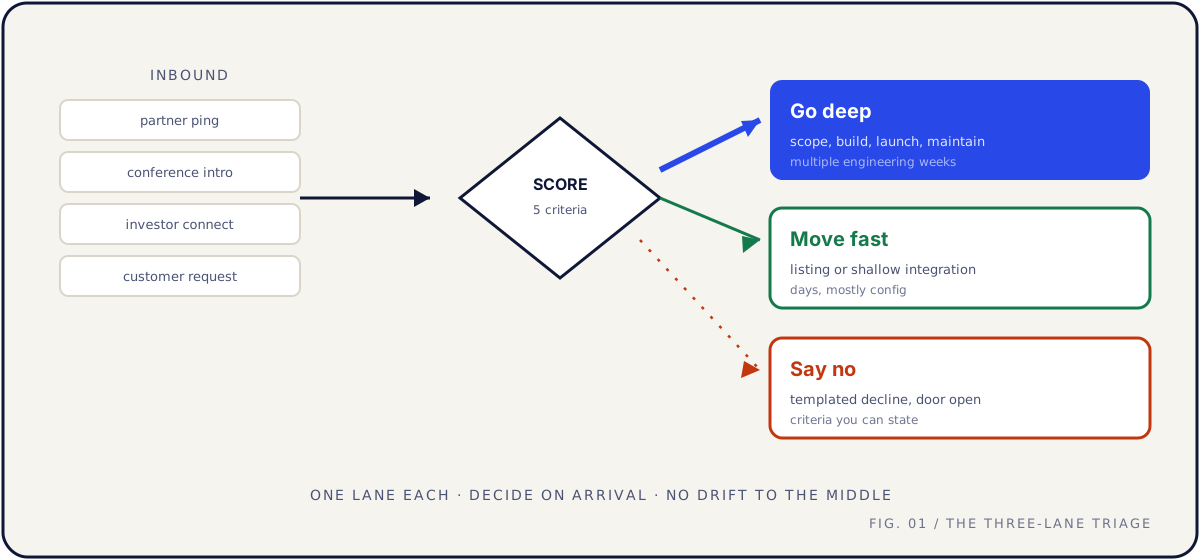
Go deep. Full lifecycle investment. You scope the integration, build and ship the code, write the enablement, run the launch, and maintain it after. This is the lane where partnerships compound, and it is also the most expensive thing your engineering team will do for a non-customer. Reserve it. A deep partnership should clear a high bar on customer pull and either distribution or strategic fit, because you are spending weeks you cannot spend elsewhere.
Move fast. Lightweight by design. A directory or marketplace listing, a shallow integration that uses an existing webhook, or a "works with" page that needs configuration rather than code. The point of the fast lane is to capture value without paying the deep-lane price. Many opportunities that are not worth a full build are absolutely worth a listing that keeps you visible in a partner's ecosystem.
Say no. Politely, and with criteria you can state. A no is not a failure of the relationship. It is a decision that this opportunity does not clear your bar right now, communicated cleanly so the partner can plan and so you do not leak a slow maybe for six months. The skill here is saying no in a way that leaves the door open, which we cover below.
| Lane | What you commit | Typical cost | When it fits |
|---|---|---|---|
| Go deep | Scope, build, launch, maintain | Multiple engineering weeks | High customer pull plus distribution or strategic fit |
| Move fast | Listing or shallow integration | Days, mostly config | Real but modest demand, low build cost |
| Say no | A clean, dated decline | An hour | Fails the bar, or no capacity this quarter |
The mistake teams make is treating these as a spectrum where everything drifts toward the middle. They are not. An opportunity is deep, fast, or no. Forcing the call is the whole value of the system.
The scorecard that makes triage repeatable
Triage based on gut feel works until two people disagree, or until the loudest customer wins. A scorecard turns the decision into something you can defend in a roadmap meeting and reproduce next quarter.
Score every opportunity on five dimensions, weighted by what actually predicts a partnership worth your time.
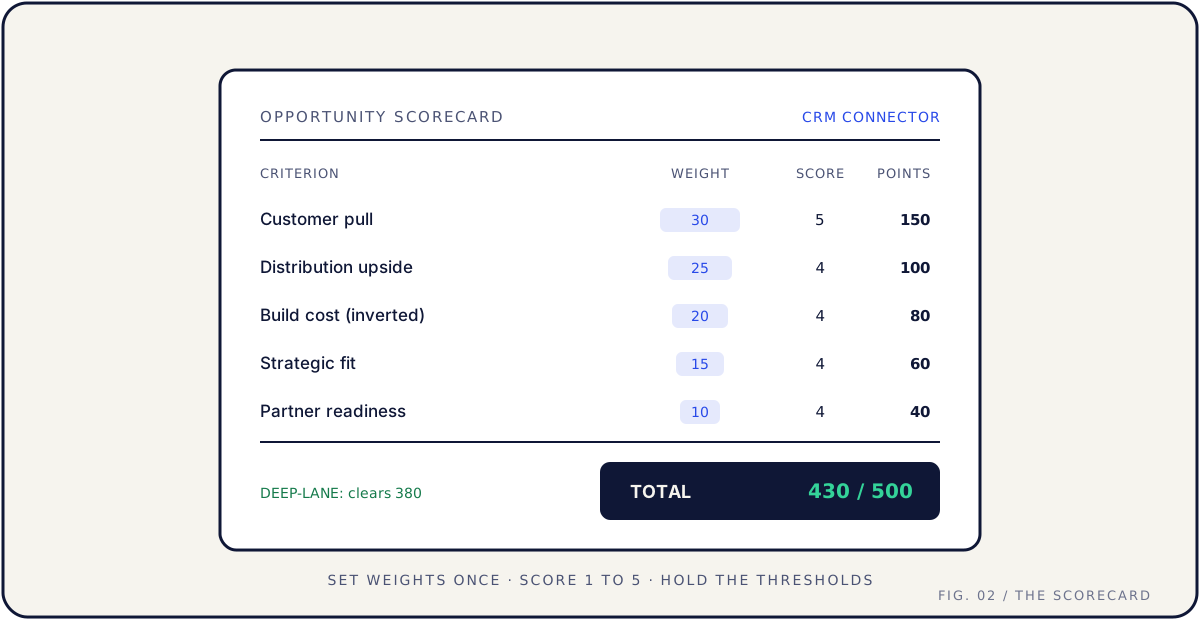
- Customer pull (weight 30). How many existing customers and active deals have asked for this, by name. Five customers describing the same manual workflow is a strong signal. One prospect mentioning it once is not.
- Distribution upside (weight 25). Does the partner run an active marketplace or partner program that can send you installs and leads? An integration that is also a distribution channel earns deep-lane treatment more easily.
- Build cost (weight 20, inverted). How stable and documented is the partner's API? Sandbox? App review? A clean API scores high here because it is cheap. An undocumented one scores low because every question becomes an email thread.
- Strategic fit (weight 15). Does this partnership point at the segment, geography, or motion you are trying to win this year? A perfect integration with the wrong segment is still the wrong integration.
- Partner readiness (weight 10). Is there a named owner on their side, a clear program, and an app review process? Or is this one enthusiastic person with no mandate? Readiness predicts whether the work survives their next reorg.
Score each dimension from 1 to 5, multiply by the weight, and total. Here is a worked hypothetical so the math is concrete.
| Dimension | Weight | A CRM connector | A niche vertical tool |
|---|---|---|---|
| Customer pull | 30 | 5 (150) | 2 (60) |
| Distribution upside | 25 | 4 (100) | 2 (50) |
| Build cost (inverted) | 20 | 4 (80) | 3 (60) |
| Strategic fit | 15 | 4 (60) | 3 (45) |
| Partner readiness | 10 | 4 (40) | 2 (20) |
| Total | 430 / 500 | 235 / 500 |
The CRM connector clears the deep-lane bar: strong pull, real distribution, a manageable build. The vertical tool does not. It is not a no, though. With modest pull and a cheap-enough build, it is a textbook fast-lane candidate: a directory listing or a shallow connector that keeps the door open without spending the quarter on it.
Set your thresholds once and hold them. A reasonable starting line: 380 and above is deep-lane eligible, 220 to 379 is fast-lane, below 220 is a no. The exact cutoffs matter less than the fact that you stop relitigating them every time a partner is charming on a call.
Capacity math: why most opportunities cannot be deep
Here is the constraint everyone forgets when an exciting partner reaches out. Deep partnerships cost engineering weeks, and a seed to Series B startup has very few of those to spare for non-customer work.
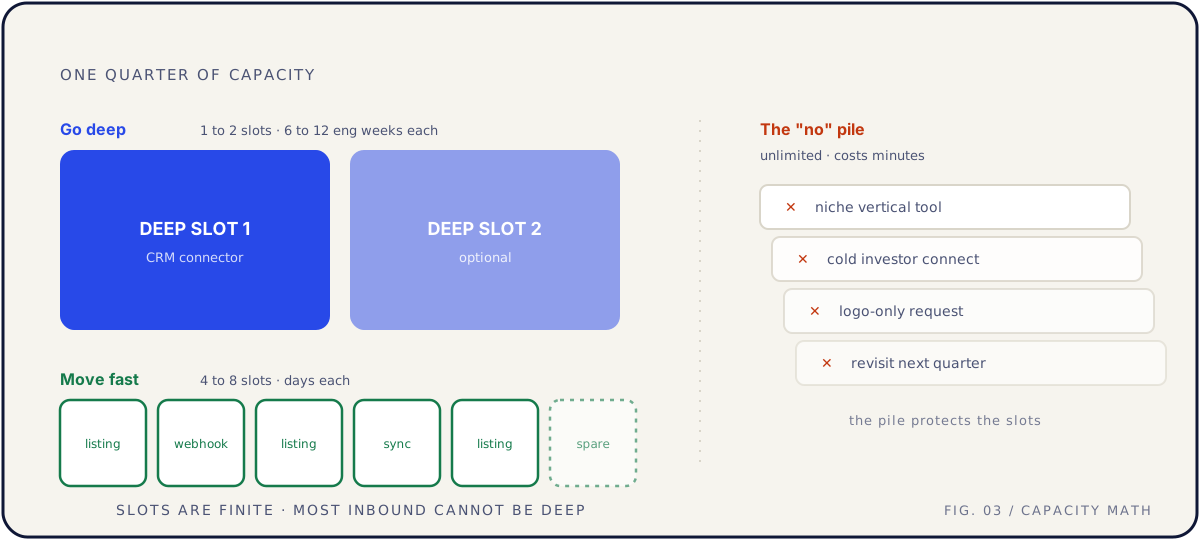
Be honest about the numbers. A deep partnership runs scope, build, launch, and the first stretch of maintenance. From scoped to live, that is commonly six to twelve weeks of focused engineering, plus the partner's app review. Most startups at this stage can run one, maybe two, of those in a quarter without starving the core roadmap. That is your deep-lane budget, and it is small.
| Lane | Slots per quarter | Cost per slot | Throughput |
|---|---|---|---|
| Go deep | 1 to 2 | 6 to 12 engineering weeks | Few, high value |
| Move fast | 4 to 8 | 1 to 5 days | Many, modest value |
| Say no | Unlimited | Minutes | Protects the budget |
The implication is uncomfortable and freeing at once. If you can only go deep on one to two partnerships this quarter, then by definition almost everything in your inbox must be fast-lane or no. That is not pessimism. It is arithmetic. A team that pretends it can go deep on six partnerships ships zero, because the slots do not exist.
So the scorecard is not just a ranking. It is a rationing tool. When two opportunities both clear the deep-lane threshold but you have one slot, the higher score wins the slot and the other one either waits in the queue or drops to the fast lane. For more on how the deep lane plays out end to end, see our SaaS partnership lifecycle breakdown.
Kill criteria and timeboxes
The opposite of a system is a pile of open threads that nobody will close. Opportunities do not die on their own. They linger, half-alive, consuming attention every time you scan the inbox and wonder whether you should follow up.
The rule that fixes this: every opportunity gets a next step and a date, or it is closed. No exceptions.
- An opportunity with a scheduled scoping call next Tuesday is alive.
- An opportunity with a "we will circle back" and no date is not alive. It is closed. Mark it closed.
- An opportunity waiting on the partner to send sandbox access has a date by which you stop waiting.
Timeboxing applies to lanes too. A fast-lane listing that has not shipped in two weeks is either deprioritized on purpose or stuck, and either way it needs a decision. A deep-lane build that slips past its scope date triggers a review, not a quiet extension.
| Status | Definition | Action |
|---|---|---|
| Active | Has a next step and a date | Work it |
| Waiting | Blocked on partner, with a stop-by date | Chase, then close |
| Closed | No next step, or failed the bar | Log the reason, revisit quarterly |
The closed pile is not a graveyard. It is a queue. Conditions change: a partner you passed on launches a marketplace, or three new customers ask for the connector you shelved. So you revisit the closed pile every quarter as part of your strategy review, re-score the live ones against current priorities, and promote anything that now clears the bar. The discipline is closing things cleanly so the revisit is a deliberate act, not archaeology.
Saying no without burning the relationship
The hardest part of triage is not deciding to say no. It is saying it in a way that keeps the partner warm for the day the answer changes.
A bad no is silence. You ghost the partner manager, they spend a month following up, and when you finally need them, the relationship is cold. A good no is fast, specific, and leaves a named condition under which yes becomes possible.
Here is a templated no you can adapt:
Thanks for reaching out, and for thinking of us. We score integration opportunities on customer demand and distribution fit, and right now this one sits below the line we can resource this quarter. We are running one deep build at a time and that slot is committed. If we see customer demand pick up, or if you would be open to a lightweight directory listing in the meantime, I would be glad to pick this back up. I will keep your details and revisit next quarter.
Notice what that does. It states the criteria, so the no does not read as personal. It offers the fast lane as a fallback, so the partner gets something. It names a revisit, so the door stays open. And it is honest about capacity, which partner managers respect far more than a vague maybe that wastes their quarter too.
The same logic applies internally. When a founder forwards a conference intro, "this scored below our deep-lane bar, here is the score, I have sent them a fast-lane offer" is a far better answer than letting the thread rot because nobody wanted to disappoint the boss.
How partnership prioritization feeds strategy reviews
Triage is not a one-time sort. It is the input to your quarterly partnership strategy review, where you check that the lanes you assigned still match where the business is going.
The artifact that makes the review fast is a single table: every live opportunity, its lane, the investment it represents, the outcome you expect, and how often you will revisit it.
| Opportunity | Lane | Investment | Expected outcome | Review cadence |
|---|---|---|---|---|
| CRM connector | Go deep | 8 eng weeks, launch | Retention plus marketplace installs | Monthly until live |
| Commerce listing | Move fast | 3 days, directory | Visibility in partner ecosystem | Quarterly |
| Analytics tool | Move fast | Shallow webhook sync | Serve a few asking customers | Quarterly |
| Vertical niche app | Say no | None this quarter | Revisit if demand grows | Quarterly |
Reading this table in a review takes minutes and surfaces the right questions. Is your one deep slot pointed at the most important workflow? Are fast-lane listings actually generating the visibility you assumed, or quietly doing nothing? Has anything in the no column accumulated enough customer pull to get promoted?
This is also where partnership work connects to the rest of your strategy. The deep-lane choices should match the integration thesis you set when you decided what partnerships are for in the first place, which we lay out in tech partnerships for SaaS. And the way you scope and ship the deep-lane winners should follow a real product process, not a handshake, which is the subject of our SaaS integration strategy guide. Triage decides which integrations get built. The lifecycle decides how well they get built.
Common mistakes, and the fix
Giving every inbound a meeting. The fix: triage on arrival. Score the opportunity before you book a call, and let the score decide whether a call is even worth it. Most fast-lane and no decisions never need a meeting.
Treating deep as the default. The fix: respect the capacity math. You have one to two deep slots per quarter. If an opportunity is not clearly worth one of those slots, it is fast-lane or no, not a deferred deep.
Leaving opportunities open with no date. The fix: every opportunity has a next step and a date, or it is closed. A closed opportunity with a logged reason is healthier than an open one that haunts your inbox.
Saying no by going silent. The fix: a templated, criteria-based no that offers the fast lane and names a revisit. Silence burns relationships. A clean no preserves them.
Triaging once and never revisiting. The fix: re-score the live pile and scan the closed pile every quarter as part of the strategy review. Demand and distribution change, and so should your lanes.
FAQ
What is partnership prioritization, in one line? It is the practice of sorting partnership opportunities into lanes (go deep, move fast, say no) and matching them to real capacity, so the few that matter get built and the rest get a fast, honest answer.
How many deep partnerships should we run at once? At seed to Series B, one to two per quarter is realistic without starving your core roadmap. A deep build costs multiple engineering weeks, and those weeks are scarce. If you think you can run more, recount your engineering capacity.
What goes in the fast lane versus a full build? The fast lane is for opportunities with real but modest demand and low build cost: a marketplace or directory listing, a "works with" page, or a shallow integration on an existing webhook. If it needs custom code, data-ownership decisions, and a launch plan, it is a deep build.
How do we score an opportunity nobody has asked for yet? It scores low on customer pull, which is the heaviest weight, so it will rarely clear the deep-lane bar on speculation alone. If the distribution upside is strong, treat it as a fast-lane bet and validate demand with prospects before committing engineering.
Should the scorecard weights be the same for every company? No. The five dimensions are stable, but the weights should reflect your strategy. A retention-focused team weights customer pull higher; a growth-focused team weights distribution upside higher. Set the weights once a year and hold them between reviews.
Who owns the triage? One person with authority to assign lanes and commit the deep slot. At this stage that is usually a founder or product leader, not a dedicated partnerships hire. The owner runs the scorecard and the quarterly revisit.
How do we say no to a partner our investor introduced? The same way you say no to anyone, with the score attached. "This scored below our deep-lane bar this quarter, here is the breakdown, we have offered a lightweight listing" is a clear, defensible answer that respects the introduction without committing engineering you do not have.
When should something move from no to deep? When the inputs change enough to clear the bar: customer pull grows, the partner launches a marketplace, or your strategy shifts toward their segment. That is exactly what the quarterly revisit is for. Re-score the closed pile and promote what now qualifies.
The short version
You do not have a partnership opportunity problem. You have a sorting problem. The inbound never stops, and without a system every ping gets a meeting and nothing ships.
Triage every opportunity into three lanes. Go deep on the one or two per quarter that clear the bar on customer pull, distribution, and fit. Move fast on the modest-but-real ones with a listing or a shallow integration. Say no, cleanly and with stated criteria, to everything else, and leave the door open. Score with a weighted scorecard so the calls are repeatable, give every live opportunity a next step and a date, and revisit the pile each quarter.
If you want help turning your partnership inbox into a ranked, capacity-aware plan, that is what a Partner Audit is for. We review your product, API, and partner opportunities, then tell you which to go deep on, which to fast-lane, and which to pass, with the build and launch handled end to end.