How to build a SaaS integration strategy that actually ships
Most B2B SaaS integration plans die in the backlog. Here is a practical framework for choosing the right partners, scoping integrations, and getting them live.
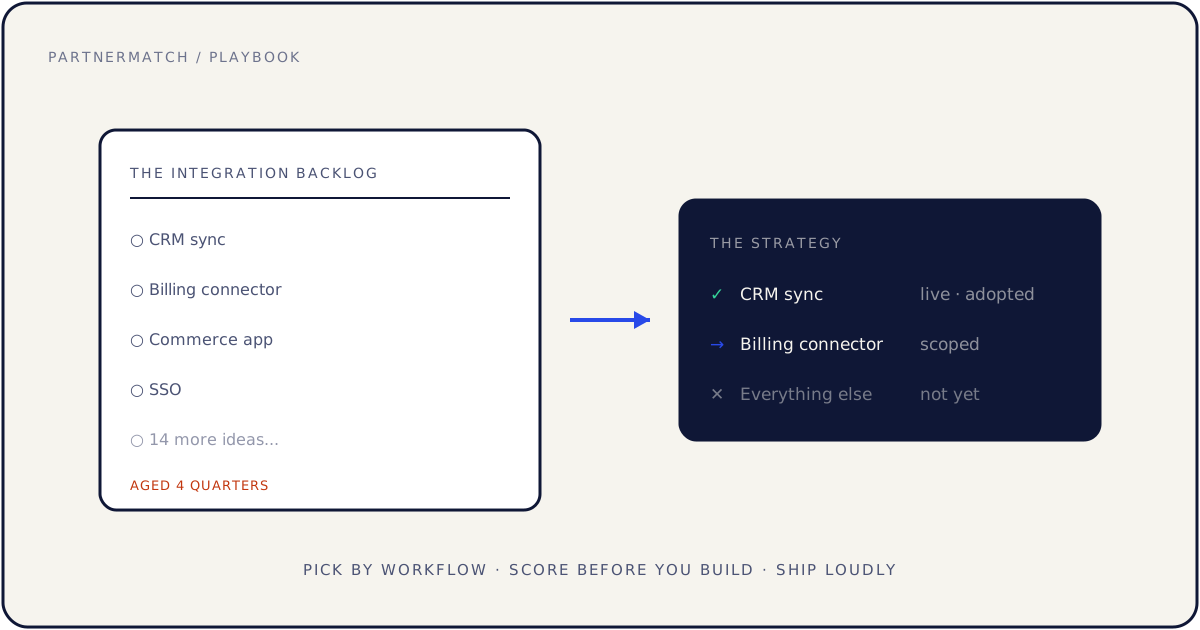
Every B2B SaaS founder has a version of the same list: the tools their customers keep asking them to connect with. HubSpot, Shopify, Stripe, Notion, a CRM, a billing system. The list is rarely the problem. The problem is that a year later, the list looks exactly the same and nothing has shipped.
This post is a practical framework for turning that list into a real integration strategy: one that picks the right partners, scopes the work properly, and ends with integrations your customers actually use.
Start with workflows, not logos
The most common mistake is choosing integration targets by brand recognition. A well-known logo on your integrations page feels like progress, but customers do not adopt integrations because of logos. They adopt them because the integration removes a step from a workflow they already run every day.
Before you commit to any partner, answer three questions:
- Which tools sit immediately before and after your product in your customers' daily workflow?
- What data do customers manually move between your product and those tools today?
- What would they stop doing by hand if the connection existed?
If you cannot describe the workflow in one sentence, you are not ready to scope the integration. "Sales reps push closed deals from our product into their CRM without retyping contact data" is a real workflow. "We integrate with Salesforce" is not.
Score opportunities before you build
Not every integration deserves to be built, and very few deserve to be built first. Score each candidate on four dimensions:
- Customer pull. How many existing customers asked for it, and how many prospects mentioned it in sales calls?
- Revenue impact. Does it unblock deals, reduce churn, or open a new segment?
- Build cost. How stable and well-documented is the partner's API? Is there a sandbox? App review?
- Distribution upside. Does the partner have a marketplace where your listing can generate leads?
The last one is the most underrated. An integration with a partner that runs an active marketplace is both a product feature and a distribution channel. That is what makes integrations a growth lever rather than a maintenance burden.
Make your API partner-ready before outreach
When a potential partner's engineering team looks at your API documentation, they are estimating one thing: how painful this will be. If they cannot answer "what can we build, how does auth work, and where is the value" within ten minutes, the conversation stalls.
Partner-ready documentation means:
- A plain-language overview of what the API exposes, written for someone who has never seen your product
- Authentication explained end to end, with a working example
- Two or three concrete integration use cases with the relevant endpoints mapped out
- A sandbox or test account a partner can use without talking to sales
This work pays off twice: it makes partner conversations move faster, and it makes your own scoping more honest, because gaps in the API surface show up before engineering commits to a date.
Scope the integration like a product, not a deal
Partnerships stall when they are treated as business development instead of product work. A signed partnership agreement with no integration scope is a press release, not a roadmap item.
A real integration scope includes:
- User stories for both sides of the integration, written from the customer's perspective
- A workflow map showing which system owns which data and when syncs happen
- Acceptance criteria that define what "done" means
- An owner with the authority to prioritize the work
If nobody on your team owns the build, the integration will lose every prioritization meeting to whatever the loudest customer asked for that week. This is the single most common reason integration roadmaps slip by quarters.
Launch is a project, not an announcement
An integration that ships silently might as well not exist. Customers do not read changelogs, and partner marketplaces do not promote listings that show no adoption.
Treat launch as its own project with its own checklist:
- A marketplace listing with screenshots and a clear use case, not feature jargon
- A help-center article that walks through setup end to end
- A sales one-pager so your team can pitch the integration in deals
- An announcement to the customers who asked for it, individually if the list is short
- A co-marketing ask to the partner: a blog mention, a newsletter slot, a social post
Then watch adoption for the first 90 days. If customers connect the integration but stop using it after a week, that is a scoping problem worth fixing before you build the next one.
The short version
Pick integrations by customer workflow, not logo. Score before you build. Get your API documentation partner-ready before outreach. Scope the build like a product with a named owner. Launch loudly, then measure adoption.
That is the difference between an integrations page that grows and a backlog that ages.