Build vs buy vs partner: how to decide on an integration
A practical build vs buy vs partner framework for B2B SaaS. The real decision criteria, when each wins, and how partnering turns an integration into a channel.
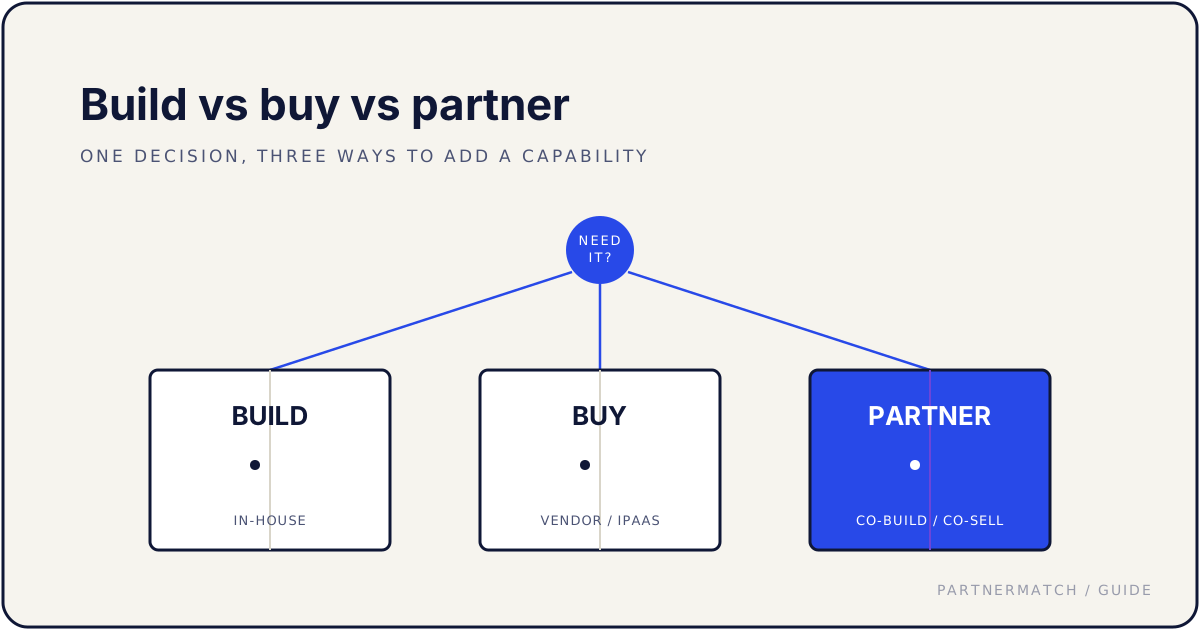
A customer asks for a connection to their billing tool. A prospect says the deal hinges on syncing with their CRM. Your roadmap meeting now has a new line item, and someone says "we should just build it."
Maybe. Or maybe you should buy it, or partner for it. The build vs buy vs partner decision is one of the most consequential calls a B2B SaaS team makes, and most teams make it by reflex. Engineers reach for build. Finance reaches for buy because a line-item fee is easy to reason about. Almost nobody reaches for partner, because it sounds like a sales motion rather than a way to add a capability.
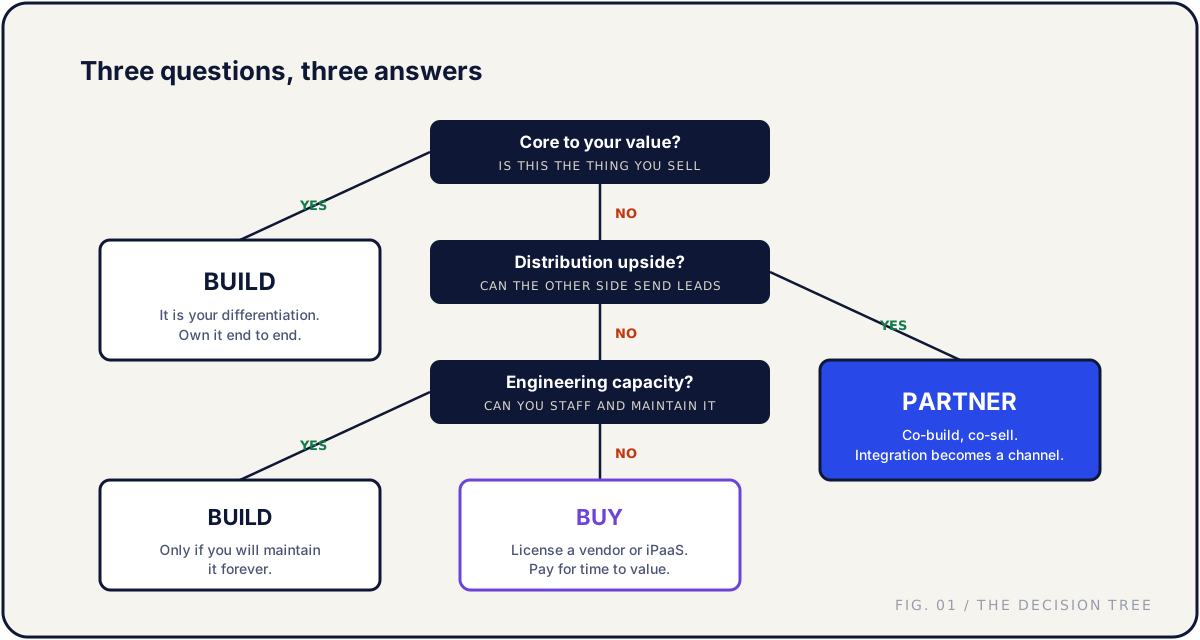
This guide gives you a real framework: criteria you can apply to the next integration request to get a defensible answer. The short version is build what is core to your value, buy what is generic and urgent, and partner when the other product can also send you customers. The rest of this post is how to tell which is which.
The 60-second version
If you only read one section, read this one:
- There are three ways to add a capability, not two: build it in-house, buy or license a vendor, or partner to co-build and co-sell.
- Build when it is core to your value. If customers pay you for this thing, owning it is the point.
- Buy when it is generic and time to value matters. A vendor or iPaaS already solved a problem that is not your differentiation.
- Partner when the other product can distribute you. That is the only one of the three that turns an integration into a growth channel instead of a cost.
- The hidden cost of building is maintenance, which you pay forever, every time the partner API changes.
- Run the decision against six criteria: core to value, customer pull, engineering capacity, time to value, maintenance burden, and distribution upside.
- Most integration requests are buy or partner, not build. Build is the expensive default people choose without pricing the next three years.
- Write the answer down with an owner, the same way you would scope any product decision.
The three ways to add a capability
When a capability is missing, you have three honest options, and they are genuinely different bets.
Build means your engineers write and own the integration. You control the user experience, the data model, and the roadmap. You also own every bug, every partner API change, and every certification renewal for as long as it exists.
Buy means you license a vendor, an iPaaS like a workflow-automation platform, or an embedded integration product. You trade control for speed. Someone else maintains the connectors, and you pay a recurring fee for the privilege of not thinking about them.
Partner means you and the other product co-build the integration, and ideally co-sell it. The work is shared, the maintenance is split, and the partner's marketplace becomes a place your product gets discovered. This is the option teams forget exists, and the only one where the integration pays you back in leads.
The mistake is treating these as a single spectrum from cheap to expensive. They are three different relationships with the capability, and the right one depends on what the capability is for.
The real build vs buy vs partner criteria
Forget the gut call. Six criteria decide this, and you can score any request against them in an afternoon.
| Criterion | The question it answers |
|---|---|
| Core to your value | Do customers pay you specifically for this capability, or is it table stakes? |
| Customer pull | How many real customers and active deals are asking? |
| Engineering capacity | Can you build this and still maintain it next year? |
| Time to value | How fast does this need to exist for the customer or deal that triggered it? |
| Maintenance burden | Who fixes it when the other side changes their API, and how often will that happen? |
| Distribution upside | Can the other product send you customers, through a marketplace or co-selling? |
The two criteria teams most often skip are maintenance burden and distribution upside, and they are exactly the two that flip the answer. Maintenance burden is the silent tax on building. Distribution upside is the silent return on partnering. Price both, and the decision usually answers itself.
A quick way to read the scores: if "core to your value" is high, lean build. If "time to value" is high and "core to value" is low, lean buy. If "distribution upside" is high, lean partner, almost regardless of the rest.
When building wins
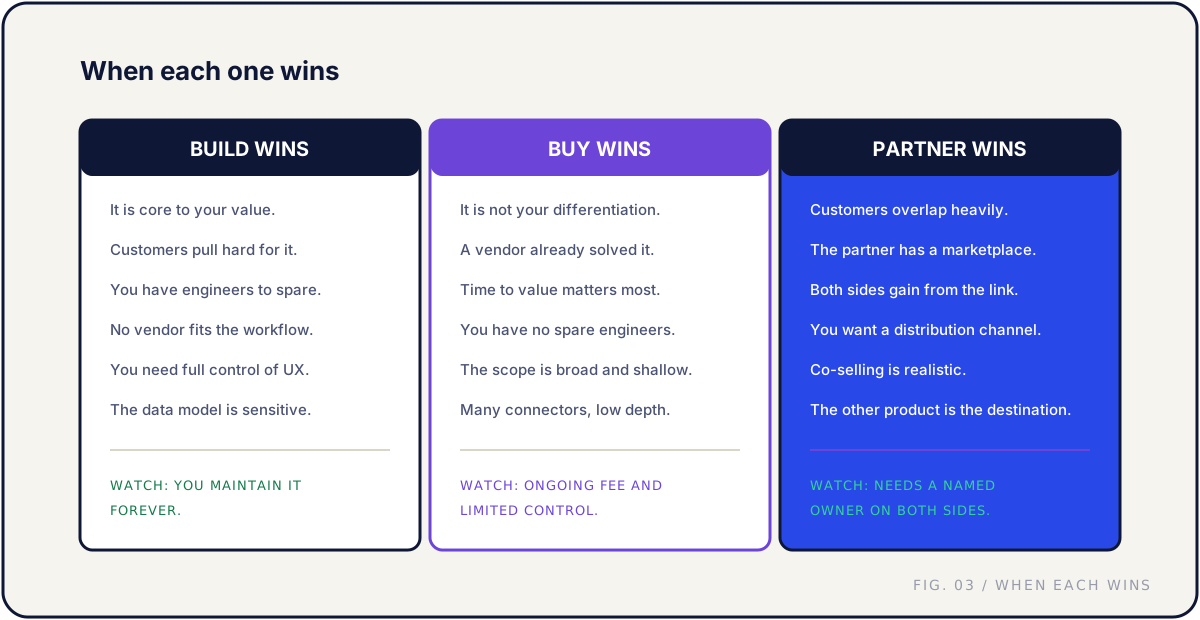
Building wins when the capability is the thing you sell. If a customer chooses your product because of how this feature works, handing it to a vendor means handing over your differentiation. Own it.
Building also wins when no vendor fits the workflow, when the data is too sensitive to route through a third party, or when you need full control of the user experience because the integration is part of your core loop.
The honest test is the maintenance one. Every integration you build is a thing you maintain forever. Partner APIs deprecate endpoints, rotate auth schemes, and change rate limits without asking you first, and a connector you shipped in a sprint can quietly break a year later. So build when you would happily staff the maintenance, not just the launch. If the answer to "who owns this when it breaks in eighteen months" is a shrug, you are not ready.
| Build wins when | Build hurts when |
|---|---|
| The capability is core to your value | It is generic plumbing a vendor already solved |
| You have engineers to build and maintain | Your team is already underwater |
| You need full control of UX and data | Time to value is the binding constraint |
| No vendor fits the specific workflow | You will not staff the maintenance |
When buying wins
Buying wins when the capability is real but generic, and speed matters more than control. Authentication, file conversion, address validation, payment rails, broad connector libraries: these are solved problems, and a vendor has spent years on edge cases you have not even hit yet.
Buying also wins when you need breadth over depth. If customers want connections to fifty tools but use each shallowly, an iPaaS or embedded integration platform gets you fifty connectors for the price of maintaining none of them. Building fifty by hand is how a small team disappears for a year.
The cost of buying is recurring and the control is limited. You inherit the vendor's roadmap, downtime, and pricing changes. For a capability that is not your differentiation, that trade is usually fine. For one that is, it is a slow mistake.
A useful framing: buy what makes your product work, build what makes it worth paying for.
When partnering wins
Partnering wins when your customers and the other product's customers overlap, and the connection helps both sides. This is the case people underweight, because it does not look like a build-or-buy choice. It looks like a relationship. But mechanically it is a third way to add the same capability, and the only one with distribution baked in.
Here is the shift that matters. A built integration is a cost center: you pay to create it and pay again to maintain it, and it sits on your integrations page hoping to get noticed. A partnered integration can be a distribution channel: the partner lists you in their marketplace, mentions you to their customers, and co-sells into shared deals. It stops being a line item you defend in roadmap meetings and becomes a way new customers find you.
Partnering wins specifically when:
- The partner runs an active marketplace where your customers already shop for tools.
- Co-selling is realistic, because your products solve adjacent parts of the same workflow.
- Both sides gain from the connection, so the partner has a reason to invest too.
- The other product is the destination your data wants to reach anyway.
The catch is that partnering needs a named owner on both sides and has to be run as product work, not a handshake. We wrote the full playbook for that in tech partnerships for B2B SaaS. A partnership with no integration scope and no owner is a press release, not a capability.
| Partner wins when | Partner struggles when |
|---|---|
| Customer bases overlap heavily | There is no real customer overlap |
| The partner has a marketplace or program | The partner has no distribution to share |
| Both products gain from the link | Only you benefit, so they will not invest |
| Co-selling into shared deals is realistic | Neither side will staff a named owner |
The hidden cost of building integrations
The build estimate you hear in the planning meeting is almost always the launch cost. Nobody quotes the cost of keeping the integration alive.
Every integration you build becomes a standing maintenance obligation. The partner ships a v2 API and deprecates v1. Auth moves from API keys to OAuth. A webhook payload changes shape. A rate limit drops. None of these is an emergency alone, and all of them land on your team, usually at the worst time.
Multiply that by the number of integrations on your page, and a healthy-looking strategy becomes a quiet drag on every sprint. This is how teams end up with a dozen integrations and no capacity to ship the thirteenth, or fix the three already broken.
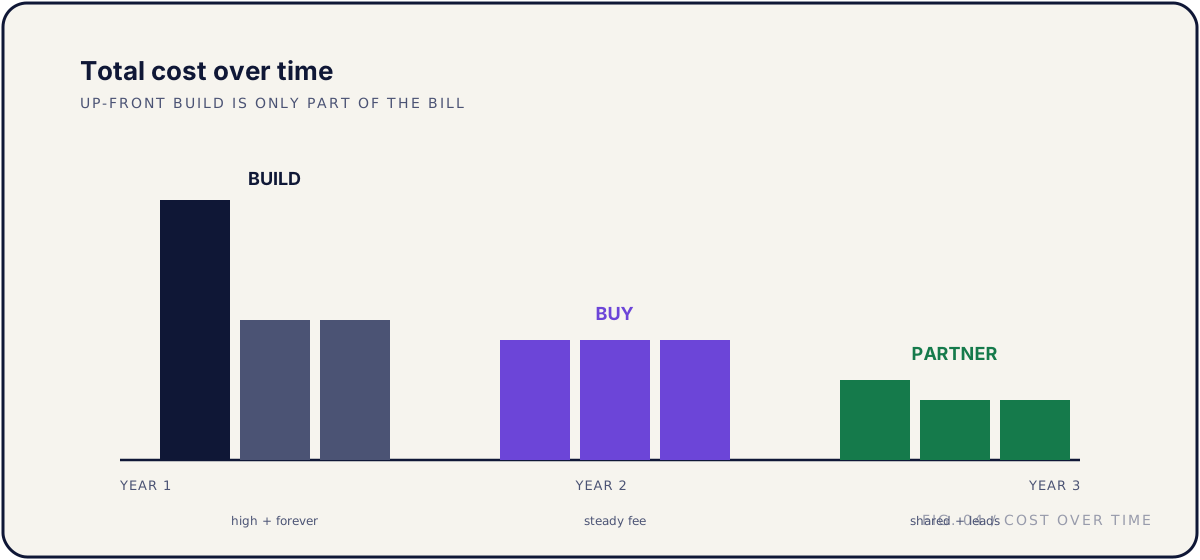
This is why time to value and maintenance burden belong in the decision, not just the up-front estimate. Buying moves the maintenance to a vendor for a fee. Partnering splits it, because the partner has their own reason to keep the connection working. Building keeps all of it, forever, on you.
None of this means never build. It means price the full life of the integration first, and choose build only when control is worth the standing cost.
Build vs buy vs partner, side by side
It helps to see the trade-offs side by side, because the right choice depends on which column you care about most.
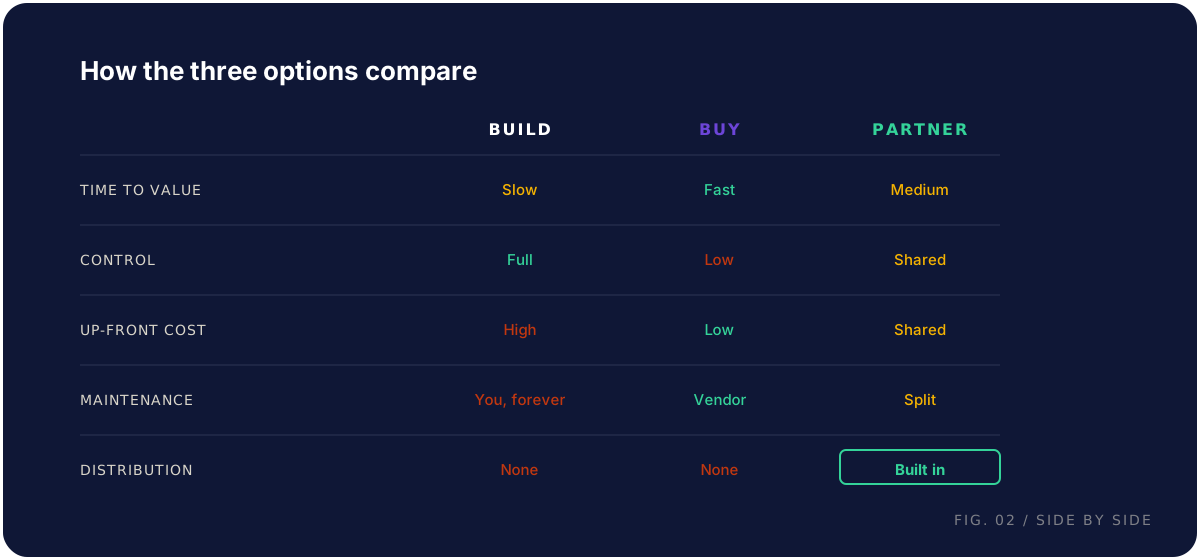
| Dimension | Build | Buy | Partner |
|---|---|---|---|
| Time to value | Slow | Fast | Medium |
| Control | Full | Low | Shared |
| Up-front cost | High | Low | Shared |
| Ongoing cost | Maintenance, forever | Recurring fee | Shared, often low |
| Maintenance owner | You | Vendor | Split with partner |
| Distribution upside | None | None | Built in |
| Best when | It is core to your value | It is generic and urgent | Customers overlap and they can distribute you |
Read down the column that matters. If control is everything, build. If time to value is everything, buy. If distribution is anywhere in the conversation, partner deserves a serious look, the only option with "built in" in the distribution row.
A worked decision
You run a Series A SaaS for field-service teams, and two requests land in the same week.
Request one: connect to a popular accounting tool so invoices sync automatically. Score it. Core to your value? No, customers buy you for scheduling. Customer pull? High, almost everyone asks. Engineering capacity? Thin. Time to value? A few deals are waiting. Maintenance burden? High, accounting APIs change often. Distribution upside? The accounting tool has a large marketplace your customers already browse.
Two criteria dominate: low "core to value" and high "distribution upside." This is a partner, not a build. You scope the integration with the accounting platform, get listed in their marketplace, and it starts sending you trial signups. Building it yourself would be the worst of the three: slow, and a permanent maintenance line for a capability that is not even yours.
Request two: an AI scheduling assistant that reads jobs and proposes routes. Score it. Core to your value? Yes, this is scheduling, the thing you sell. Customer pull? High. Engineering capacity? You will make room. Maintenance burden? Yours either way, since it touches your core data. Distribution upside? None.
Here "core to value" dominates. This is a build. Handing your scheduling intelligence to a vendor would mean licensing back your own differentiation. Same week, same team, opposite answers, because the criteria pointed different directions. That is the point of running the framework instead of defaulting to build.
How this ties to your integration strategy
The build-vs-buy-vs-partner call is not made once. You make it for every capability, and the pattern of your answers is your integration strategy.
Score requests before you commit, the same way you prioritize a roadmap. A capability that is core, high-pull, and yours to maintain is a build. A generic, urgent one is a buy. One where a partner can distribute you is a partner, and those compound, because each shipped partnership widens your presence and warms the next conversation. We cover the scoring and sequencing in how to build a SaaS integration strategy that actually ships.
The partner motion matters more as buyers use AI agents and connectors to assemble their own workflows across tools. When customers expect your product to be reachable from the other tools they live in, partnering is how you stay in the workflow at all. We get into that shift in connectors, agents, and third-party workflows.
The throughline: build, buy, and partner are not a hierarchy. They are three tools, and a good integration strategy uses all three on purpose.
Common mistakes, and the fix
Defaulting to build because building is the team's reflex. The fix: run the six criteria before anyone opens an editor. Build only when "core to your value" is high and you will staff the maintenance.
Pricing the launch, not the lifetime. The fix: estimate three years, not three sprints. Add maintenance, API migrations, and certification renewals before you compare build against buy.
Forgetting that partner is an option at all. The fix: for every integration request, ask whether the other product could distribute you. If yes, partner moves to the top of the list, because it is the only path with distribution upside.
Buying a vendor for the one capability that is your differentiation. The fix: buy what makes your product work, build what makes it worth paying for. Never license back the thing customers choose you for.
Treating a partner integration as BD instead of product work. The fix: scope it, name an owner on both sides, and define done as live and adopted, not as a signed agreement.
FAQ
What is the difference between build, buy, and partner for an integration? Build means your engineers write and own the integration. Buy means you license a vendor or iPaaS that maintains the connectors for a recurring fee. Partner means you co-build with the other product and ideally co-sell it, sharing the work and gaining distribution. The three differ in control, cost over time, and whether the integration can send you customers.
How do I decide between building and buying an integration? Score it on whether the capability is core to your value and how much time to value matters. If customers pay you specifically for this thing, build it. If it is generic plumbing and you need it fast, buy it. The deciding factor is usually whether you will staff the maintenance.
When should I partner instead of building or buying? Partner when your customers overlap with the other product's customers and the partner can distribute you, through a marketplace or co-selling. It is the only option of the three that turns an integration from a cost into a channel. The trade is that it needs a named owner on both sides.
Is partnering always cheaper than building? Not always up front, but often cheaper over time, because maintenance is split. The bigger difference is the return: a partnered integration can generate leads through the partner's marketplace, which a built or bought one never will.
What is the hidden cost of building integrations? Maintenance. Every integration you build is one you maintain forever. Partner APIs deprecate endpoints, change auth, and adjust rate limits on timelines you do not control, and each change lands on your team. The true cost of building is the launch plus years of upkeep.
Can I change my mind later, for example build something I first bought? Yes, and many teams do. A common path is to buy a connector to serve urgent demand, then build a deeper version once the capability proves core. The reverse also happens: a built integration becomes a maintenance drain and gets replaced by a vendor. Treat the first choice as reversible.
Does this decision change as customers adopt AI agents? It raises the stakes on partnering. As buyers use agents and connectors to assemble workflows across tools, being reachable from the other products your customers use becomes part of staying in the workflow at all. That makes the partner option more valuable relative to a built integration that only lives on your own page. We cover it in connectors, agents, and third-party workflows.
How does this fit into a broader integration strategy? You make the build-vs-buy-vs-partner call for every capability, and the pattern of those calls is your strategy. Score requests, build the core, buy the generic, and partner where distribution exists. The partnered ones compound, because each shipped integration widens your presence and warms the next conversation.
The short version
There are three ways to add a capability, not two. Build when it is core to your value and you will own the maintenance. Buy when it is generic and time to value is the constraint. Partner when the other product can distribute you, because that is the only path that turns an integration into a channel instead of a forever cost.
Run the six criteria, price the full lifetime and not just the launch, and write the answer down with an owner. Most integration requests turn out to be buy or partner, not the build everyone reaches for first.
If you want help making the call and shipping the result, that is what a Partner Audit is for. We review your product, API, and integration requests, then tell you what to build, what to buy, and where partnering would turn a cost into a distribution channel.