Partnership OKRs a startup can actually hit
Outcome-based partnership OKRs for B2B SaaS: how to set objectives and key results by stage, why leading beats lagging, and examples you can copy this quarter.
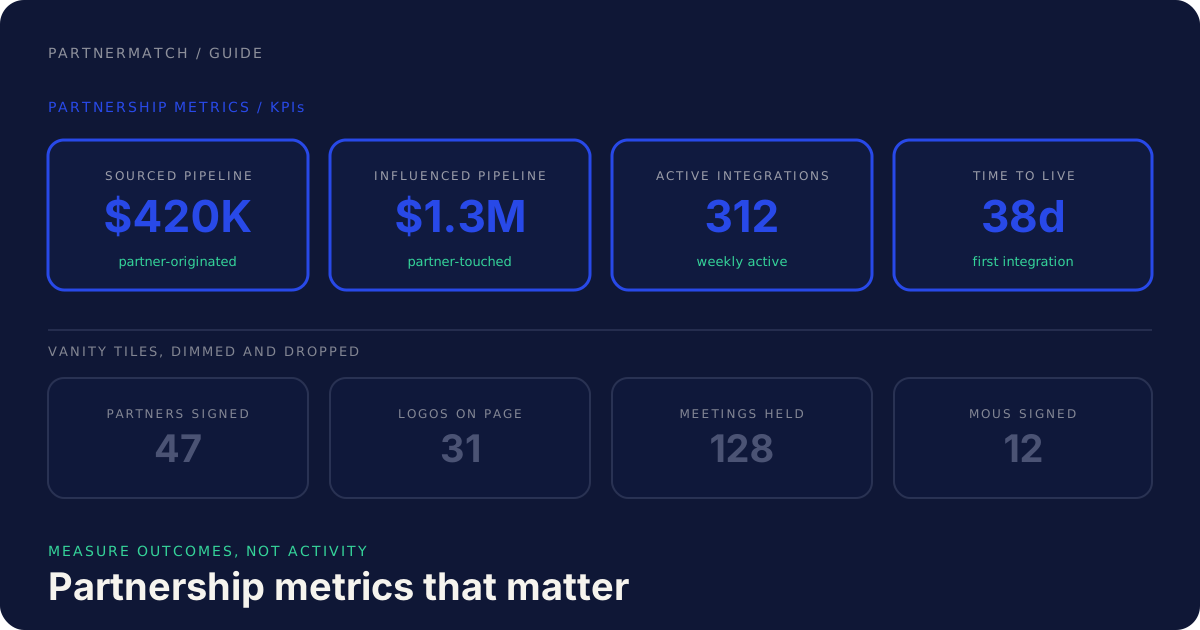
A founder sits down to write the quarter's partnership goals and produces a list that looks responsible and means nothing: "sign five partners," "launch the marketplace listing," "grow the ecosystem." Three months later the list is half-checked and nobody can say whether the partnership function is working, because none of those items was tied to an outcome anyone cares about. Signing five partners is not a result. It is an activity that may or may not produce a result, and a partnership program measured by activity will happily stay busy while producing nothing.
Partnership OKRs are how you point the function at outcomes instead of motion. An OKR pairs an objective, the thing you are trying to achieve, with a small set of key results, the measurable evidence that you achieved it. Done well, they force the uncomfortable question every partnership team should answer out loud: if we do all this work, what changes for the business. Done badly, they become the same activity list with a fashionable label, and the team learns to hit numbers that do not matter.
This guide is about doing them well for a startup, where the constraints are real and the temptation to measure activity is strongest. We cover what makes a partnership OKR outcome-based rather than activity-based, why leading indicators beat lagging ones early, how the right OKRs change by stage from seed to Series B, a set of examples you can adapt, and the common mistakes that turn OKRs back into a to-do list. At the end you get a by-stage table you can start from this quarter.
The 60-second version
If you only read one section, read this one:
- An OKR pairs an objective with key results. The objective is the outcome you want; the key results are the measurable evidence you got there. If a key result is an activity you control, it is not a key result.
- Outcome beats activity. "Sign five partners" is activity. "Reach 200,000 dollars in partner-influenced pipeline" is an outcome. Measure the second, because the first can be true while the business gains nothing.
- Leading indicators beat lagging ones early. Sourced revenue is the goal, but it lags by quarters. Track the leading signals that predict it, so you can steer before the results land.
- The right OKRs change by stage. Seed is about proving a motion works at all; Series A is about repeatability; Series B is about scale and efficiency. Copying a late-stage OKR at seed sets a target you cannot hit.
- Fewer OKRs beat more. One objective and two or three key results per quarter for a small team. A page of OKRs is a wish list nobody owns.
- An OKR you fully control is a task, not an outcome. If hitting it depends only on your effort and not on the market responding, you have written a to-do item.
What makes a partnership OKR outcome-based
The whole value of an OKR is the distinction between what you do and what results from it. An objective names a state of the world you want to be true at the end of the quarter. A key result is a number that tells you whether you got there. The trap, especially in partnerships, is writing key results that describe your own activity, because activity feels controllable and outcomes feel scary. "Launch three integrations" is comfortable to commit to, because you can make it happen by working hard. That is exactly why it is a weak key result: it can be fully true while producing zero adoption, zero pipeline, and zero reason to have done it.
The OKR framework, popularized inside large technology companies and now common at startups, exists precisely to break this habit. The objective is qualitative and directional. The key results are quantitative and, crucially, measure the outcome rather than the effort. A good test: if you could hit the key result by yourself, through pure activity, with no response from a partner, a customer, or the market, it is not a key result, it is a task. Real key results require the world to respond, which is uncomfortable, which is the point.
For partnerships specifically, the outcome you ultimately care about is business the partnership produced: pipeline sourced or influenced, revenue closed, integrations adopted by real customers. Those are the honest measures of whether the function is working. Activity metrics, partners signed, listings launched, calls held, are inputs that may lead to those outcomes, but they are not the outcomes, and confusing the two is how a partnership program stays busy for a year with nothing to show a board.
| Framing | Example | Why it is what it is |
|---|---|---|
| Activity (weak) | "Sign five new partners" | You control it entirely; it may produce nothing |
| Activity (weak) | "Launch the marketplace listing" | A task with a deadline, not an outcome |
| Outcome (strong) | "200,000 dollars in partner-influenced pipeline" | Requires partners to actually drive deals |
| Outcome (strong) | "Three integrations each with 20+ active accounts" | Requires customers to adopt, not just you to ship |
The mental shift is to write the objective from the business's point of view, not the partnership team's. The business does not want partners signed; it wants pipeline, revenue, and retention that partnerships helped create. Anchor every OKR to one of those, and the activity you need to do falls out naturally underneath as the plan, not the goal.
Why leading indicators beat lagging ones early
Here is the tension at the heart of partnership OKRs: the outcome that matters most, revenue the partnership sourced, is also the slowest to arrive. A partnership signed this quarter might not influence a closed deal for two or three quarters, because the integration has to ship, customers have to adopt it, and a sales cycle has to run its course. If your only key result is sourced revenue, you spend the first several quarters with a scoreboard that reads zero, and zero tells you nothing about whether you are on track.
The answer is to build your OKRs around leading indicators, the earlier signals that reliably predict the lagging outcome, while keeping the lagging outcome in view as the ultimate goal. A performance indicator is only useful if it moves early enough to let you act on it. Sourced revenue is a lagging indicator: by the time it moves, the quarter that produced it is long gone. Partner-influenced pipeline, integration adoption, and enablement completion are leading indicators: they move within the quarter, and a healthy reading on them today predicts revenue later.
| Indicator | Type | When it moves | What it tells you |
|---|---|---|---|
| Partner-sourced revenue | Lagging | Quarters after the work | Whether the motion ultimately paid off |
| Partner-influenced pipeline | Leading | Within the quarter | Whether deals are entering the funnel |
| Active integration accounts | Leading | Weeks after launch | Whether customers actually adopt |
| Enabled partner reps | Leading | Within the quarter | Whether the field can pitch you at all |
The discipline is to pick leading indicators that genuinely predict the outcome, not ones that are merely easy to move. Enablement completion predicts co-sell pipeline only if trained reps actually pitch you, so pair it with a pipeline read. The distinction between the two kinds of pipeline is worth getting right, because it decides what you can honestly claim; we untangle it in influenced versus sourced pipeline. And the full menu of what to measure across the function lives in our guide to partnership metrics, which is the reference behind the key results in this post.
How OKRs change by stage
The single most common OKR mistake at a startup is copying a goal that belongs to a different stage. A Series B partnership team with a working motion can set an OKR about scaling co-sell across regions. A seed-stage team setting the same OKR is committing to scale a motion it has not yet proven exists, which guarantees a miss and teaches the team that OKRs are theater. The right objective depends entirely on what you are trying to learn or prove right now.
Seed: prove a motion works at all. At seed, you do not yet know which partner motion will produce anything, so the objective is discovery, not scale. You are trying to get one integration live, adopted by a handful of real customers, and ideally tied to a first influenced deal. The key results are small absolute numbers, because small is honest at this stage. One integration with twenty active accounts is a real result at seed and a rounding error at Series B.
Series A: make it repeatable. Once one motion works, the Series A objective is to prove it repeats without heroics. You are looking for a second and third integration that adopt on the same playbook, a co-sell motion that produces pipeline from more than one partner, and enablement that a new partner can run through without you improvising each time. The key results shift from "does this work" to "does this work again, predictably."
Series B: scale and efficiency. With a repeatable motion, the Series B objective is leverage: more pipeline per partner, more partners on the same operating cost, and efficiency ratios that hold as you grow. Now sourced revenue is a fair key result, because the motion has run long enough to produce it, and you can add efficiency measures like pipeline per partner or cost per sourced dollar that would have been meaningless earlier.
| Stage | The objective | Example key result | What you are proving |
|---|---|---|---|
| Seed | Prove one motion works | One integration, 20 active accounts | That partnerships can produce anything |
| Series A | Make it repeatable | 3 integrations adopting on one playbook | That it works more than once |
| Series B | Scale and stay efficient | 500,000 dollars sourced, pipeline-per-partner up 20% | That it grows without proportional cost |
Reading the table top to bottom shows the through-line: the objective climbs from existence to repeatability to leverage, and the key results move from small absolute counts to ratios and efficiency. Setting a target from the wrong row is the fastest way to write an OKR you cannot hit, or worse, one you hit while learning nothing. If you are not sure which stage your function is actually at, our guide to when to hire for partnerships covers the maturity signals that place you.
Examples you can adapt
Abstract advice about outcomes is easy to nod along to and hard to apply, so here are concrete OKRs by stage. Treat them as starting points to edit, not targets to adopt unread; the right numbers depend on your deal sizes, sales cycle, and how many partners you can realistically support. The structure is what transfers: one objective, two or three outcome-based key results, at least one of them leading.
Seed example. Objective: prove that a technology partnership can produce real customer adoption. Key results: (1) one integration live and documented on a partner page; (2) twenty active accounts using the integration within the quarter; (3) one partner-influenced opportunity in the pipeline. Note that only the first is fully in your control; the other two require customers and a partner to respond, which is what makes them real.
Series A example. Objective: prove the integration motion repeats beyond the first partner. Key results: (1) three integrations live, each with at least fifteen active accounts; (2) 250,000 dollars in partner-influenced pipeline across at least two partners; (3) an enablement path that ten partner reps complete without custom support. The pipeline and adoption results are outcomes; the enablement result is a leading indicator that predicts next quarter's pipeline.
Series B example. Objective: scale co-sell into a predictable revenue channel. Key results: (1) 500,000 dollars in partner-sourced revenue closed; (2) partner-influenced pipeline up 40 percent quarter over quarter; (3) pipeline per active partner up 20 percent, proving efficiency and not just headcount. Sourced revenue is fair game here because the motion is mature enough to produce it reliably.
A word on target-setting inside these. A key result should follow the SMART criteria in spirit: specific, measurable, and time-bound, with a number you could not hit by accident. But resist the urge to sandbag. An OKR you are certain to hit was set too low and taught you nothing; the framework works best when a full score is genuinely uncertain at the start of the quarter, and hitting seventy percent of an ambitious target beats hitting a hundred percent of a safe one.
Common mistakes, and the fix
Writing activity as key results. The fix: for every key result, ask whether you could hit it by pure effort with no market response. If yes, it is a task; rewrite it as the outcome that effort is supposed to produce. "Launch three integrations" becomes "three integrations each with twenty active accounts."
Measuring only the lagging outcome. The fix: pair every lagging goal like sourced revenue with a leading indicator that moves within the quarter, so you can steer before the results arrive. A scoreboard that only moves two quarters late cannot guide the work in between.
Copying an OKR from the wrong stage. The fix: set the objective from what you are trying to prove right now, existence at seed, repeatability at Series A, efficiency at Series B. A scale target at seed is a guaranteed miss dressed up as ambition.
Setting too many OKRs. The fix: one objective and two or three key results per quarter for a small team. A page of OKRs is not a focused goal, it is a backlog, and a backlog measures nothing because the team cannot move all of it. The same prioritization discipline that ranks partners applies here; a simple prioritization matrix helps you choose the one objective that matters most.
Chasing metrics that look good and mean nothing. The fix: audit each key result for whether it changes a real business outcome. Partners signed and page views are classic vanity metrics: they rise reliably and predict nothing, which makes them worse than no metric because they create false confidence.
FAQ
What is a partnership OKR? It is an objective, the partnership outcome you want this quarter, paired with two or three key results, the measurable evidence that you achieved it. The objective is directional, like "prove co-sell produces pipeline." The key results are numbers that require the market to respond, like "200,000 dollars in partner-influenced pipeline," not activities you fully control.
How is an OKR different from a KPI? A KPI is a metric you track continuously to monitor health, like partner-influenced pipeline or active integration accounts. An OKR is a time-bound goal for a specific quarter, built from a target on one or more of those metrics. KPIs are the dashboard you always watch; OKRs are the specific hills you commit to climb this quarter.
Why are activity goals like "sign five partners" bad OKRs? Because you can hit them entirely through your own effort while the business gains nothing. Five signed partners who never produce pipeline is a fully achieved key result and a failed quarter. Outcome-based key results require partners and customers to respond, which is uncomfortable but is the only honest measure of whether the function works.
How many partnership OKRs should a startup set? One objective with two or three key results per quarter for a small team. The constraint is the point: a single objective forces you to decide what matters most, and a short list is something a small team can actually move. A page of OKRs is a wish list that measures nothing because nobody can advance all of it.
Should I use leading or lagging indicators? Both, but weight leading indicators early. Sourced revenue is the ultimate lagging outcome and belongs in the picture, but it moves too slowly to steer by in the first several quarters. Pair it, or replace it early on, with leading indicators like influenced pipeline, adoption, and enablement that move within the quarter and predict the revenue later.
What is a realistic partnership OKR at seed stage? Something small and honest: one integration live, twenty active accounts using it, and one partner-influenced opportunity in the pipeline. At seed you are proving a motion can produce anything at all, so small absolute numbers are the right target. Copying a Series B revenue goal at seed sets a number you cannot hit and teaches the team to ignore OKRs.
How do I set the target number for a key result? Aim for a number that is specific, time-bound, and genuinely uncertain at the start of the quarter, following the SMART idea without sandbagging. A key result you are sure to hit was set too low. The framework works when a full score is a real stretch, and reaching seventy percent of an ambitious target usually beats a hundred percent of a safe one.
Further reading
- Wikipedia, OKR, on the objective-and-key-result framework and why key results measure outcomes.
- Wikipedia, performance indicator, on leading versus lagging measures and what makes an indicator actionable.
- Wikipedia, SMART criteria, on setting targets that are specific, measurable, and time-bound.
- Wikipedia, vanity metric, on metrics that rise reliably and predict nothing.
- Nielsen Norman Group, prioritization matrices, on choosing the one objective that matters most when everything competes for attention.
The short version
Partnership OKRs work when they point the function at outcomes instead of activity. An OKR pairs an objective, the business result you want, with two or three key results that measure whether you got there, and a real key result requires the market to respond rather than just your own effort. "Sign five partners" is a task; "200,000 dollars in partner-influenced pipeline" is an outcome.
Build the OKRs around leading indicators early, because the outcome that matters most, sourced revenue, lags by quarters and cannot steer the work in between. Set the objective from your stage: prove a motion exists at seed, prove it repeats at Series A, prove it scales efficiently at Series B. Keep the list short, one objective and a few key results, and audit each one for whether it changes something the business actually cares about.
If you want the whole path handled, from partner strategy and a partner-ready API through the shipped integration, the enablement, and the metrics that prove it worked, that is exactly what a Partner Audit is for. We review your product, API, and partner potential, then define what to build, who to approach, and how to ship and measure it together.