Co-selling with cloud providers (AWS, Azure, GCP)
An independent guide to cloud co-sell programs: how marketplace and co-sell fit together, what is required, and how a startup can actually run the motion.
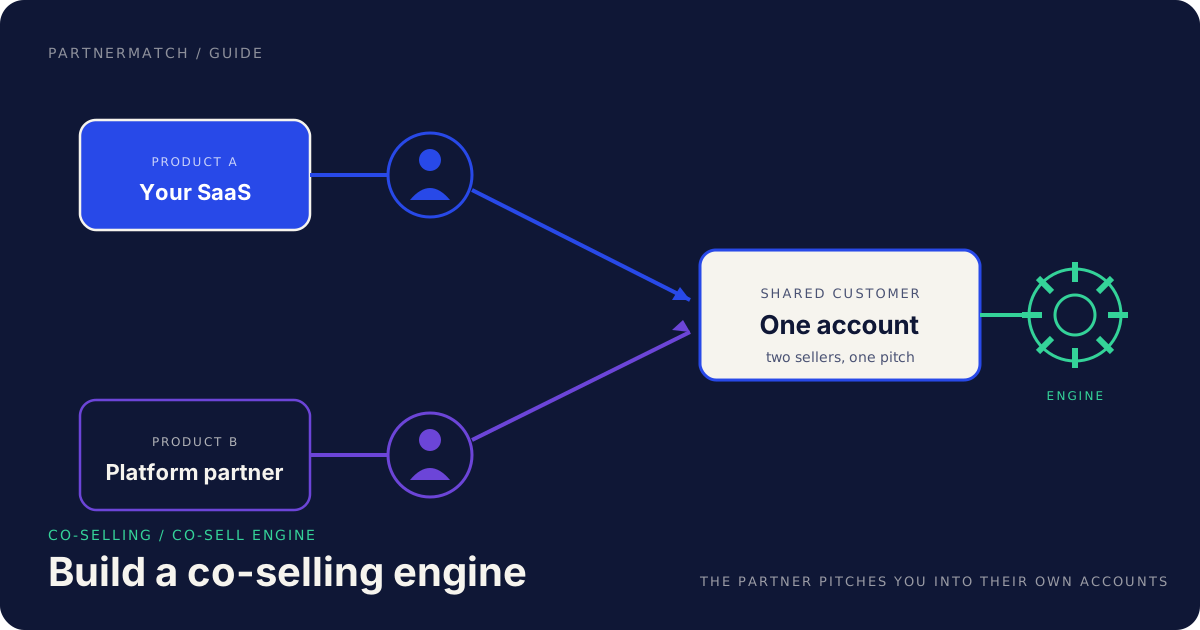
A cloud provider's field team is the largest sales force you will never hire. When one of their account executives is shaping a customer's architecture and names your product as part of the answer, you arrive inside a live deal, vouched for, at the moment the budget is open. That is the promise of cloud co-sell, and it is real. It is also the motion most startups misread, because they treat "get on the marketplace" and "co-sell with the field" as the same project. They are not.
This guide is an independent overview of how co-selling with the major cloud providers works in practice. It is not affiliated with any provider, and it does not quote specific program names, fees, tiers, or eligibility criteria, because those change and vary by region and segment. What it does is explain the durable shape of the motion: how a cloud marketplace and a co-sell program relate, what you generally have to put in place before a provider's sellers will engage, and how a small team can run the whole thing without a dedicated alliances hire.
If you have read our SaaS marketplace strategy guide, this is the co-sell companion to it: the marketplace is the storefront, co-sell is the field motion that fills it.
The 60-second version
- A cloud marketplace and a cloud co-sell program are two different things. The marketplace is a transaction surface where customers buy; co-sell is a relationship with the provider's field sellers who pitch you inside their deals. You usually want both, in that order.
- The marketplace listing is the price of admission to co-sell. Most providers want a transactable offer in place before their field engages, because a marketplace transaction is how the deal gets counted on their side.
- Co-sell runs on the provider seller's self-interest. Their account executive co-sells you when your product grows their consumption number, unblocks their customer, or makes their deal bigger. Build the joint story around that, not around your features.
- The mechanics are deal registration and account mapping. You register a deal so the provider can see and credit it, and you map your pipeline against accounts the provider already owns to find where you both have a reason to be.
- Private offers are how real deals close. Public list pricing seeds small transactions; negotiated private offers through the marketplace are where larger committed deals actually land.
- None of this is automatic. A signed enrollment enables nobody. The unit of a working co-sell motion is one provider seller who can say what you do and why it helps their deal.
- Start with one provider. Pick the one where your customers already run their workloads, get transactable and co-sell-ready there, and prove the motion before adding a second.
Marketplace and co-sell: two motions, one ecosystem
The single most common confusion is collapsing two separate motions into one. They share an ecosystem, but they do different jobs and require different work.
A cloud marketplace is a transaction surface. A customer browses or searches, finds an offer, and buys it, often drawing the spend down against a commitment they have already made to the provider. The marketplace solves procurement: it puts your product on an invoice the customer is already paying. It does not, on its own, generate demand. A listing nobody is pointed to behaves like any other unvisited storefront.
A cloud co-sell program is a relationship with the provider's field organization. It is the motion where the provider's sellers and solution architects bring you into their accounts, position you in a customer's architecture, and stay involved through the deal. Co-sell generates and accelerates demand. But it needs somewhere for the resulting transaction to land, which is usually the marketplace.
So the two reinforce each other. Co-sell creates the deal; the marketplace transacts it and makes it countable on the provider's side, which is what motivates their field to keep co-selling. Run only the marketplace and you have a storefront with no traffic. Run only co-sell with no transactable offer and the provider's seller has no clean way to book the deal, so the incentive to co-sell weakens.
| Motion | What it is | What it produces | What it does not do |
|---|---|---|---|
| Cloud marketplace | A transaction and procurement surface | A clean way to buy and bill your product | Generate demand by itself |
| Cloud co-sell | A relationship with the provider's field | Deals brought into accounts and accelerated | Transact the deal by itself |
The practical takeaway: sequence them. Get transactable on one marketplace first, because that is usually the prerequisite the provider's field looks for, then build the co-sell relationship on top of a listing that can actually take an order.
What providers generally require before they co-sell
Cloud providers do not co-sell with everyone who asks. Their field sellers' time is the scarcest resource in the ecosystem, and they spend it on partners who make deals bigger and easier, not harder. The specifics differ by provider, region, and segment, and they change, so treat the following as the durable categories of what is required rather than a checklist of named criteria.
A transactable offer. As covered above, a listing the customer can actually buy through is usually the entry ticket. This is what lets the provider count the deal, which is what makes their field care.
Proven customer value on the platform. Providers want partners whose products drive real customer outcomes on their cloud, often including consumption of the underlying platform. A product that increases what the customer does on the provider's infrastructure is a product the provider's field has a selfish reason to push.
Solution and security readiness. Expect to demonstrate that your product is architected sensibly on the platform and that you handle data and security responsibly. This is the same readiness that an enterprise buyer demands, and it overlaps heavily with marketplace certification and the security questionnaire work we cover in app certification and review without the pain.
A joint value story the field can use. The provider's seller needs a one-sentence reason to bring you up that helps their own deal. Without it, even an enrolled, transactable, secure partner gets ignored, because there is nothing for the field to say.
An owner on your side. Co-sell is a relationship, and relationships need a named human who answers fast, shows up to reviews, and keeps the provider's contacts informed. A program enrollment with nobody behind it goes quiet within a quarter.
The mental model: enrollment is necessary but does nothing on its own. The provider's program team can put you in the system, but only the provider's individual sellers can co-sell you, and they will do it only when the five categories above add up to a deal that is easier with you than without you.
The joint value proposition for a cloud deal
Co-selling with a cloud provider runs on the same engine as co-selling with any platform: a joint value proposition the other side's seller will actually say. We cover the general version in how to build a co-selling engine. The cloud-specific twist is that the provider's seller is usually compensated, in part, on how much the customer consumes of the underlying platform. So the most powerful joint value props connect your product to that.
A weak cloud joint value prop is a hosting statement: "We run on their cloud." That tells the provider's seller nothing they can use in a customer meeting. A strong one names the customer workflow and the platform outcome: "Their customers running large data workloads on the platform can adopt our analytics layer to get reporting live in days instead of months, and it scales their underlying compute as usage grows." That sentence helps the provider's seller because it makes the customer more successful on the platform and grows the consumption the seller is measured on.
Write it from the provider seller's incentive, then test it with one question: does saying this sentence help the provider's account executive close their own deal and grow their number? If your product makes the customer stickier on the platform, expands their footprint, or removes a blocker that is stalling the provider's deal, the seller has a reason to bring you up. If it only helps you, it will sit unsaid.
Keep it to one workflow and one outcome. A joint value prop that tries to cover every way you touch the platform becomes a paragraph no seller will remember. Pick the single workflow where your product most obviously grows the customer's success on the provider's cloud, and let that carry the relationship.
The mechanics: deal registration, account mapping, private offers
Three mechanics make a cloud co-sell motion run. They are not exotic, and a small team can operate all three.
Deal registration. When you have a deal where the provider could help, or where the provider's seller brought you in, you register it so the provider can see it, credit it, and route it to the right field contact. Registration is how influence becomes visible on the provider's side. Skip it and the provider's seller has no record that you contributed, which means no credit, which means no reason to co-sell you on the next deal. Register early and keep the record honest.
Account mapping. This is the same overlap analysis that powers any co-sell engine: match your open pipeline and customer list against the accounts the provider already owns, and work the overlap. The zones are familiar.
| Zone | What it is | The cloud co-sell play |
|---|---|---|
| Your pipeline, their customer | A deal you are working at an account already running on the provider | Register it, ask the provider seller for an intro and air cover |
| Their pipeline, your prospect | A deal the provider is working where your product fits the architecture | Get positioned in the solution so you arrive with the provider |
| Both prospecting | Neither has the account yet, but both want it | Plan a joint approach so you show up together |
You do not need a partner platform for the first pass. A spreadsheet that matches on company name or domain finds the overlap; the value is in working the list, not building it. We go deeper on running this lightly in the co-selling engine guide.
Private offers. Public list pricing on a marketplace is good for small, self-serve transactions, but most substantial cloud deals close through a negotiated private offer: custom pricing and terms, agreed with the customer, transacted through the marketplace so the spend can draw against the customer's commitment to the provider. Private offers are where committed, multi-year deals actually land. If you plan to sell anything beyond a small monthly subscription through the cloud, the private-offer flow is the mechanic to learn early.
Incentives: why a provider's seller actually co-sells you
The reason a provider's field engages comes down to incentives, and as with any co-sell motion the mistake is designing for the provider's company instead of the provider's individual seller. A program-level relationship wins sponsorship; it does not move an account executive with a quota this quarter.
Three layers of incentive reach different people, and the most durable one is not the payout.
- Strategic (the provider's leadership). Your product strengthens the platform's competitiveness in a category. This wins program sponsorship but does little for the individual seller.
- Tactical (the provider's seller). Co-selling you makes the seller's own deal bigger, faster, or more likely to close, and it grows the customer's consumption the seller is measured on. This is the layer that actually moves the field, and it is exactly what a good cloud joint value prop delivers.
- Procurement (the customer). The customer can buy you through the marketplace against an existing commitment, which removes a procurement obstacle and sometimes draws down spend they have already committed. This makes the deal easier for everyone, which the provider's seller appreciates because it accelerates their close.
Lean on the tactical layer. If co-selling your product reliably grows the provider seller's deal and the customer's success on the platform, that seller keeps doing it without needing a special payout, and tells the next account executive to do the same. Build the joint value prop so that bringing you up is in the seller's self-interest, and the motion runs on its own fuel.
A realistic path for a startup
You do not need an alliances team to start. You need an owner, one provider, and a sequence that does not skip steps.
| Step | What you do | Why it comes here |
|---|---|---|
| 1. Pick one provider | Choose the cloud where your customers already run their workloads | Customer pull beats provider size; you co-sell where the deals already are |
| 2. Get transactable | Stand up a marketplace offer the customer can buy through | The transactable listing is usually the entry ticket to co-sell |
| 3. Pass readiness | Handle the security and solution review like acceptance criteria | Providers and enterprise buyers ask the same questions |
| 4. Write the joint value prop | One sentence tying your product to the customer's success on the platform | The field needs something to say that grows their number |
| 5. Map and register | Find overlapping accounts, register the early deals | Influence has to be visible to be credited |
| 6. Enable a few sellers | Teach a handful of provider sellers your two-minute story | A signed enrollment enables nobody; individual sellers co-sell |
| 7. Prove, then expand | Show influenced pipeline, then consider a second provider | One channel that works beats three that do not |
The order matters. Trying to co-sell before you are transactable gives the provider's seller no clean way to book the deal. Enrolling before you have a joint value prop gives the field nothing to say. Adding a second provider before the first one produces deals just splits a small team across two relationships that both go shallow. Sequence it, and a startup can run a credible cloud co-sell motion with one owner and a spreadsheet.
Common mistakes, and the fix
Treating the marketplace and co-sell as one project. The fix: sequence them. Get transactable first, then build the field relationship on top. They are different motions that require different work.
Enrolling and waiting. The fix: an enrollment is a starting line, not a result. Enable individual provider sellers until one of them can say your two-minute story unprompted. The provider's program team cannot co-sell you; only the provider's sellers can.
A hosting-statement joint value prop. The fix: tie your product to the customer's success and consumption on the platform, in one sentence the provider's seller can repeat. "We run on their cloud" moves nobody.
Ignoring deal registration. The fix: register early and keep it honest. Unregistered influence is invisible influence, and invisible influence earns no credit and no future co-sell.
Spreading across all three providers at once. The fix: pick the one where your customers already run, prove the motion, then expand. Three shallow relationships return less than one that works.
FAQ
Do we need to be on a cloud marketplace before we can co-sell? Usually, yes. Most providers look for a transactable offer before their field engages, because a marketplace transaction is how the deal gets counted and credited on their side. Get transactable first, then build the co-sell relationship on top of a listing that can take an order.
Which cloud provider should we start with? The one where your customers already run their workloads. Customer pull beats provider size every time. A co-sell relationship with the provider your buyers already use returns deals faster than one with the largest provider your buyers have never touched.
What actually makes a provider's seller co-sell us? Self-interest. Their account executive co-sells you when your product makes their deal bigger or faster and grows the customer's consumption of the platform, which is part of what they are measured on. Build the joint value prop around that outcome and the field has a reason to bring you up.
What is a private offer and why does it matter? A private offer is a negotiated, custom-priced deal transacted through the marketplace, often drawing against the customer's existing commitment to the provider. Public list pricing seeds small transactions, but most substantial, committed deals close through private offers, so learn that flow early if you sell beyond a small subscription.
Can we run cloud co-sell without an alliances hire? Yes, at seed to Series B. What you cannot skip is an owner: a named person who answers the provider fast, registers deals, runs the account mapping, and enables a few sellers. The motion fails from an unowned relationship, not from missing headcount.
How is cloud co-sell different from a referral program? In a referral program a partner sends a lead and steps back. In co-sell the provider's seller stays in the deal, positions you in the customer's architecture, and helps it close, with the transaction landing on the marketplace. Co-sell takes more enablement but produces warmer, larger, better-timed deals.
Further reading
- Strategies for two-sided markets, Harvard Business Review, on the economics that make platform ecosystems work for both sides.
- Cloud computing on Wikipedia, for an independent overview of the platform model these programs sit on top of.
- Two-sided market on Wikipedia, for the marketplace dynamics that explain why providers and partners both gain from co-sell.
The short version
Cloud co-sell is two motions that reinforce each other, not one. The marketplace is a transaction surface that makes your product easy to buy and countable on the provider's side; co-sell is the field relationship that brings you into deals and accelerates them. Get transactable on one provider first, because that is usually the entry ticket, then build the co-sell relationship on top with a joint value prop tied to the customer's success on the platform. Run the mechanics, deal registration, account mapping, and private offers, and lean on the provider seller's self-interest rather than a payout. A startup can do all of this with one owner and a spreadsheet, as long as it sequences the steps and proves one provider before adding a second.
If you want the whole path handled, from getting transactable to building the co-sell motion on top, that is exactly what a Partner Audit is for. We review your product, your platform readiness, and your co-sell potential, then define which provider to start with, what to build, and how to ship and sell it together.