Co-sell attribution: giving partners credit without double counting
An independent guide to co-sell attribution: deal registration, attribution windows, and the CRM mechanics that give partners credit for influenced pipeline without double counting it against your direct team.
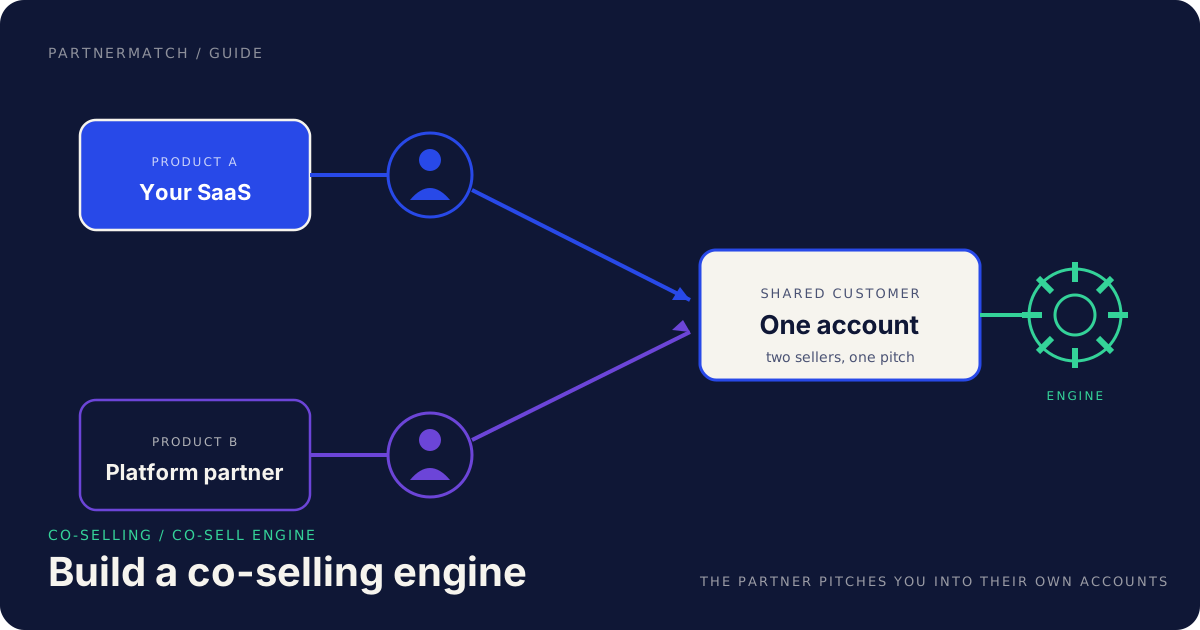
A partner swears their seller brought you the deal. Your account executive swears they sourced it months earlier. The deal closed, everyone wants credit, and your CRM has no clean answer because nobody tagged the partner when they actually entered the deal. So you split the difference in a spreadsheet, the partner feels shortchanged, your rep feels robbed, and finance quietly concludes the partnership inflates the same pipeline twice. That is how a co-sell program loses its funding, not because it failed to produce deals but because it could never say cleanly which deals it touched.
This is an independent guide to co-sell attribution: how to give partners credit for the deals they influence without double counting that influence against your direct team. Attribution is the unglamorous machinery that decides whether a co-sell program survives, because a program that cannot prove its contribution gets defunded the first time someone runs the numbers. The good news is that the machinery is mostly discipline, not software: a way to register deals, a clear window for when a partner's touch counts, and a small set of CRM fields applied consistently. Get those right and the credit fight disappears, because the system answered the question before anyone had to argue about it.
It builds on our co-selling engine guide, where attribution is one of five components, and on influenced versus sourced pipeline, which draws the distinction this whole guide depends on. Where those set the strategy, this one gets into the mechanics: deal registration, attribution windows, and the CRM setup that makes credit a fact rather than a negotiation.
The 60-second version
- Attribution exists to keep the program funded. If you cannot show which deals a partner touched, the partnership reads as a cost the moment finance reviews it.
- Separate sourced from influenced, and never mix them. A partner who originated a deal is sourced; a partner who helped on a deal you already had is influenced. Double counting starts when you blur the two.
- Deal registration is the front door. A partner registering a deal before it is in your pipeline is what cleanly establishes a sourced claim, and it prevents two partners claiming the same account.
- An attribution window bounds the claim. A touch only counts as influence for a defined period, so a partner cannot claim a deal they brushed a year ago.
- The CRM is the single source of truth. Partner credit lives in fields on the opportunity, tagged the moment the partner enters, and carried to closed-won.
- Report influence as influence, not as a second sale. Influenced pipeline runs alongside direct revenue, not added on top of it, or your totals stop adding up.
- Agree the rules before the deals, not after. Credit rules written during a dispute are never trusted. Write them while no money is on the table.
Why attribution decides whether co-sell survives
A co-sell program produces a kind of value that is easy to feel and hard to count. The partner's seller is in the room, the customer trusts them, the deal moves faster, but at closed-won the revenue lands on someone's quota and the partner's hand in it is invisible unless you recorded it. That invisibility is fatal in one specific meeting: the budget review, where every program has to justify its cost in numbers. A co-sell program that cannot point to the deals it influenced looks like spend without return, and it gets cut, regardless of how much it actually contributed.
So attribution is not bookkeeping; it is the program's survival mechanism. The number that keeps a partnership funded is influenced pipeline, the value of deals a partner touched, tracked over time and tied to win rate. You cannot reconstruct that number after the fact, because nobody remembers six months later which partner was in which deal. It has to be captured as the deals happen, which means the discipline has to be in place before the program scales, not bolted on once someone asks for a report.
The deeper reason attribution is hard is that influence is genuinely shared. A co-sold deal usually had several touches: a marketing campaign, an inbound signal, a direct rep, and a partner, all contributing. The temptation is to let each function claim the whole deal so their numbers look good, but that is exactly what produces double counting and destroys credibility. The discipline of attribution is the discipline of telling the truth about shared credit, and a program that reports influence honestly survives scrutiny that a program inflating its claims does not. This is the same point we make about reporting influence rather than sole credit in the co-selling engine guide: the boring, honest number is the one that survives a board review.
Step 1: separate sourced from influenced
Every double-counting problem traces back to one confusion: treating "the partner sourced this" and "the partner helped on this" as the same claim. They are not, and a co-sell attribution model that does not distinguish them will either rob partners of credit they earned or hand them credit your direct team earned. The first discipline is to define the two cleanly and tag every partner-touched deal as one or the other.
The distinction is about origin, not effort:
| Type | What it means | Who would have had the deal without the partner |
|---|---|---|
| Sourced | The partner originated the deal; it did not exist in your pipeline before them | Nobody. The partner created it. |
| Influenced | The partner helped on a deal you were already working or already had access to | You would have, but the partner made it bigger, faster, or more likely |
The reason this matters for double counting is arithmetic. A sourced deal is new pipeline the partner created, so crediting the partner does not take anything from your direct team. An influenced deal is one your team was already going to work, so the partner's credit is a contribution to a shared deal, not a separate sale. If you count an influenced deal as both a direct sale and a partner sale at full value, you have booked the same revenue twice, and your reported totals will exceed your actual revenue. The way out is to treat sourced and influenced as different kinds of credit that are reported differently, which the rest of this guide builds on. We go deeper on the strategic difference in influenced versus sourced pipeline; here the point is narrow: tag which one every partner-touched deal is, the moment the partner enters it.
A practical test settles most cases: ask whether the deal would exist in your pipeline at all without the partner. If the honest answer is no, it is sourced. If the answer is yes but the partner clearly helped, it is influenced. Edge cases will remain, which is why you also need registration and a window, covered next, to adjudicate them with a rule rather than an argument.
Step 2: use deal registration as the front door
Deal registration is the mechanism that turns a partner's claim into a clean, timestamped fact. A partner registers a deal, an account they are bringing or actively working, before or as it enters your pipeline, and that registration establishes the sourced claim with a date attached. Without it, sourcing is a memory, and memories conflict. With it, the question "who brought this" has an answer you recorded at the time, which is what makes the later credit conversation short.
Registration does three jobs at once:
- It establishes the sourced claim with a timestamp. The registration date is the evidence that the partner was on the account before your pipeline was, which is the whole basis of a sourced claim. A claim made at closed-won, with no earlier record, is not credible and should not pay like a sourced deal.
- It prevents two partners claiming the same account. When registration is the front door, the first partner to register an account holds the claim, and a second partner cannot later assert they sourced the same deal. This is the single most common source of partner-versus-partner credit fights, and registration resolves it by date.
- It flags channel conflict early. If a partner registers an account your direct team is already working, you find out at registration, when you can decide the rule calmly, rather than at closed-won, when money is on the line and feelings run high.
For registration to work, it has to be easy and fast to approve or decline, with clear criteria. A partner who registers a deal and hears nothing for weeks stops registering, and then you are back to claims from memory. Decide up front what a valid registration requires, an account name, a contact, evidence of an active opportunity, and what disqualifies one, such as an account already in late-stage direct pipeline, and apply those criteria consistently. The goal is that a partner knows, quickly, whether their claim is recognized, so the front door stays in use.
Step 3: set an attribution window
An attribution window is the period during which a partner's touch on a deal counts. It exists because influence decays: a partner who introduced you to an account last week is plausibly part of the deal closing now, while a partner who brushed the account eighteen months ago is not, and without a window every partner who ever touched an account can claim every deal that ever closes there. The window turns "did the partner touch this" into "did the partner touch this recently enough to have plausibly mattered," which is the question credit should actually answer.
Windows come in two flavors, and a co-sell program usually needs both:
| Window | What it bounds | A reasonable shape |
|---|---|---|
| Registration window | How long a sourced claim stays protected after registration | A fixed period in which the partner has exclusive claim to work the deal |
| Influence window | How long a touch counts as influence before close | A look-back period before closed-won during which a partner touch earns influence credit |
The exact lengths depend on your sales cycle, and that is the point: the window should match how long your deals actually take. A program with a three-month sales cycle and a twelve-month influence window will credit partners for touches that happened two cycles before the deal that closed, which is influence in name only. A window roughly the length of a typical sales cycle, give or take, keeps the credit tied to deals the touch could realistically have shaped. The idea of a bounded look-back is borrowed from marketing attribution, where models assign credit to touches within a defined window before a conversion; the relevant point here is to set the window deliberately rather than leaving it open-ended.
Two rules keep windows fair. First, write the window into the partner agreement so it is a known rule, not a surprise applied during a dispute. Second, let registration extend protection: a partner who registered an account should hold a sourced claim for the registration window even if the deal closes slightly outside the generic influence window, because they did the thing the program wanted. Windows are how you say no to stale claims without having the same argument every quarter, and a program with clear windows spends far less time adjudicating credit than one without.
Step 4: build the CRM mechanics
Attribution lives or dies in the CRM, because that is where a deal becomes a record and where credit has to attach to survive to the report. The mechanics are not elaborate: a few fields on the opportunity, populated the moment a partner enters the deal and carried unbroken to closed-won. The discipline is in the consistency, not the complexity, and most attribution failures are not missing tools but fields left blank because no one owned filling them in.
The core fields a co-sell attribution model needs on the opportunity:
| Field | What it records | Why it matters |
|---|---|---|
| Partner involved | Which partner, if any, touched the deal | The basic flag that a deal is partner-touched at all |
| Credit type | Sourced or influenced | Keeps the two kinds of credit from being added together |
| Registration date | When the partner registered, if they did | The timestamp that backs a sourced claim |
| Partner motion | Co-sell, referral, or reseller | Lets you report each motion's contribution separately |
| Influence touch date | When the partner entered the deal | Tests the claim against the attribution window |
A few mechanics make the fields reliable rather than decorative. Tag the partner the moment they enter the deal, not at closed-won, because a field filled in at the end is a guess and a field filled in at the time is a record. Carry the tag through every stage so it survives to the won report; if a stage change wipes the partner field, the credit evaporates exactly when you need it. And make the fields required where it counts, so a deal cannot quietly lose its partner attribution because someone skipped a box. The same end-to-end tagging discipline, carrying a source from first touch to closed-won, is what we describe for co-marketing source tags in the co-selling engine guide; here it is the partner fields that have to survive the whole journey.
Build a single, boring report on top of these fields: influenced pipeline by partner, sourced pipeline by partner, and win rate on partner-touched deals, refreshed each quarter. The audience for that report is a budget meeting, so it should be repeatable and unsurprising, the same shape every time. A consistent quarterly report that finance learns to trust is worth more than an elaborate dashboard nobody believes, because the entire purpose of the mechanics is to make partner contribution a fact the business accepts.
Step 5: report influence without double counting
The last step is where double counting is avoided or committed: how the numbers roll up. The failure is seductive because each function has a reason to claim full credit, the direct team for its quota, the partner team for its program, marketing for its campaign, so the same deal gets counted at full value in several places and the totals balloon past actual revenue. A leadership team that adds those numbers and gets more than the company booked stops trusting all of them at once.
The rule that prevents this is simple to state and requires discipline to hold: revenue is counted once, and influence is reported alongside it, not added to it. Concretely:
- Direct revenue is the single revenue total. Closed-won revenue is booked once against the team that owns the quota. That is the number that ties to finance, and nothing should make the company's reported revenue exceed it.
- Influenced pipeline is a separate, parallel metric. "Partners influenced this much pipeline" is reported as influence, with the explicit understanding that most of those deals also count in direct revenue. It is a measure of the partner's contribution to shared deals, not a second pile of money.
- Sourced revenue can be attributed more cleanly. Because a sourced deal would not exist without the partner, attributing its revenue to the partner channel does not double count against direct, though even here the deal still appears once in the company total.
- Label every number with its basis. A report that says "influenced" where it means influenced, and "sourced" where it means sourced, lets the reader add up only the things that should be added. Mixing the labels is how honest numbers become misleading ones.
The test for whether your reporting double counts is to ask whether summing every credited number across every function exceeds the company's actual revenue. If it does, you are counting deals more than once, and the fix is to demote the overlapping claims from "revenue" to "influence." Reporting influence as influence feels less impressive than claiming the whole deal, but it is the thing that survives scrutiny, and a co-sell program that survives scrutiny is one that keeps getting funded. As Harvard Business Review has explored on the shift toward consensus, multi-party B2B buying, modern deals involve many contributors by nature, which is exactly why credit has to be reported as shared rather than sole.
Common mistakes, and the fix
Blurring sourced and influenced. The fix: tag every partner-touched deal as one or the other, using the test of whether the deal would exist without the partner. Counting an influenced deal as a full partner sale and a full direct sale books the same revenue twice, and the totals stop adding up.
Relying on memory instead of deal registration. The fix: make registration the front door, with a timestamp that establishes the sourced claim and a fast approve-or-decline. Sourcing claimed at closed-won with no earlier record is not credible, and the first-to-register rule is what stops two partners fighting over one account.
Leaving the attribution window open-ended. The fix: set a window roughly the length of your sales cycle, write it into the agreement, and use it to decline stale claims. Without a window, every partner who ever touched an account can claim every deal that ever closes there.
Filling in the CRM at closed-won. The fix: tag the partner the moment they enter the deal and carry the tag unbroken to the won report. A field populated at the end is a guess, and a tag wiped by a stage change takes the credit with it.
Adding influence on top of revenue. The fix: count revenue once and report influenced pipeline as a separate, parallel metric, clearly labeled. If summing every function's credited number exceeds actual revenue, you are double counting, and the overlapping claims belong in influence, not revenue.
Writing the credit rules during a dispute. The fix: agree sourced-versus-influenced definitions, registration criteria, and windows with partners before the deals start. Rules written while money is on the table are never trusted by the side they go against, and the resentment outlasts the deal.
FAQ
What is the difference between sourced and influenced credit? A sourced deal is one the partner originated; it did not exist in your pipeline before them. An influenced deal is one you were already working or already had access to, where the partner helped make it bigger, faster, or more likely to close. The test is whether the deal would exist without the partner. The distinction matters because sourced credit is new pipeline the partner created, while influenced credit is a contribution to a shared deal, and treating influence as a full separate sale is exactly what double counts.
Why do I need deal registration if I already track partners in the CRM? Registration adds a timestamp that establishes when the partner was on the account, which is what backs a sourced claim. Tracking a partner on a deal at closed-won tells you they were involved but not that they originated it, and it does not stop a second partner from claiming the same account later. Registration resolves both: the first partner to register holds the sourced claim, and channel conflict surfaces early, when you can decide the rule calmly rather than at closed-won.
How long should an attribution window be? Roughly the length of your typical sales cycle, set deliberately and written into the partner agreement rather than left open-ended. A window much longer than your sales cycle credits partners for touches too old to have realistically shaped the deal, while one much shorter denies credit for real influence on longer deals. Use a registration window to protect sourced claims and an influence look-back window for touches before close, and match both to how long your deals actually take.
What CRM fields do I actually need for co-sell attribution? At minimum: which partner is involved, the credit type (sourced or influenced), the registration date, the partner motion (co-sell, referral, or reseller), and the date the partner entered the deal. Populate them when the partner enters, not at closed-won, and carry them unbroken through every stage to the won report. The complexity is low; the discipline is keeping the fields filled and intact, which is where most attribution efforts actually fail.
How do I report partner influence without inflating our numbers? Count revenue once, against the team that owns the quota, and report influenced pipeline as a separate, parallel metric that is explicitly understood to overlap with direct revenue. Label sourced and influenced credit distinctly so a reader only sums what should be summed. The check is simple: if adding every credited number across every function exceeds your actual revenue, you are double counting, and the overlapping claims belong in influence rather than revenue.
Who should own co-sell attribution? Sales operations or the partnerships team, with the rules agreed jointly with sales leadership before deals start. Someone has to own the CRM fields, the registration approvals, and the quarterly report, because attribution fails most often not from missing tools but from no one owning the discipline. The owner's real job is to keep the rules consistent and the report boring, so finance learns to trust the number that keeps the program funded.
Further reading
- How to build a co-selling engine for the full motion that attribution is one component of.
- Influenced versus sourced pipeline for the strategic distinction this guide's mechanics depend on.
- Building a partner page that converts for the surface that brings co-sell buyers in before attribution tracks them.
- Harvard Business Review on the new sales imperative for why modern B2B deals involve many contributors, which is why credit must be reported as shared.
- Harvard Business Review on the end of solution sales for how multi-party, consensus buying reshapes who is in a deal and therefore who can claim it.
- Attribution in marketing for the look-back-window concept that co-sell attribution borrows for influence credit.
The short version
Co-sell attribution is the machinery that lets you give partners credit for the deals they influence without booking that influence twice, and it decides whether a co-sell program keeps its funding. Start by separating sourced from influenced and never mixing them: a sourced deal is one the partner created, so crediting it costs your direct team nothing, while an influenced deal is one you already had, so the partner's credit is a contribution to a shared deal rather than a second sale. Make deal registration the front door, so a sourced claim carries a timestamp and two partners cannot fight over one account. Set an attribution window about the length of your sales cycle, written into the agreement, so stale touches cannot claim fresh deals. Build the CRM mechanics as a few fields tagged the moment a partner enters and carried unbroken to closed-won, then report from them every quarter in the same boring shape. And report influence as influence, alongside revenue rather than added to it, so your totals never exceed what the company actually booked. Agree all of it before the deals start, because credit rules written during a dispute are never trusted by the side they go against.
If you want the whole co-sell motion handled, from the joint value proposition and enablement through the attribution that keeps it funded, a Partner Audit reviews your program, your CRM setup, and your partner potential, then hands you a concrete plan for what to fix and where to focus.