Partner program ROI: a simple model for startups
An independent guide to partner program ROI for startups. A simple model for the costs and the returns, what counts as sourced and influenced revenue, how to read payback, and the mistakes that make the number lie.
Someone on your leadership team is going to ask whether the partner program is worth it, and the honest answer for most startups is that they cannot say. They know roughly what the program costs, because cost shows up in headcount and tools and the occasional event, but they have never put a number on what it returns, so the conversation drifts into anecdotes about a deal a partner once brought in. That is not a business case. It is a feeling. A partner program ROI model fixes this by making both halves of the question explicit: what the program costs to run, and what revenue it actually drives. The model does not have to be elaborate. It has to be honest, repeatable, and built from numbers both you and your finance team can trust.
This is an independent guide to building a partner program ROI model for a startup, written for a small partnerships team that needs to defend its budget without a finance department or a dozen dashboards. The exact inputs depend on your motion, your deal sizes, and how your partners actually drive revenue, so treat the structure here as a template to fill in rather than a formula to copy. What does not change is the shape of an ROI model that holds up: a clear and complete view of the cost side, a disciplined view of the revenue side that separates sourced from influenced, a payback view that respects how long deals take, and a habit of counting conservatively so the number survives scrutiny. That shape is what this guide covers.
It pairs with our guide to partnership metrics that matter, the influenced vs sourced pipeline distinction the model depends on, and our partner QBR guide, where the ROI conversation usually happens out loud with the partner in the room.
The 60-second version
- ROI is two honest numbers, not one impressive one. The cost to run the program and the revenue it actually drives. Get both right before you compute a ratio.
- Count all the cost, including the time. Headcount is usually the biggest cost in a partner program, and the one teams forget. A program that looks cheap on the tools line is rarely cheap on the people line.
- Separate sourced from influenced revenue. They are both real and they tell different stories. Mixing them produces a number that is easy to attack and hard to defend.
- Discount influenced revenue, do not claim all of it. A partner who touched a deal did not close it alone. Counting full deal value as partner revenue is the fastest way to lose credibility.
- Read payback, not just the ratio. A program can be positive over two years and underwater in the first one. Payback tells you when the bet turns, which is what a startup actually needs to know.
- Be conservative on purpose. A modest number you can defend beats an impressive one that falls apart the first time someone in finance pushes on it.
- Recompute it on a fixed cadence. ROI is a trend, not a one-time slide. A model you refresh every quarter is one leadership learns to trust.
Why most partner program ROI numbers do not survive scrutiny
The first reason a partner ROI number falls apart is that the cost side is incomplete. Teams tally the obvious line items, the partner platform, an event, a bit of co-marketing, and quietly leave out the largest cost of all: the people. The partnerships manager's salary, the sales time spent on co-sell, the engineering hours that built and maintain an integration, all of it is program cost, and all of it is usually missing from the first version of the model. A program that looks efficient because its tooling is cheap can be expensive once the fully loaded people cost is on the page, and a number built on a partial cost base is one any careful reader can puncture.
The second reason is the opposite problem on the revenue side: teams claim too much. A partner was involved in a deal, so the full value of the deal gets booked as partner revenue, even though the partner introduced the account and the sales team did the work of closing it over four months. This is the single fastest way to lose a finance team's trust, because the moment they see a deal counted in full to the partner program that they know the AE actually closed, every other number in the model becomes suspect. Overclaiming does not make the program look good. It makes the model look dishonest, which is worse than looking modest.
The third reason is timing. A partner program is an investment that pays back over time, and a number computed on a single quarter of revenue against a full year of cost will always look bad, while a number computed at the end of a good year can look unrealistically good. An ROI model that ignores timing, that does not show when the program crossed from cost to return, hides the one thing a startup most needs to decide: is this paying back fast enough to keep funding. The rest of this guide is about avoiding these three failures: count all the cost, count the revenue conservatively and split it, and read the result against time rather than as a single static ratio.
Step 1: count the full cost of the program
The cost side feels like the easy half and is the one most often wrong, because the obvious costs are small and the hidden ones are large. Start by listing everything the program consumes, then make sure the biggest category, people, is fully loaded rather than guessed at. The goal is a cost number a finance partner would recognize as complete, because a cost base they can poke holes in undermines everything built on top of it.
The cost categories worth itemizing in most partner programs:
| Cost category | What it includes |
|---|---|
| Partnerships headcount | Fully loaded salary and overhead for the people running the program |
| Co-sell time from sales | The AE and SE hours spent on partner-sourced and partner-influenced deals |
| Engineering for integrations | The build and ongoing maintenance of any technical integration |
| Tools and platform | Partner management software, deal registration, tracking |
| Co-marketing and events | Joint campaigns, sponsorships, and event presence tied to partners |
| Enablement and content | The cost of building and maintaining partner enablement material |
Two habits keep the cost side honest. First, use fully loaded costs for people, salary plus the overhead a finance team would attach, rather than base salary alone, because a partnerships hire costs the company more than their paycheck and the model should reflect what the program truly consumes. Second, attribute time, not just spend: if a quarter of your sales team's effort goes to partner deals, that effort is a program cost even though it does not appear on a partner invoice. You do not need perfect precision here. A reasonable, defensible estimate of fully loaded cost beats a precise count of only the line items that happen to have invoices, and it is what makes the ROI number credible when someone in finance reads it.
For a startup, the practical move is to keep the cost model simple and complete rather than detailed and partial. A short list of fully loaded categories you update each quarter is more useful than an elaborate spreadsheet you build once and never touch. The discipline is completeness, not granularity.
Step 2: count the revenue the program actually drives
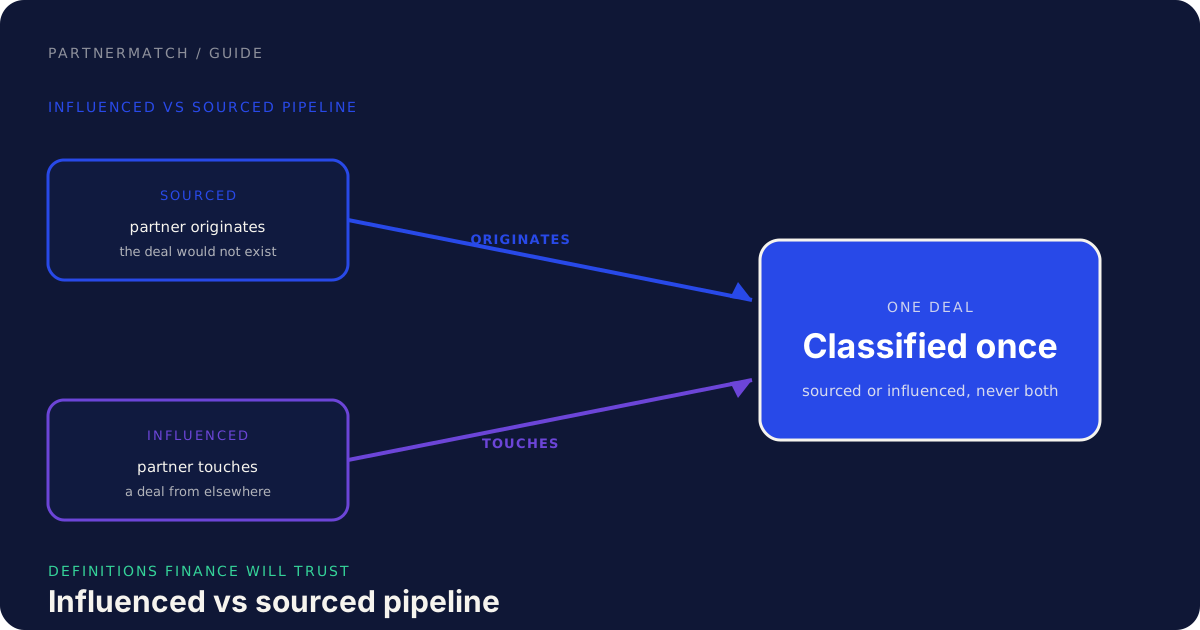
The revenue side is where the model earns or loses its credibility, and the discipline is to count carefully and to split the count. The foundational distinction is the one we cover in depth in influenced vs sourced pipeline: sourced revenue is from deals a partner brought you that you would not otherwise have had, and influenced revenue is from deals a partner touched along the way but did not originate. Both are real contributions and both belong in an ROI model, but they are worth different amounts and they must be counted differently.
Sourced revenue is the cleaner number. When a partner introduces an account you had no prior relationship with and that account becomes a customer, the revenue is reasonably attributed to the program, because without the partner the deal does not exist. You should still apply judgment, an introduction that closes a year later through entirely your own effort is more shared than fully sourced, but in general sourced revenue can be counted closer to its full value because the partner created the opportunity.
Influenced revenue needs a heavier hand, and this is where most models go wrong by claiming the full deal value. A partner who helped a deal you already had in motion contributed to it but did not create or close it, so booking the entire deal as partner revenue overstates the program's effect. The honest move is to discount influenced revenue to a fraction that reflects the partner's actual contribution.
| Revenue type | How to count it | Why |
|---|---|---|
| Sourced revenue | Closer to full value, with judgment on long-delayed closes | The partner created an opportunity that would not otherwise exist |
| Influenced revenue | A discounted fraction of deal value | The partner contributed to a deal you already had, but did not create or close it |
| Retained or expansion revenue | Count only the part the partner demonstrably affected | Renewals and expansions are mostly your product's work, not the partner's |
The exact discount you apply to influenced revenue is a judgment call, and the right move is to pick a conservative fraction, document it, and apply it consistently rather than chasing a precise attribution science a startup cannot run. A consistent, modest discount that everyone in the room agrees is fair produces a number people trust. An aggressive or shifting discount produces a number people argue about. For more on choosing which figures to track at all and which to drop, see our partnership metrics guide.
Step 3: build the ROI model
With an honest cost side and a disciplined revenue side, the model itself is straightforward arithmetic. ROI in its plainest form is the return the program drives set against what it costs to run, and for a partner program the return is the counted revenue, or more precisely the margin on that revenue, and the cost is the fully loaded program cost from step one. The standard way to express it, covered in any reference on return on investment, is net return divided by cost, but for a partner program the inputs matter more than the exact formula, because a clean formula fed bad inputs produces a confident wrong answer.
A simple, defensible model on one page:
| Line | What goes here |
|---|---|
| Program cost | The total fully loaded cost from step one for the period |
| Sourced revenue (counted) | Sourced deals at close to full value, with judgment |
| Influenced revenue (counted) | Influenced deals at your documented discount |
| Total counted revenue | Sourced plus influenced, after discounting |
| Margin on counted revenue | Counted revenue adjusted to gross margin, not top line |
| Net return | Margin on counted revenue minus program cost |
| ROI | Net return divided by program cost, as a ratio or percent |
Two refinements make the model more honest. First, work in margin, not top-line revenue, where you can, because a dollar of revenue does not cost the company nothing to deliver, and comparing program cost to gross margin rather than to raw revenue gives a truer picture of what the program nets. A finance team will make this adjustment anyway, so making it yourself signals that the model is built to their standard. Second, show the assumptions on the same page as the result, the influenced discount you used, the margin you assumed, the period you measured, so a reader can see exactly how the number was built. A model whose assumptions are visible invites trust. A model that presents only a final ratio invites suspicion, because the reader cannot tell what is inside it.
Resist the urge to present a single hero number. The most useful version of this model shows a range or a couple of scenarios, a conservative count and a fuller one, so the conversation is about a credible band rather than one figure that is either accepted or attacked. The point of the model is to support a decision about whether and how much to fund the program, and a decision is better served by an honest range than by a precise number that pretends to a certainty the inputs do not have.
Step 4: read payback and timing, not just the ratio
A single ROI ratio hides the question a startup most needs answered: when does the program pay back. A partner program spends real money now and earns revenue later, sometimes much later, because partner-sourced deals can take as long or longer than direct ones to close. A ratio computed over a full year can look positive while the program was deeply underwater for the first two quarters, and for a company watching its cash that timing is not a detail. It is the decision.
Payback is the more useful lens here. The payback period is simply how long it takes the cumulative return to cover the cumulative cost, the point where the program crosses from net cost to net return. For a partner program, tracking this means plotting program cost and counted revenue over time and finding where the lines cross, rather than reporting a single end-of-period ratio that erases the journey to get there.
What the timing view shows that a flat ratio does not:
- The crossover point. When cumulative counted revenue first exceeds cumulative cost is the moment the program stops being a bet and starts being a return, and it is the single most useful date in the model.
- The ramp. A new partner program is supposed to be underwater early. Seeing the gap narrow quarter over quarter tells you the program is working even before it is net positive, which is exactly what a startup needs to know to keep funding it.
- The trend, not the snapshot. One quarter's ROI is noisy. The slope of cumulative return against cumulative cost over several quarters tells you whether the program is on track to pay back, accelerating, or stalling.
- The funding decision. Knowing the program pays back in, say, four quarters versus eight changes how much you invest and how patient leadership needs to be. A flat ratio cannot tell you this; a timing view can.
This is also where the ROI model connects to the conversations you already have. A partner QBR is a natural place to review the trend with the partner and decide where to push next, and the payback view turns the QBR from a recap into a forward-looking funding and prioritization conversation. The model is not just a slide for leadership. It is a tool for deciding, quarter by quarter, where the program's next dollar should go.
Common mistakes, and the fix
Leaving people cost out of the model. The fix: use fully loaded costs for partnerships headcount and attribute the sales and engineering time the program consumes. The biggest cost in most partner programs is people, and a model that omits it is not measuring the program, only its invoices.
Counting full deal value as partner revenue. The fix: separate sourced from influenced revenue and discount the influenced portion to a documented, conservative fraction. Claiming a whole deal the AE closed as partner revenue is the fastest way to lose finance's trust in the entire model.
Comparing cost to top-line revenue. The fix: work in gross margin where you can, because a dollar of revenue is not a dollar of return. A finance team will make this adjustment anyway, so build it in yourself.
Reporting one ratio with no timing. The fix: plot cumulative cost against cumulative counted revenue and find the payback point. A program can be positive over a year and underwater all of the first half, and the timing is the part a cash-conscious startup actually needs.
Hiding the assumptions. The fix: show the influenced discount, the margin, and the period on the same page as the result. A model whose inputs are visible earns trust; one that presents only a final number invites suspicion.
Computing it once and never again. The fix: recompute on a fixed cadence, ideally quarterly, and watch the trend. ROI is a slope, not a snapshot, and a model leadership sees refreshed regularly is one they learn to rely on.
FAQ
What is partner program ROI? Partner program ROI is the relationship between what your partner program costs to run and the revenue it actually drives, expressed as net return over cost. The cost side should be fully loaded, including partnerships headcount and the sales and engineering time the program consumes, not just tools and events. The revenue side should separate sourced from influenced revenue and discount the influenced portion, so the number reflects the program's real contribution rather than every deal a partner happened to touch.
What should I count as partner-driven revenue? Count sourced revenue, deals a partner brought that you would not otherwise have had, closer to full value with judgment for long-delayed closes, and count influenced revenue, deals a partner touched but did not originate, at a documented, conservative discount. Count expansion and retention only for the part a partner demonstrably affected. The discipline is to never book a full deal to the program when the partner contributed to but did not create or close it, because overclaiming is what makes finance distrust the whole model.
How do I calculate the cost side if we are a small team? Keep it simple and complete rather than detailed and partial. List the categories, partnerships headcount, co-sell time from sales, engineering for integrations, tools, co-marketing, and enablement, and use fully loaded estimates for the people costs rather than base salary alone. A reasonable, defensible estimate of total cost is more useful than a precise count of only the line items that have invoices, because completeness, not granularity, is what makes the number credible.
What is a good ROI for a partner program? There is no universal benchmark, because it depends on your margins, your deal sizes, and how mature the program is, and a new program is supposed to look weak before it ramps. Rather than chasing a target ratio, read payback: how long it takes cumulative counted revenue to cover cumulative cost. A program that is underwater early but narrowing the gap each quarter is on track, and the slope over several quarters tells you more than any single ratio about whether to keep funding it.
Should I use revenue or margin in the model? Use gross margin where you can, because a dollar of revenue costs something to deliver and is not a dollar of return. Comparing fully loaded program cost to the margin on counted revenue gives a truer picture than comparing it to top-line revenue, and a finance team will make this adjustment regardless, so building it in yourself signals the model is built to their standard. If you cannot get a clean margin figure, say so and note that the revenue-based number overstates the true return.
How often should I recompute partner program ROI? Quarterly is a sensible default for most startups, because it matches the rhythm of partner reviews and is frequent enough to show a trend without becoming busywork. The value is in the slope over several quarters, not in any single snapshot, and a model leadership sees refreshed on a regular cadence becomes a trusted input to the funding decision rather than a one-time slide that gets argued over and forgotten.
Further reading
- Partnership metrics that matter for choosing which figures to track and which to drop before you build them into an ROI model.
- Influenced vs sourced pipeline for the distinction the revenue side of the model depends on.
- How to run a partner QBR for where the ROI and payback conversation usually happens with the partner.
- Return on investment for the standard definition of the ratio the model is built on.
- Payback period for the timing lens that shows when a program crosses from cost to return.
- Customer acquisition cost for a related way of thinking about what it costs to win revenue through a channel.
- Harvard Business Review's collection on financial analysis for the broader discipline of building numbers that survive scrutiny.
- Harvard Business Review's collection on sales and marketing for the wider context of measuring what a go-to-market motion returns.
The short version
Partner program ROI is two honest numbers: what the program costs to run and what revenue it actually drives. Count the full cost, using fully loaded figures for partnerships headcount and attributing the sales and engineering time the program consumes, because people are the largest cost and the one most often left out. Count the revenue conservatively and split it, sourced revenue close to full value with judgment, influenced revenue at a documented discount, because claiming whole deals the sales team closed is the fastest way to lose finance's trust. Build the model in gross margin where you can, show your assumptions on the same page as the result, and present a credible range rather than a single hero number. Then read payback, not just the ratio, by plotting cumulative cost against cumulative counted revenue to find when the program crosses from bet to return, since a program can be positive over a year and underwater for the first half. Recompute it every quarter and watch the slope, because ROI is a trend leadership learns to trust, not a one-time slide.
If you want help building a partner ROI model your leadership will trust, a Partner Audit looks at your program costs, your sourced and influenced revenue, and your attribution, then hands you a concrete model and a plan for where the program's next dollar should go.