Partnership metrics that matter, and the vanity metrics to drop
A guide to partnership metrics and KPIs for B2B SaaS: track sourced and influenced pipeline, integration adoption, and time to live, not vanity counts.
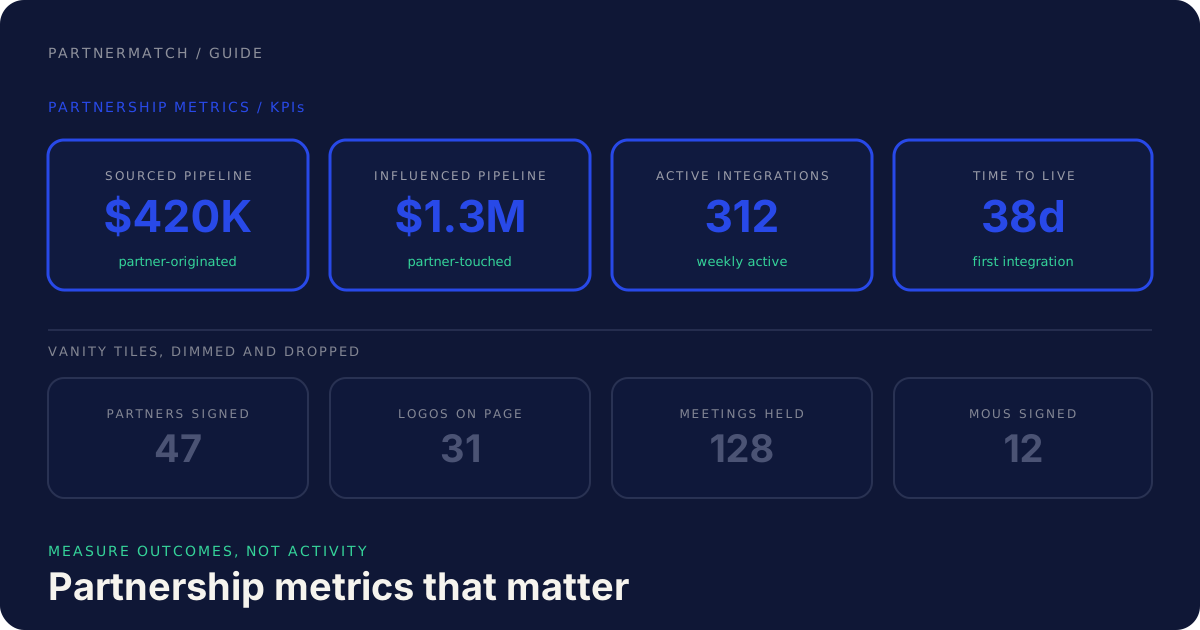
Open most partnership dashboards and you find the same slide of partnership metrics. Number of partners signed. Logos on a page. Meetings held this quarter. Every number is going up and to the right, and not one of them tells you whether the partnership program is worth funding next quarter.
That is the problem with partnership metrics at most startups. They measure motion, not money. They count what the team did, not what changed for the business. So when a board member asks the only question that matters, "what did partnerships actually drive," the honest answer is a shrug dressed up as a logo wall.
This guide fixes that. We cover why most partner dashboards measure activity instead of outcomes, the three tiers of partnership KPIs and how to read up the stack, the specific metrics that matter for a seed-to-Series-B startup, how to define sourced versus influenced pipeline so finance trusts the number, integration health metrics, how to set targets by stage, how to build a dashboard execs actually read, and the vanity metrics to drop with the outcome to replace each one.
The 60-second version
- Most partner dashboards measure activity, not outcomes. Partners signed, logos, and meetings held all rise while the business stays flat. That is the definition of a vanity metric.
- Partnership metrics come in three tiers: activity, output, outcome. Activity is motion, output is what the work produced, outcome is what changed for the business. Read up the stack and report the top.
- The metrics that matter for a startup are few. Sourced pipeline, influenced pipeline, integration adoption and active usage, time to first integration live, and partner-attributed revenue and retention.
- Sourced and influenced must be defined cleanly or finance will not trust either. Sourced means the partner originated a deal that would not exist otherwise. Influenced means the partner touched a deal that already did.
- Integration health is its own small panel: installs, weekly active connections, and error rate. Installs without active usage is a vanity metric wearing a technical costume.
- Targets move by stage. At seed you are proving the motion works at all. By Series B you are defending a revenue line. The same metric carries a different number.
- Build a dashboard execs trust by showing the same four outcome numbers every quarter, with trends, not a new set of activity counts each time.
- Drop the vanity metrics and replace each one. Swap partners signed for integrations adopted, logos for sourced pipeline, meetings for time to live, MOUs for attributed revenue.
Why most partner dashboards measure the wrong thing
The reason is not laziness. Activity metrics are easy to collect and instantly available. You can count partners signed the day you sign them and meetings the moment they end. Outcome metrics are slower, messier, and require plumbing that did not exist when the program started. So the dashboard fills up with what is countable rather than what is meaningful.
The trouble is that a metric you can grow without growing the business will eventually embarrass you. You can sign forty partners and source zero dollars. You can hold a hundred meetings and ship one integration nobody uses. The number goes up, the chart looks healthy, and then a downturn arrives and someone asks what it all returned. If the answer is not in revenue, retention, or adoption, the program gets cut, because it never proved it belonged.
Consider a hypothetical seed-stage SaaS company that reports "12 new partnerships this quarter" to its board. It sounds like progress. But three of those partners never shipped an integration, five shipped one that sits at zero weekly active connections, and the other four have not sent a single lead. The real outcome is closer to zero than to twelve, and the activity metric hid that. A good partnership KPI makes the gap between motion and money impossible to hide.
The three tiers of partnership metrics
Every partnership metric sits in one of three tiers. Once you can place a metric in its tier, you can tell at a glance whether you are measuring something real or something cosmetic.
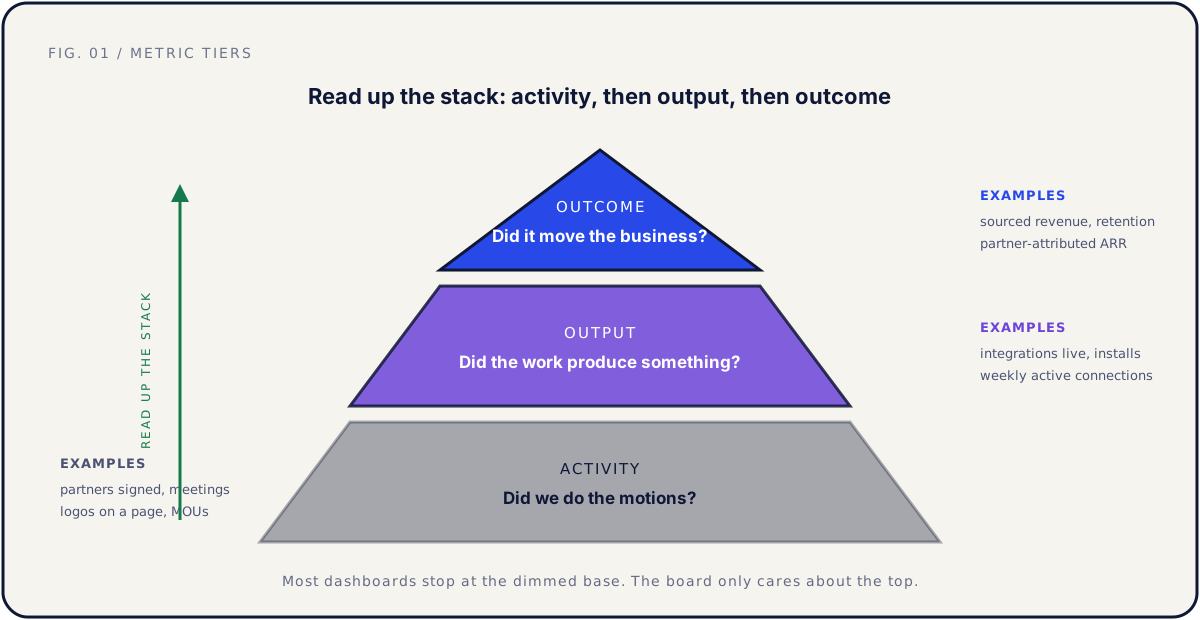
Activity is the base. It measures motion: did the team do the work. Partners signed, meetings held, emails sent, MOUs in place. Activity metrics are not useless. Early on, they confirm the team is actually moving. But they answer the cheapest question, "are we busy," and a busy team that produces nothing is still producing nothing.
Output is the middle. It measures what the work produced: integrations live, installs, listings published, sellers enabled. Output is a real step up, because an integration that exists is harder to fake than a meeting that happened. But output still does not prove the business changed. An integration with zero active users is output with no outcome.
Outcome is the top, and it is the only tier a board cares about. It measures what changed for the business: sourced revenue, influenced pipeline, partner-attributed retention, active usage that drives the product's own value. Outcome is the slowest to measure and the hardest to game, which is exactly why it is the one to report.
The discipline is to read up the stack. Activity should produce output, output should produce outcome, and if a tier below is growing while the tier above is flat, you have found a leak. Lots of meetings but few integrations means the pitch or the scoping is broken. Lots of installs but no active usage means the integration solves a problem nobody has. Report the top tier, but use the lower tiers to diagnose why the top is stuck.
| Tier | The question it answers | Example metrics | Who should see it |
|---|---|---|---|
| Activity | Did we do the motions? | Partners signed, meetings held, MOUs | The partnerships owner, internally |
| Output | Did the work produce something? | Integrations live, installs, sellers enabled | Product and the partnerships owner |
| Outcome | Did it move the business? | Sourced revenue, influenced pipeline, retention | The board and the exec team |
The partnership KPIs that actually matter for a startup
You do not need thirty partnership metrics. At seed to Series B you need a handful that map cleanly to outcomes, plus a small health panel underneath them. Here is the short list that earns its place on a startup dashboard.
Sourced pipeline. Pipeline value from deals the partner originated, that would not exist without them. This is the cleanest proof a partnership creates demand rather than just riding alongside it.
Influenced pipeline. Pipeline value from deals the partner touched but did not originate, including co-sell and referral assists. This is usually the larger number, and it is the one that survives budget season, the same way it does for the co-selling engine.
Integration adoption and active usage. Not installs alone. The count of connections that are actually doing work week over week, because adoption is what turns an integration from a cost into a retention lever.
Time to first integration live. The median days from a scoped integration to a live, working one. This measures whether your partnership machine can actually ship, which is the bottleneck for almost every early program.
Partner-attributed revenue and retention. Closed-won revenue carrying a partner tag, and the renewal-rate lift for customers who use an integration versus those who do not. This is the outcome the whole program exists to produce.
| Metric | Tier | What good looks like at a startup | Where the data lives |
|---|---|---|---|
| Sourced pipeline | Outcome | A real, traceable line that grows quarter over quarter | CRM, partner-source field |
| Influenced pipeline | Outcome | Larger than sourced, with a higher win rate than unassisted deals | CRM, influence tag |
| Integration adoption | Output to outcome | Weekly active connections climbing, not just installs | Product analytics |
| Time to first live | Output | Trending down as the team learns the motion | Project tracker |
| Partner-attributed revenue | Outcome | A growing share of new and retained ARR | CRM plus billing |
Notice what is not on this list: partners signed, logos, meetings, MOUs. None of them survive the test of "could this go up while the business stays flat." All five metrics above fail that test in the right direction. They cannot rise unless something real happened.
For the wider context of where these metrics sit in the arc of a partnership, from first call through renewal, see the full SaaS partnership lifecycle.
Sourced vs influenced, defined so finance trusts it
The fastest way to lose finance's trust is to double-count. If sourced and influenced overlap, or if every deal a partner ever breathed near gets full credit, the numbers inflate, someone checks, and the whole dashboard loses credibility in one meeting. So define the two cleanly and hold the line.
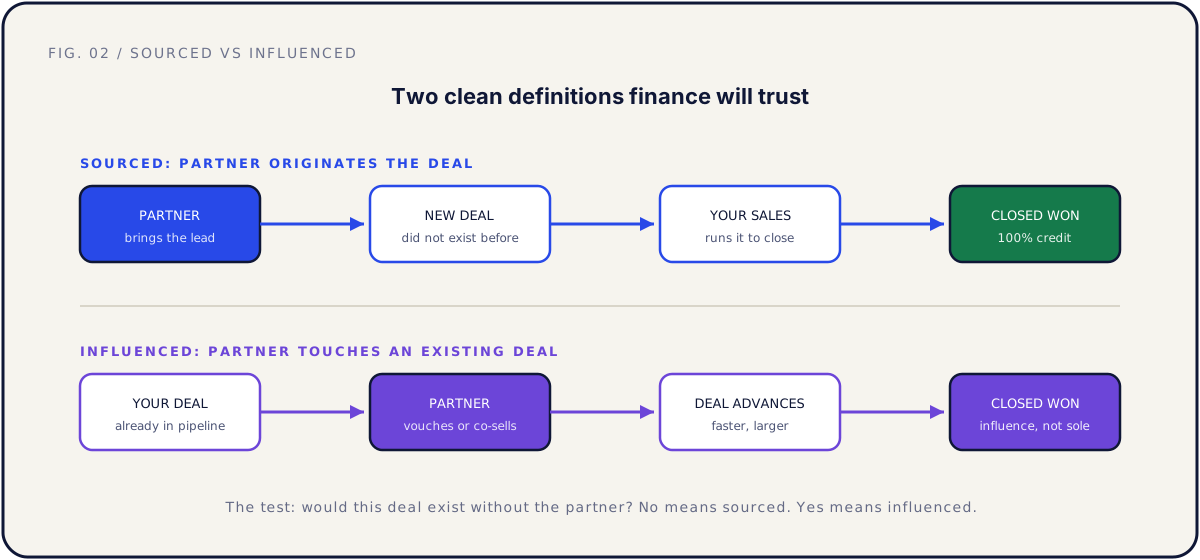
The test is one question: would this deal exist without the partner?
Sourced means no. The partner originated a deal that did not exist in your pipeline before they brought it. They found the customer, made the introduction, and handed you a net-new opportunity. Sourced deals get full credit, because without the partner there is no deal to credit.
Influenced means yes. The deal already existed in your pipeline, and the partner touched it in a way that helped it advance, close, or grow. A co-sell where the partner's seller vouches for you. A referral into a deal you were already working. An integration that became the reason the customer chose you. Influenced deals get influence credit, not sole credit, because the deal would have existed regardless.
A few rules keep both numbers honest:
- A deal is sourced or influenced, never both. If the partner originated it, it is sourced. If they touched an existing deal, it is influenced. The two buckets do not overlap.
- Tag at entry, not at close. Add the partner-source field the moment the partner enters the deal, and carry it to closed-won. Reconstructing attribution after the fact is where credibility goes to die.
- Report influence as influence. Never claim the partner closed a deal that had five other touches. Show influenced pipeline and the win rate on influenced versus unassisted deals, and let the comparison make the case.
- Agree credit rules with the partner up front. Nothing sours a partnership faster than fighting over who closed what after the money lands.
| Dimension | Sourced | Influenced |
|---|---|---|
| Did the deal exist before? | No, the partner created it | Yes, it was already in pipeline |
| Credit | Full | Influence, not sole |
| Typical volume | Smaller, higher-signal | Larger, the bulk of partner value |
| The risk to manage | Confirming it was truly net-new | Not over-claiming a multi-touch deal |
| What it proves | Partnerships create demand | Partnerships improve win rate and deal size |
When both numbers are defined this tightly, finance stops treating partnership pipeline as a fiction and starts treating it as a line they can forecast against. That shift is the whole point.
Integration health metrics that matter
Sourced and influenced pipeline are the revenue story. But for a product-led tech partnership, there is a second story underneath: is the integration actually healthy and used. This is its own small panel, and it is where the most common vanity trap in technical partnerships hides.
The trap is installs. Installs feel like adoption, but an install is just a customer flipping a switch. If the connection sits idle after that, you have a number that grew and a workflow nobody uses. Installs is an output metric pretending to be an outcome metric.
The three numbers that describe integration health:
- Installs. How many customers connected the integration. Useful as a denominator, dangerous as a headline. Track it, but never report it alone.
- Weekly active connections. How many of those installs are doing real work week over week. This is the adoption number, and the ratio of active connections to installs tells you whether the integration solved a real problem or just got clicked once.
- Error rate. The share of sync attempts or API calls that fail. A quietly rising error rate is how an integration dies without anyone noticing, because customers stop using a thing that keeps breaking instead of filing a ticket.
| Health metric | What it tells you | The failure it catches |
|---|---|---|
| Installs | Reach: how many connected | None on its own; needs the ratio below |
| Weekly active connections | Adoption: how many actually use it | Installs that never became usage |
| Active-to-install ratio | Whether the workflow was real | A solution to a problem nobody had |
| Error rate | Reliability: is it breaking | Silent decay before churn shows up |
The signal you want is active connections climbing as a share of installs, with error rate flat and low. The signal that something is wrong is installs climbing while active connections stay flat, which means you shipped a feature customers tried once and abandoned. That is a product problem, and the health panel is what surfaces it early enough to fix.
A partnerships dashboard execs actually trust
Put the right metrics on one screen and the partnership program stops being a story you tell and starts being a number people check. The goal is a dashboard an exec can read in fifteen seconds and a board can trust without a footnote.
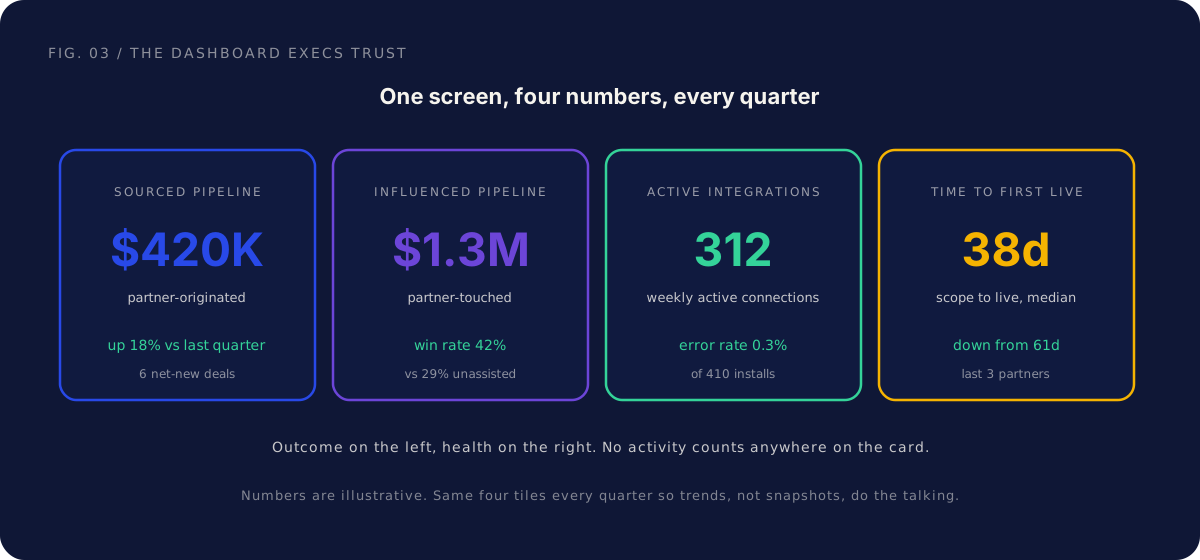
Four principles make a dashboard trustworthy:
Lead with outcome, support with health. The top of the dashboard is sourced pipeline, influenced pipeline, attributed revenue. Underneath sits the integration health panel. Activity metrics, if they appear at all, live in an appendix the owner uses to diagnose, not on the exec view.
Show the same numbers every quarter. The fastest way to lose trust is to change which metrics you report based on which ones look good this quarter. Pick the four that matter and show them every single time, so the audience watches a trend rather than a fresh set of cherry-picked snapshots.
Show trends, not just levels. A single number is a snapshot and a snapshot can be staged. A trend across four quarters cannot. Every tile should carry its prior-period comparison, because the direction is more honest than the value.
Make every number traceable. When an exec asks "where does sourced pipeline come from," the answer should be one click to a CRM report, not a spreadsheet only the partnerships lead understands. Traceability is what separates a dashboard finance trusts from one they quietly discount.
Built this way, the dashboard changes the conversation. Instead of defending whether partnerships matter, you are discussing how to grow a line everyone already believes. That is the difference between a program that gets funded and one that gets cut.
Setting targets by stage, seed to Series B
The same metric carries a very different target depending on where the company is. A number that would be a triumph at seed is a disappointment at Series B, and setting stage-appropriate targets is how you avoid both false alarms and false comfort.
At seed, you are proving the motion works at all. The target is existence, not scale. Can you source a single deal, ship one integration that gets real usage, and show the first dollar of influenced pipeline. The honest seed metric is "did this work once," and time to first integration live matters more here than any revenue number, because shipping at all is the bottleneck.
At Series A, you are proving the motion repeats. One integration becoming several, sourced pipeline becoming a recurring line rather than a one-off, adoption rates that hold across more than one partner. The target shifts from existence to repeatability.
At Series B, you are defending a revenue channel. Partnerships are now a meaningful share of new and retained ARR, the dashboard is a board fixture, and the targets read like any revenue line: growth rate, win-rate lift, attributed retention. The metric that mattered at seed, time to first live, is now table stakes rather than a headline.
| Metric | Seed target | Series A target | Series B target |
|---|---|---|---|
| Sourced pipeline | First traceable deal | A recurring quarterly line | A growing share of new ARR |
| Influenced pipeline | First tagged influence | Repeatable across partners | A material, forecastable channel |
| Integration adoption | One integration with real usage | Healthy adoption across several | Adoption as a retention driver |
| Time to first live | Ship one at all | Shrinking with each partner | A fast, predictable median |
| Attributed retention | Not yet measured | Early signal emerging | A defended renewal-rate lift |
The mistake to avoid is importing a Series B dashboard into a seed company. If you ask a seed program to defend a revenue channel that does not exist yet, you will kill a motion that simply needed another two quarters to prove itself. Match the target to the stage. Deciding which partners even deserve this measurement effort is its own exercise, covered in the partnership prioritization framework.
The vanity metrics to drop, and what to track instead
Here is the direct part. Below are the partnership metrics to stop reporting, and the outcome metric to replace each one with. The rule behind every swap is the same: if a metric can rise while the business stays flat, it is vanity, and there is an outcome metric that cannot.
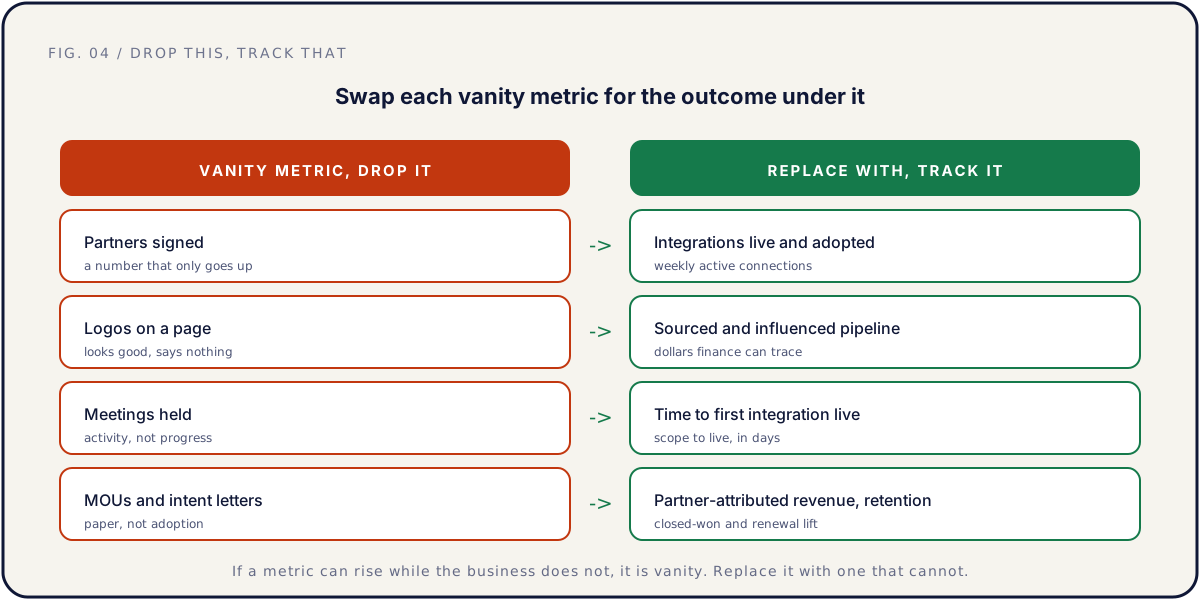
Drop partners signed. Track integrations live and adopted. Signing a partner costs nothing and proves nothing. A live integration with climbing weekly active connections proves a customer got value.
Drop logos on a page. Track sourced and influenced pipeline. A logo wall is decoration. Pipeline finance can trace is the actual contribution, and the only version of the logo wall that survives scrutiny.
Drop meetings held. Track time to first integration live. Meetings measure busyness. Time to live measures whether the busyness produced anything, and it trends down as the team gets good.
Drop MOUs and intent letters. Track partner-attributed revenue and retention. Intent is not adoption. Attributed revenue and the renewal lift from integrated customers are the outcomes the intent was supposed to lead to.
| Drop this vanity metric | Why it misleads | Replace it with |
|---|---|---|
| Partners signed | Goes up with zero business impact | Integrations live and weekly active |
| Logos on a page | Decoration, not contribution | Sourced and influenced pipeline |
| Meetings held | Measures motion, not progress | Time to first integration live |
| MOUs and intent letters | Paper, not adoption | Partner-attributed revenue and retention |
| Total installs (alone) | Hides idle, unused connections | Active-to-install ratio |
None of these vanity metrics are forbidden to look at. The partnerships owner can use partners signed and meetings held internally to sanity-check the team's activity. The rule is narrower: they do not belong on the dashboard you show an exec or a board, because they invite exactly the wrong question and answer it badly.
Common mistakes, and the fix
Reporting activity to the board because it is easy to collect. The fix: report only outcome metrics to execs, and keep activity metrics in an internal view for diagnosis. If a number can grow while the business stays flat, it does not belong on the board slide.
Letting sourced and influenced overlap. The fix: enforce one rule, a deal is sourced or influenced but never both, and tag it at entry. Double-counting is the single fastest way to lose finance's trust in the whole program.
Reporting installs as if they were adoption. The fix: never show installs without the active-to-install ratio beside it. An integration with high installs and flat active connections is a product problem hiding behind a flattering number.
Changing which metrics you report each quarter. The fix: lock the same four outcome metrics and show them every quarter, with trends. Cherry-picking whichever metric looks good this period is how a dashboard quietly loses its credibility.
Holding a Series B program to seed targets, or the reverse. The fix: set stage-appropriate targets. At seed, prove the motion exists at all. By Series B, defend it as a revenue line. The same metric carries a different number at each stage.
FAQ
What is the single most important partnership metric for a startup? Influenced pipeline, with sourced pipeline close behind. Influenced pipeline is usually the larger number and it captures the bulk of what partnerships do for an early company: improving win rate and deal size on deals you were already working. It is also the number that keeps the program funded when budgets tighten, because it ties partnerships directly to revenue.
How is sourced pipeline different from influenced pipeline? Sourced means the partner originated a deal that would not exist without them, so they get full credit. Influenced means the partner touched a deal that already existed in your pipeline and helped it advance, so they get influence credit but not sole credit. The clean test is one question: would this deal exist without the partner? No means sourced, yes means influenced.
Why is "number of partners signed" considered a vanity metric? Because it can grow without anything changing for the business. You can sign forty partners and source zero dollars, ship zero integrations, and influence zero deals. The number goes up and the chart looks healthy, but it measures motion rather than money. Replace it with integrations live and adopted, which cannot rise unless a customer got real value.
What integration health metrics should we track? Installs as a denominator, weekly active connections as the adoption number, the ratio between them as the signal of whether the workflow was real, and error rate as the reliability check. The pattern to watch for is installs climbing while active connections stay flat, which means customers tried the integration once and abandoned it.
How do we set partnership targets at our stage? Match the target to the stage. At seed, prove the motion works once: a single sourced deal, one adopted integration, the first dollar of influenced pipeline. At Series A, prove it repeats across partners. At Series B, defend it as a revenue line with growth rate, win-rate lift, and attributed retention. The same metric carries a different number at each stage.
How do we attribute revenue to a partner when a deal had many touches? Report influence, not sole credit. Add a partner-source field to the opportunity, tag it the moment the partner enters the deal, and carry the tag to closed-won. Then report influenced pipeline and the win rate on partner-influenced deals versus unassisted ones. Showing the partner reliably touched winning deals is more honest and more durable than claiming they closed them alone.
Do we need a dedicated tool to track partnership KPIs? No. Sourced and influenced pipeline live in a partner-source field in your CRM. Integration health lives in your product analytics. Time to first live lives in a project tracker. A simple quarterly report that pulls from those three is enough to run a credible dashboard at seed to Series B. Buy a partnerships platform later, once the manual version is producing numbers worth automating.
How many partnership metrics should a startup dashboard show? Four outcome metrics at the top, sourced pipeline, influenced pipeline, integration adoption, and time to first live, with a small integration health panel underneath. Fewer, consistent, traceable numbers shown every quarter build more trust than a long, shifting list. The discipline is what makes the dashboard credible, not the count.
The short version
Partnership metrics fail when they measure activity instead of outcomes. Partners signed, logos on a page, and meetings held all rise while the business stays flat, which is the precise definition of a vanity metric and the reason partnership programs get cut in a downturn.
Track outcomes instead. Sourced pipeline for demand the partner created. Influenced pipeline for deals the partner improved. Integration adoption and active usage for whether customers got value. Time to first integration live for whether your machine can ship. Partner-attributed revenue and retention for the outcome the whole program exists to produce. Define sourced and influenced cleanly so finance trusts both, set targets that match your stage, and show the same four numbers every quarter so trends, not snapshots, make the case.
If you want the whole partnership engine handled, from strategy and a partner-ready API through shipped integration code, launch, and the metrics that prove it worked, that is exactly what a Partner Audit is for. We review your product, API, and partner potential, then define what to build, who to approach, and how to measure whether it moved the business.