Partner incentives that motivate a field sales team
A practical guide to partner incentives for B2B SaaS: rev share, referral fees, co-sell credits, and spiffs, and how to design the ones that actually move a partner's field reps.
You sign a partnership, agree a rev-share number, and announce it to both companies. The partner's leadership is happy. Their field reps do nothing. Six months later you are staring at a co-sell pipeline of zero and wondering whether the partnership was a mistake. It was not. The incentive was. You paid the company and forgot the person who actually sits in the deal.
Partner incentives are where most B2B SaaS partnerships quietly fail, because the money gets designed for an org chart instead of for a quota-carrying rep who has to decide, in a live deal, whether mentioning your product is worth their time. A field seller is not paid to advance your partnership. They are paid to hit their number this quarter, and they will spend their selling minutes on whatever moves it. If bringing you up does not, you will not get brought up, no matter how generous the headline rev share looks.
This is an independent guide to partner incentives for a small partnerships team: the four instruments you have to work with, who each one actually reaches, how to combine them, and the mistakes that turn an incentive budget into a line item nobody can defend. The specifics of any one program depend on your motion and your channel, so treat this as a design framework rather than a fixed plan. What does not change is the test every incentive has to pass: does it reach the rep, and does it make their deal easier.
The 60-second version
If you only read one section, read this one:
- Incentives have to reach the field rep, not the partner's executive. A company-level rev share rarely changes what an individual seller does in a deal. The person you need to move is the one carrying the quota.
- You have four instruments: revenue share, referral fees, co-sell credits, and spiffs. They differ in who they reach, how fast they pay, and how much channel friction they carry.
- The strongest motivator is usually not money at all. It is the deal in front of the rep getting bigger, faster, or more likely to close when they bring you up. Design for that first.
- Speed beats size. A small payout that lands fast and predictably moves more behavior than a large one buried in a slow, complicated approval chain.
- Quota relief often beats cash. A co-sell credit that counts toward the rep's number can outpull a check, because attainment is what a seller is measured on.
- Match the instrument to the motion. Referral fees fit a hands-off intro; rev share fits a reseller; co-sell credits and spiffs fit a true co-sell where both reps stay in the deal.
- Keep it simple and visible. A rep who cannot explain how they get paid will not change their behavior to chase it.
Why company-level incentives do not move the field
The default partner incentive is a percentage agreed between two leadership teams. It is clean, it goes in the contract, and it does almost nothing to the person who decides whether your product comes up in a customer meeting. The partner's executive cares about the rev-share number because it shows up in their P&L. The field rep does not see that number, is not measured on it, and gets none of it personally. You have incentivized the wrong layer.
A field seller's world is narrow and short. They have a quota, a quarter, and a finite number of selling hours, and they triage ruthlessly toward whatever moves attainment fastest. A partnership that lives in a contract they have never read is invisible to that triage. Decades of sales-force research point the same way: what reps do is shaped by how they are measured and paid at the individual level, not by what their company agreed to strategically. Harvard Business Review's work on what really motivates salespeople makes the broader case that compensation design changes behavior in specific, sometimes non-obvious ways, which is exactly why a vague company-level deal so rarely produces field activity.
So the first move in designing partner incentives is to stop thinking about the partner as a company and start thinking about the individual reps you need to act. Everything below is organized around that question: of the four instruments, which one actually reaches the seller in the room, and how do you make it land fast enough to change what they do next quarter. This is the same field-versus-executive distinction that runs through the incentives section of our co-selling engine playbook, and it is the single idea most partner programs get wrong.
The four incentive instruments
You have four instruments to work with, and they are not interchangeable. Each reaches a different person, pays on a different timeline, and carries a different amount of channel and contractual friction. Choosing the wrong one for your motion is how programs end up funding behavior they never get.
| Instrument | Who it reaches | How it pays | Best fit |
|---|---|---|---|
| Revenue share | The partner company | Ongoing percentage of revenue | Reseller and managed-service motions |
| Referral fee | The company, sometimes the rep | One-time fee on a closed referral | Hands-off intro motions |
| Co-sell credit | The individual rep | Quota or attainment credit | True co-sell where both reps stay in |
| Spiff | The individual rep | Fast cash bonus per deal | Short campaigns and behavior nudges |
The pattern to notice: the instruments that reach the company (rev share, most referral fees) are easy to put in a contract but slow to change field behavior, while the instruments that reach the individual (co-sell credits, spiffs) are harder to administer but are the ones that actually move a rep in a deal. The rest of this section takes them one at a time.
Revenue share
Revenue share is an ongoing percentage of the revenue a partnership generates, paid company to company. It is the natural fit for reseller and managed-service motions, where the partner sells and owns the customer and carries some of the delivery, so a recurring cut of the revenue matches the recurring work they do. It aligns the two companies' interests at the strategic level, which is real and worth having.
What rev share does not do is reach the rep. A field seller does not personally see the company's rev-share percentage, so on its own it does not change what they do in a deal. If you run a reseller motion, rev share is correct and necessary, but pair it with something that touches the individual, or with a partner who internally passes a slice of that share down to their reps as commission. The difference between referral, reseller, and co-sell motions, and the incentive each one needs, is the whole subject of our referral, reseller, and co-sell guide.
Referral fee
A referral fee is a one-time payment on a closed deal that the partner introduced. It fits a hands-off motion: the partner sends a lead, steps back, and you do the selling. Referral fees are the simplest instrument to administer because the trigger is clean, the partner made an intro that turned into a closed-won deal, and the payout is a single event rather than an ongoing obligation.
The reach of a referral fee depends entirely on who pockets it. If it goes to the partner company, it has the same field-blindness problem as rev share. If the partner passes it to the individual rep who made the intro, or if you are paying an individual referrer directly, it becomes a personal incentive and starts to move behavior. The design lever is to make sure the fee reaches a person and pays quickly, because a referral fee that takes two quarters to land teaches reps that referring you is not worth the paperwork.
Co-sell credit
A co-sell credit is the instrument built for the motion that matters most: a true co-sell where the partner's rep stays in the deal and pitches you alongside their own product. Instead of cash, you give the rep credit that counts toward their quota or attainment, often arranged through the partner's own comp plan so that co-selling you helps the rep hit their number.
Co-sell credit is powerful precisely because attainment is what a seller is measured on. For many reps, a credit that moves them closer to quota is worth more than an equivalent amount of cash, because it touches the metric their job, their bonus, and their standing all hang on. The catch is that co-sell credit usually has to be built with the partner, since it lives inside their compensation system, not yours. That makes it a slower thing to set up, but a far stronger thing once it runs, and it is the incentive a partner QBR is a good place to negotiate and review.
Spiff
A spiff is a fast, focused cash bonus paid to an individual rep for a specific action, usually a closed co-sell deal in a defined window. Spiffs are the sharpest behavior nudge you have, because they are personal, immediate, and easy to understand: close a tagged deal this quarter, get a clear bonus. They are ideal for kick-starting a motion, running a time-boxed campaign, or rewarding the early reps who try co-selling before it is habitual.
Spiffs carry the most friction of the four, though. They are the layer most likely to run into channel-conflict rules, partner comp policies, and your own finance and legal constraints, because you are paying another company's employee directly. Use them where they are clean and fast, lean on them to start a motion rather than to sustain it forever, and keep them simple enough that a rep can explain the spiff in one sentence. A spiff nobody understands is a spiff nobody chases.
What actually moves a field rep
Step back from the instruments and ask what genuinely changes a seller's behavior, and the answer reorders your priorities. The strongest motivator is usually not in the table above at all. It is whether bringing you up makes the rep's own deal bigger, faster, or more likely to close. A product that expands the deal size, removes a blocker the customer raised, or makes the partner's platform stickier gives the rep a selfish reason to pitch you that does not depend on any payout structure surviving the next comp reset.
That tactical, deal-level motivator is durable in a way cash incentives are not. A spiff can be cut in a budget review; a referral fee can get tangled in approvals; a co-sell credit depends on a comp plan that changes every year. But if co-selling your product reliably makes the rep's quarter easier, they keep doing it on their own and teach the next rep to do the same, because it is in their interest regardless of what you pay. This is why the joint value proposition is the real foundation of any incentive program: the value prop is the tactical incentive, written down.
When you do reach for money, two design principles matter more than the amount. The first is speed: a smaller payout that lands fast and predictably changes behavior more than a larger one buried in a slow approval chain, because reps discount heavily for uncertainty and delay. The second is that quota relief often beats cash, since attainment is the number a seller actually lives by. A clear set of choices, ranked the way a field rep would rank them:
| Motivator | Why it moves a rep | How durable it is |
|---|---|---|
| A bigger, easier deal | Directly helps their number this quarter | Very durable, survives comp changes |
| Quota or attainment credit | Touches the metric they are measured on | Durable while the comp plan holds |
| A fast, clear spiff | Immediate personal reward, easy to chase | Temporary, good for kick-starting |
| A slow company-level fee | Barely reaches the rep at all | Weak, easy to ignore |
The lesson is to build from the top of that list down. Make the deal better first, arrange quota credit second, and use cash spiffs to start the motion rather than to carry it. The sales-comp literature is consistent that pay design has to fit the behavior you actually want and the stage the rep is in; Harvard Business Review's discussion of how to really motivate salespeople describes how different reps respond to different structures, which is a useful caution against assuming one incentive shape fits every seller.
A simple model for layering incentives
The instruments are strongest in combination, but only if each layer reaches the level it is meant to. A working partner incentive program usually has three layers stacked deliberately, each aimed at a different person and doing a different job.
| Layer | Aimed at | The instrument | The job |
|---|---|---|---|
| Strategic | Partner executive | Revenue share | Win program sponsorship and budget |
| Tactical | Field rep | Joint value prop, co-sell credit | Make the rep's deal better |
| Direct | Field rep | Spiff, referral fee | Nudge specific behavior, fast |
Read the layers as a stack, not a menu. The strategic layer buys you sponsorship: the partner's leadership agrees the partnership is worth supporting, which gets you access to their field. The tactical layer is where most of the real work lives, because it is what changes day-to-day rep behavior, and it costs you product and positioning work rather than cash. The direct layer is the accelerant: spiffs and fees you apply surgically to kick-start the motion or reward early adopters, then dial back once the tactical layer is carrying the load.
The mistake to avoid is funding the wrong layer. Teams routinely pour budget into the direct layer, hoping cash alone will produce a co-sell motion, while leaving the tactical layer empty because it is harder to build. That gets you a burst of spiff-chasing that stops the moment the spiff ends. The durable program is the inverse: a strong tactical layer that makes pitching you worth a rep's time on its own, with direct incentives used to start the engine, not to run it forever. Get the layering right and you can also tie incentive level to partner commitment, the way partner program tiers reward your most engaged partners with the richest incentives.
Common mistakes, and the fix
Paying the company and forgetting the rep. The fix: for every incentive, name the individual it reaches and confirm it touches their quota, bonus, or wallet. A rev share the field never sees does not produce field activity. If the only incentive is company-level, the partnership stays a contract, not a motion.
Designing the payout for finance instead of the seller. The fix: make the incentive fast and simple enough that a rep can explain it in one sentence. Reps discount heavily for delay and complexity, so a small fast spiff beats a large, slow, tiered scheme nobody on the field understands.
Leading with cash instead of a better deal. The fix: build the joint value proposition first, so bringing you up makes the rep's own deal bigger or easier, then add money on top. Cash-only incentives stop working the moment the cash stops; a tactical incentive survives the next comp reset.
Matching the wrong instrument to the motion. The fix: use referral fees for hands-off intros, rev share for reseller motions, and co-sell credits or spiffs for true co-sell. Paying a one-time referral fee for a motion that needs a rep to stay in the deal underpays the actual work and the co-sell never happens.
Treating spiffs as a permanent program. The fix: use spiffs to kick-start a motion or reward early adopters, then transition to durable tactical and quota-based incentives. A motion that only runs while the spiff is funded is not a motion, it is a temporary campaign you are mistaking for a system.
Ignoring channel conflict and partner comp rules. The fix: check before you design, because paying another company's rep directly can collide with their comp policy and your own channel rules. Co-sell credit arranged through the partner's own plan often sidesteps the friction that a direct cash spiff runs into.
FAQ
What are the main types of partner incentives? The four you work with most are revenue share, referral fees, co-sell credits, and spiffs. Revenue share is an ongoing percentage paid company to company and fits reseller motions. A referral fee is a one-time payout on a closed referral. A co-sell credit gives an individual rep quota or attainment credit for co-selling you. A spiff is a fast cash bonus to a rep for a specific closed deal. They differ in who they reach, how fast they pay, and how much channel friction they carry.
Why do company-level incentives often fail to drive partner sales? Because the person who decides whether your product comes up in a deal is the field rep, and a company-level rev share rarely reaches them. The rep is measured and paid on their own quota, not on the partnership P&L, so an incentive they never personally see does not change how they spend their selling hours. Incentives move behavior when they touch the individual seller's number, bonus, or wallet.
What actually motivates a partner's field reps? Most of all, their own deal getting bigger, faster, or more likely to close when they bring you up. That tactical, deal-level benefit is more durable than any cash incentive because it does not depend on a payout structure surviving a budget cut. After that, quota or attainment credit tends to beat cash, because attainment is the metric a seller lives by, and a fast, simple spiff beats a slow, complicated one.
How do spiffs differ from co-sell credits? A spiff is a direct cash bonus paid quickly to a rep for a specific closed deal, which makes it a sharp short-term nudge. A co-sell credit gives the rep quota or attainment credit instead of cash, usually arranged through the partner's own comp plan, which makes it slower to set up but often more powerful because it touches the number the rep is measured on. Spiffs are good for starting a motion; co-sell credits are good for sustaining one.
How big should a partner incentive be? Less than most teams assume, because speed and clarity move behavior more than size. A modest payout that lands fast and predictably outpulls a large one buried in a slow approval chain, since reps discount heavily for delay and uncertainty. Before raising the amount, fix the timeline and simplicity, and make sure the incentive actually reaches the individual rep rather than the partner company.
How do I avoid channel conflict when paying a partner's reps? Check the partner's comp policy and your own channel rules before you design the incentive, because paying another company's employee directly can collide with both. Co-sell credit arranged inside the partner's own compensation plan often avoids the friction that a direct cash spiff creates, and agreeing the rules with the partner up front prevents the disputes that sour a program later.
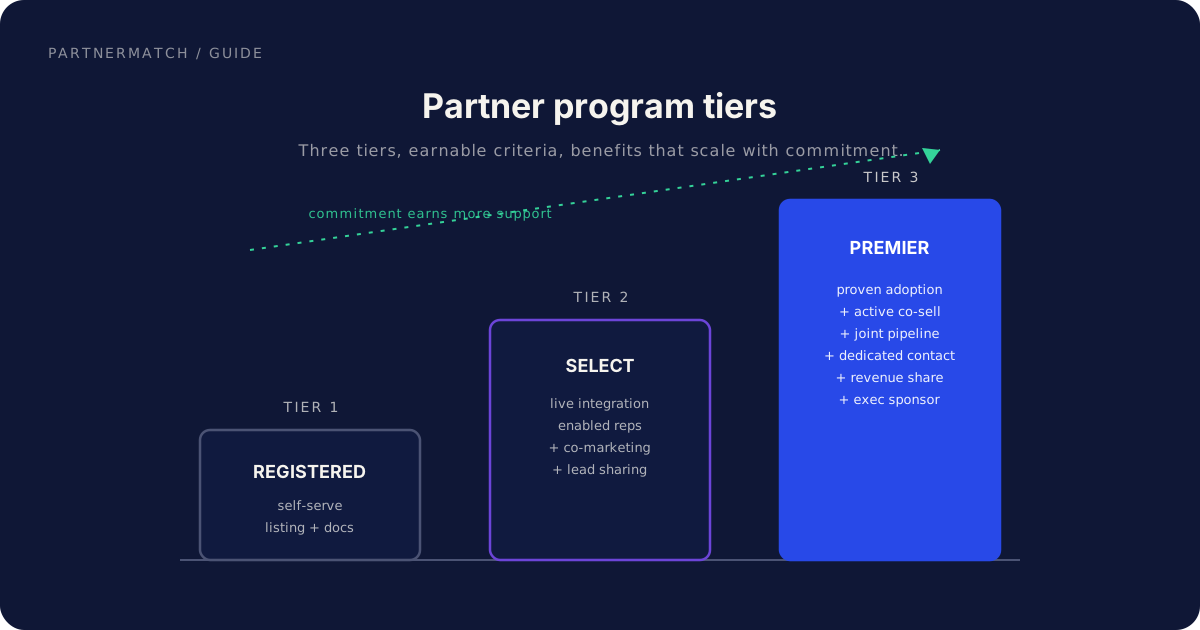
Should incentives scale with partner tier? Often, yes. Tying richer incentives to deeper commitment rewards your most engaged partners and gives others a reason to invest more in the relationship. The structure for that is a tiered program, where the incentive level, support, and co-marketing all rise with the partner's contribution, which is the subject of our partner program tiers guide.
Further reading
- How to build a co-selling engine for the motion that partner incentives are meant to fuel, and where field-level incentives fit in the system.
- Referral, reseller, and co-sell for matching each incentive instrument to the partner motion it suits.
- Partner program tiers for scaling incentives with partner commitment.
- How to write a joint value proposition for co-sell for building the tactical incentive that makes pitching you worth a rep's time.
- Harvard Business Review on what really motivates salespeople, on how compensation design changes seller behavior in specific ways.
- Harvard Business Review on how to really motivate salespeople, on why different reps respond to different incentive structures.
- Harvard Business Review on matching your sales force structure to your business life cycle, on aligning sales and incentive design with the stage you are in.
The short version
Partner incentives fail when they are designed for the partner's org chart instead of the rep in the deal. A field seller is paid to hit their own quota this quarter, so an incentive that never reaches them, like a company-level rev share they never see, does not change what they do. You have four instruments: revenue share for reseller motions, referral fees for hands-off intros, co-sell credits for true co-sell, and spiffs for fast behavior nudges. They differ in who they reach, how fast they pay, and how much channel friction they carry.
The strongest motivator is usually not money at all. It is the rep's own deal getting bigger, faster, or more likely to close when they bring you up, which is what a good joint value proposition delivers. After that, quota credit tends to beat cash, and a fast simple payout beats a large slow one. Layer your program deliberately: a strategic layer to win sponsorship, a tactical layer to make the rep's deal better, and a direct layer of spiffs and fees to kick-start the motion. Fund the tactical layer first, use cash to start rather than to sustain, and keep every incentive simple enough that a rep can explain it in a sentence.
If you want help designing a partner incentive program that actually reaches the field, a Partner Audit reviews your partner motions, your incentive structure, and where deals are leaking, then hands you a concrete plan for what to run and how to pay for it.