Referral vs reseller vs co-sell: which partner GTM model fits
A plain guide to partner GTM models for B2B SaaS. Referral vs reseller vs co-sell, who sells, who owns the customer, margin, and which to start with.
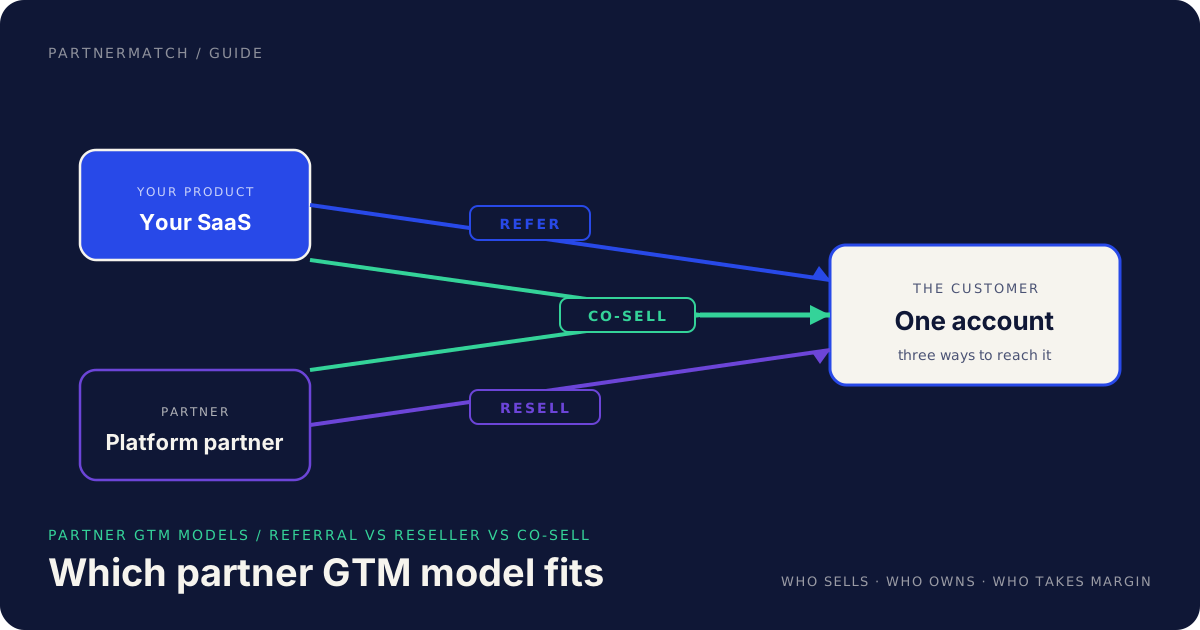
A partner manager wants to "do a partnership" with you. Good. Now the harder question: what kind? Because "partnership" is not a plan. It is three very different motions wearing the same word, and picking the wrong one quietly costs you margin, control, or both.
The choice between partner GTM models, referral vs reseller vs co-sell, decides who sells, who owns the customer, how much money you keep, and how much work it takes to stand the thing up. Get it right and the partner becomes a channel. Get it wrong and you have signed away the customer relationship for a logo, or built a heavy reseller program for a partner who only ever sends a lead a quarter.
This guide defines the three models in plain terms, lines them up across the axes that actually matter, and gives you a way to pick. It also covers why most B2B SaaS startups should start with referral or co-sell before they ever resell, how the model interacts with your integrations and marketplace presence, and how to layer models as the program matures without setting off channel conflict.
The 60-second version
If you only read one section, read this one:
- There are three core partner GTM models: referral (partner introduces, you sell and own), reseller (partner sells and owns, you wholesale), and co-sell (both sell together into the same account).
- The deciding questions are who sells and who owns the customer. Margin, control, and effort all follow from those two answers.
- Referral is the cheapest to stand up and keeps you in full control. It is the right first move for most startups.
- Co-sell is the highest-leverage motion when the partner is already in the deal, because they arrive with trust and timing you cannot buy.
- Reseller trades margin and control for reach. It is powerful at scale and a trap before you have a proven motion to hand off.
- Most startups should start with referral or co-sell, not reselling. Earn each rung of the ladder before the next.
- The model rides on your integration and your marketplace listing. A live, adopted integration is what gives any partner something real to sell.
- Layering models invites channel conflict. Deal registration and clear credit rules are what keep it civil.
The three models, defined plainly
Strip away the jargon and there are only three ways a partner takes your product to market. They differ on two things: who does the selling, and who ends up owning the customer.
Referral. The partner spots a fit, makes an introduction, and steps back. You run the sales process, you sign the contract, you own the customer for support and renewals. The partner collects a fee, if anything. It is the lightest possible relationship: low effort, full control, almost all the margin.
Reseller. The partner sells your product as part of their own offering. They quote it, they invoice the customer, they carry first-line support, and they own the relationship. You wholesale to them at a discount and rarely meet the end customer. It is the heaviest model: more reach, but you give up margin and control of the experience.
Co-sell. Both companies sell into the same account at the same time. The partner's seller raises you inside their own deal, you stay in the room, and the customer hears one joint pitch. You keep the customer and the margin; the leverage comes from the partner's access and timing, not from handing the relationship over. It sits between referral and reseller: more effort than a referral, far more control than a resale.
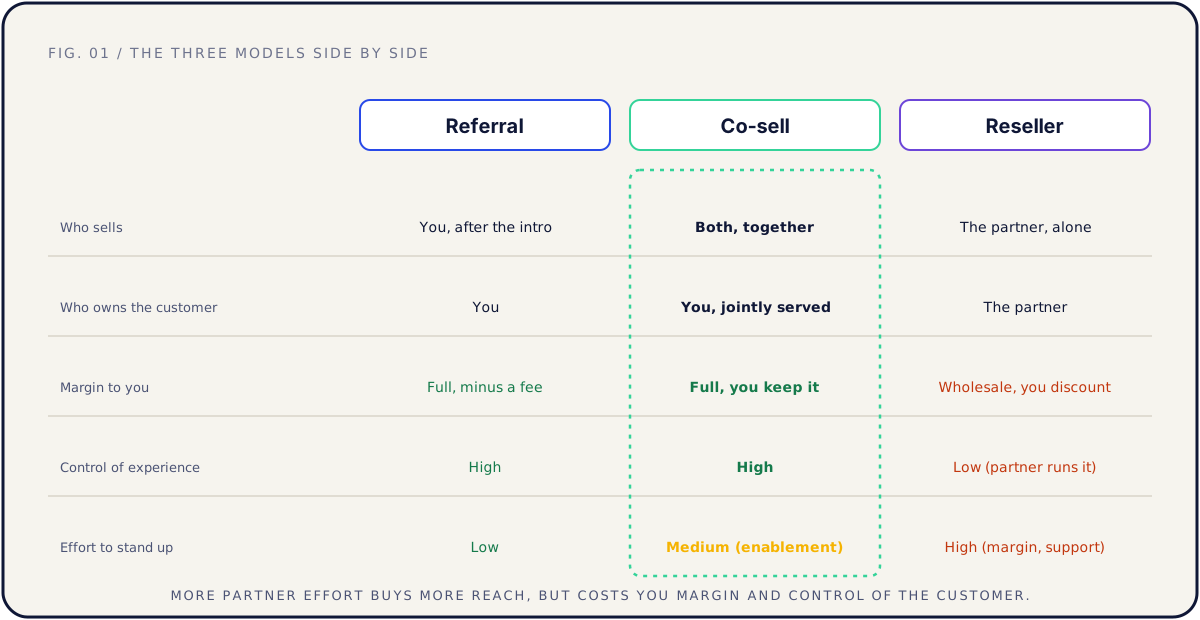
A simple way to remember the difference: referral hands off a lead, reseller hands off the customer, co-sell keeps both sellers in the room. Everything else, the contracts, the comp, the support model, is downstream of that one distinction.
| Model | Who sells | Who owns the customer | What the partner gets |
|---|---|---|---|
| Referral | You, after the intro | You | A referral fee |
| Co-sell | Both, together | You, jointly served | A bigger, faster deal of their own |
| Reseller | The partner, alone | The partner | Resale margin |
How each model handles the things that matter
Picking a model is really picking a set of tradeoffs. Six dimensions decide it, and once you score a partner on these, the right model usually names itself.
Who sells. In referral, you do. In reseller, the partner does. In co-sell, both do, which is the whole point and also the hard part.
Who owns the customer. This is the dimension founders underweight and regret. Reselling means the partner owns the renewal conversation, the support tickets, and the data about how the product is used. You lose the direct line to the customer that tells you what to build next.
Margin. Referral costs you a fee. Co-sell costs you nothing on the deal itself, only the time to enable the partner. Reselling costs you a wholesale discount, often 20 to 40 percent, on every deal forever.
Control of experience. Referral and co-sell keep you driving the demo, the onboarding, and the relationship. Reselling puts a layer between you and the customer, so the experience is only as good as the partner's team.
Effort to stand up. Referral is a link and a payout. Co-sell needs enablement and account mapping. Reselling needs contracts, margin terms, support training, and often a partner portal.
When it fits a startup. Referral fits almost any stage. Co-sell fits once you have a live integration and a partner whose sellers are in the deal. Reselling fits later, when the motion is proven and you want reach you cannot staff yourself.
| Dimension | Referral | Co-sell | Reseller |
|---|---|---|---|
| Margin impact | A fee per deal | None on the deal | Wholesale discount, every deal |
| Control of experience | High | High | Low, partner runs it |
| Effort to stand up | Low | Medium | High |
| Data you keep | Full | Full | Little, partner owns it |
| Best startup stage | Any | After a live integration | Once the motion is proven |
The pattern is hard to miss: as you move from referral to reseller, the partner does more of the work and you give up more of the value. That is not automatically bad. It is a trade you should make on purpose, not by accident because a partnership "felt big."
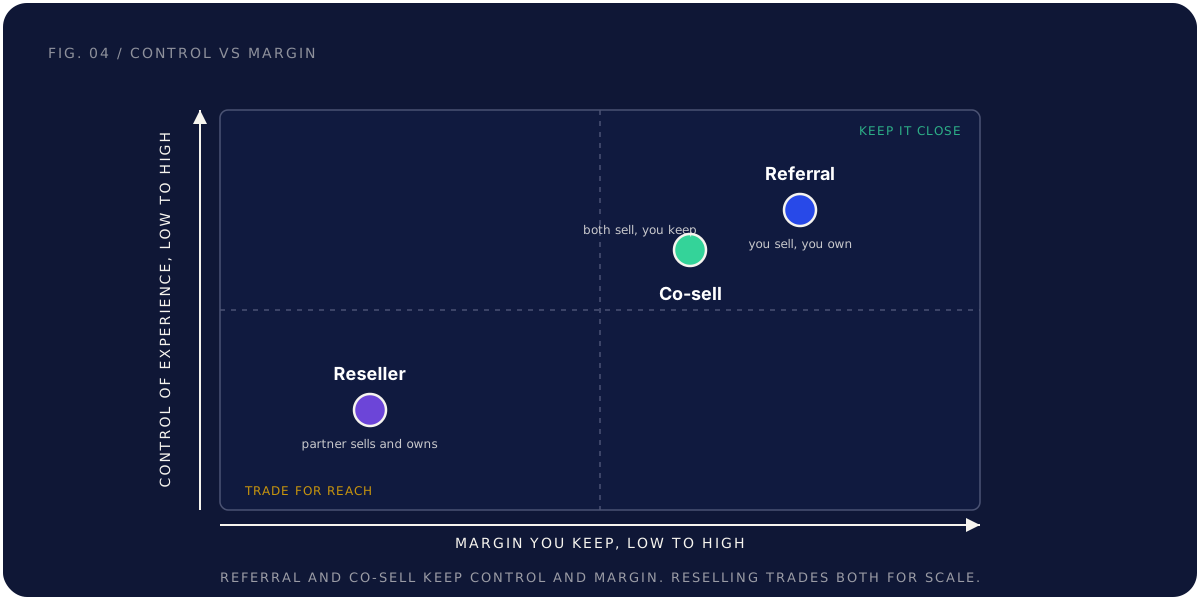
Plotted on control against margin, referral and co-sell cluster in the same corner: you keep both. Reselling sits in the opposite corner, where you have traded control and margin for reach. The chart is a quick test of intent: if a proposed model lands in the bottom-left and reach is not the thing you actually need, reconsider.
How to pick: start from your motion, not the logo
The wrong way to choose is to look at the partner's size and reach for the model that sounds the most ambitious. The right way is to start from one question: at the moment the customer is ready to buy, who is in the room?
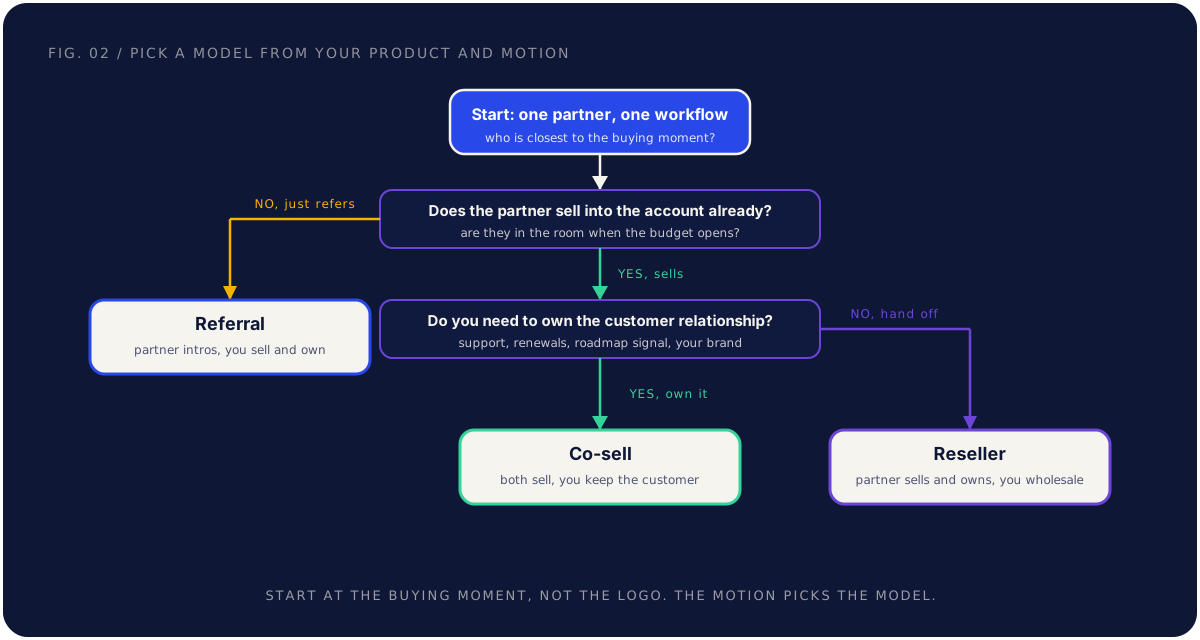
Walk it in two steps.
First, does the partner actually sell into the account, or do they just know people there? If they only ever make introductions, you are looking at a referral relationship no matter what the deck says. Build the link, pay the fee, and do not pretend it is more. If their sellers are genuinely in live deals where your product fits, co-sell and reseller are both on the table.
Second, do you need to own the customer? For most seed-to-Series-B SaaS, the answer is yes. You need the renewal signal, the support relationship, and the product feedback that only comes from talking to the people who use your product. If you need to own the customer, co-sell. Only when you are willing to hand the relationship over, usually for reach into a market or geography you cannot serve directly, does reselling make sense.
A useful gut check: if you cannot yet describe the one workflow where your product makes the partner's customer's life better, you are not ready for any model that needs the partner to sell. Go write that joint value proposition first. The whole machinery of co-selling depends on it, which is why we treat it as component one in the co-selling engine deep dive.
Why most startups should start with referral or co-sell
Reselling looks like the grown-up option. It is usually the wrong first move, and here is the blunt reason: you cannot hand off a motion you have not figured out yourself.
A reseller takes your product and sells it without you in the room. If you do not yet know which customers say yes, why they say yes, and what objections kill the deal, you are asking a partner's team to discover all of that on your behalf, while you pay them a margin to do it badly. They will not invest the effort, the deals will not close, and you will conclude that "the channel does not work" when really the product was not ready to be sold by proxy.
Referral and co-sell keep you in the deal, which means you keep learning. You hear the objections, you see which workflows land, and you build the playbook a reseller will eventually need. Start light, prove the motion, and earn the right to hand it off.
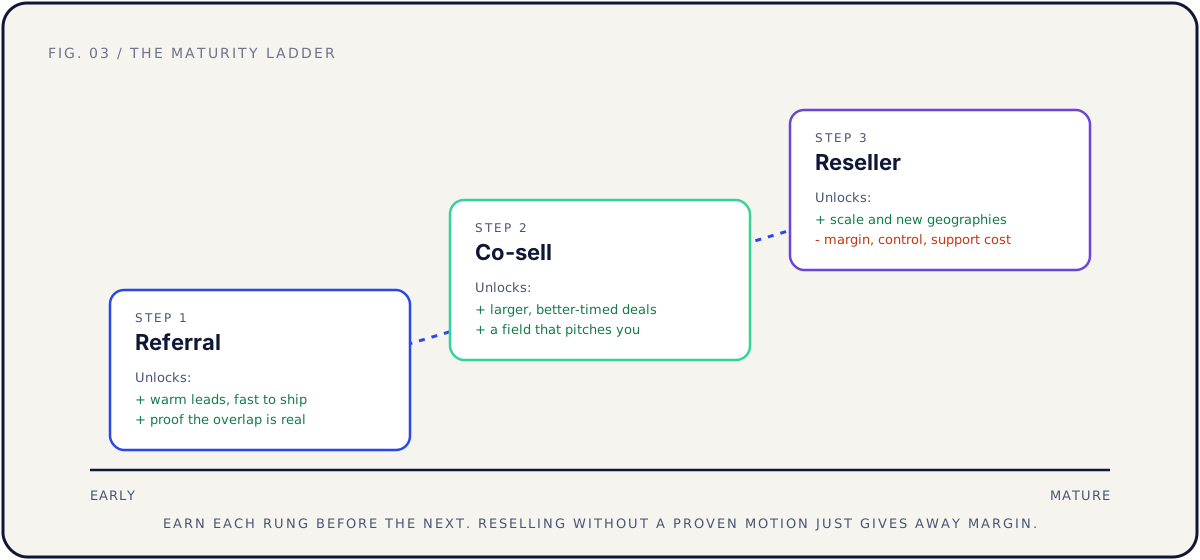
There is a sequencing logic to the ladder, and it is worth saying out loud.
| Rung | What you prove | What it earns you |
|---|---|---|
| Referral | The customer overlap is real and leads convert | Warm pipeline, fast, at almost no risk |
| Co-sell | A partner's field can pitch you and win | Larger, better-timed deals you still own |
| Reseller | The motion works without you in the room | Scale and reach you cannot staff yourself |
Skip a rung and you usually fall. A startup that resells before it has co-sold is handing a partner a product the partner does not know how to sell, with no proof that the joint motion produces deals. The margin you give up buys you nothing.
How the model interacts with integrations and marketplaces
None of these models float free of your product. They all ride on one thing: whether there is something real for the partner to point at. For tech partnerships in SaaS, that something is almost always a live integration and, often, a marketplace listing.
A referral is easy to stand up, but it converts far better when the partner can say "and it connects to what you already run." A co-sell motion needs a joint value proposition, and a joint value proposition needs a working shared workflow, which is to say an integration that exists and is adopted. A reseller is selling your product into their stack; if the integration is flaky or absent, every support ticket lands on them and they stop selling you. The integration is the substrate the model runs on.
Marketplaces change the math too. If the partner runs a marketplace where your customers already shop for tools, a listing can do a lot of the referral work automatically: customers find you, install, and convert without a human intro. That same listing is the proof point a co-selling seller links to, and the fulfillment rail a reseller motion can be built on.
| Asset | Referral | Co-sell | Reseller |
|---|---|---|---|
| Live integration | Helps conversion | Required for the joint pitch | Required, or support breaks |
| Marketplace listing | Can automate the intro | The proof a seller links to | A fulfillment and discovery rail |
| Partner-ready API docs | Nice to have | Needed so their team trusts you | Needed for their support team |
The practical takeaway: before you negotiate any partner GTM model, make sure the underlying integration is real, adopted, and documented. The order is not optional. A model is a way to sell a working thing, not a substitute for building it.
Layering models as the program matures
Mature partner programs rarely run one model. The same partner might refer some deals, co-sell others, and resell in a region you do not cover. That is healthy, as long as it is deliberate and the boundaries are written down.
The natural progression looks like this. You start with referral to prove the overlap converts. As the integration lands and the partner's sellers see deals where you fit, you graduate the best relationships to co-sell, where the partner actively pitches you and you both work the account. Later, for partners with reach into segments or geographies you cannot serve, you add a reseller track on top, so they can transact without you in every deal.
Layering is also how you match the model to the deal size, not just the partner. A partner might refer small, self-serve deals where co-selling is not worth the effort, and co-sell the large strategic accounts where the joint pitch wins. The model is a tool you apply per situation, not a label you stamp on the whole relationship.
Two cautions. First, do not run a model the partner cannot support. A reseller track with no margin terms, no support training, and no portal is a contract waiting to fail. Second, every added model multiplies the chances of two sides claiming the same deal, which is the subject of the next section. The co-marketing that announces these motions has the same discipline; if you want the amplification playbook that sits alongside this, the SaaS co-marketing playbook covers it. And the order in which models earn their place is part of the broader partnership lifecycle, where the long stages after launch are where the value actually compounds.
Compensation and conflict: deal registration and channel conflict
The fastest way to poison a partner relationship is to fight over a deal. Channel conflict, two parties believing they own the same opportunity, is the predictable failure mode the moment money is on the table, and it gets worse with every model you layer on.
Channel conflict shows up in two forms. Internal conflict is when your own direct sales team and a partner work the same account, and your rep does not want to "lose" the deal to the channel. External conflict is when two partners both claim the same customer. Both are solvable, but only if you decide the rules before the deals exist, not after.
The standard tool is deal registration: the partner registers an opportunity, and if it is genuinely theirs and net-new, they get protected credit and the agreed economics for a set window. It does two things at once. It tells you who was first, and it tells your direct team to stand down on a registered deal so the partner is not punished for sourcing it.
| Conflict type | What it looks like | The mechanism that fixes it |
|---|---|---|
| Direct vs partner | Your rep and the partner both work an account | Deal registration plus a clear "hands off registered deals" rule |
| Partner vs partner | Two partners claim the same customer | First-to-register wins, with a tie-break rule agreed up front |
| Referral vs co-sell credit | Was this a refer or a co-sell? | Tag the motion in your CRM when the partner enters the deal |
Compensation has to reach the person who actually moves the deal. A company-level agreement does nothing for a partner rep with a quota this quarter. In a referral model, a clean, fast-paying fee works. In co-sell, the durable motivator is making the rep's own deal bigger or faster, with a spiff only where it is clean. In reseller, the margin is the incentive, but it has to be enough that the partner prioritizes you over the other products on their line card. We go deep on reaching the individual seller in the co-selling engine deep dive; the short version is that you compensate the human in the deal, not the org chart above them.
Whatever you decide, write the credit rules down and agree them with the partner before the first deal, not in the middle of an argument about a closed-won. Attribution disputes are the single most common reason a promising partnership goes cold.
Common mistakes, and the fix
Reselling before you have a proven motion. The fix: start with referral or co-sell. A reseller needs a playbook to follow, and if you have not built one by selling the product yourself, you are paying margin for a partner to fail in slow motion. Earn the rung.
Signing away the customer for a logo. The fix: decide, deliberately, whether you can afford to lose the renewal signal, the support relationship, and the product feedback. If you need to own the customer, the model is referral or co-sell, full stop, no matter how big the reselling partner is.
Treating the model as a label for the whole relationship. The fix: match the model to the deal. The same partner can refer small deals, co-sell strategic accounts, and resell in a geography you do not cover. Apply the model per situation.
Launching a model with no integration behind it. The fix: build and adopt the integration first. A partner has nothing real to sell without a working shared workflow, and a reseller with a flaky integration drowns in support tickets and stops selling you.
Leaving credit rules until the first dispute. The fix: set up deal registration and write the credit rules before any deal closes. Decide how a refer is distinguished from a co-sell, who wins a tie, and how fast the partner gets paid. Do it cold, in advance.
FAQ
What is the simplest difference between referral, reseller, and co-sell? Referral: the partner introduces, you sell and own the customer. Reseller: the partner sells and owns the customer, you wholesale to them. Co-sell: both sell together into the same account, and you keep the customer. Who sells and who owns the customer are the two questions that separate them; everything else follows.
Which partner GTM model should a startup start with? Referral or co-sell, almost always. Both keep you in the deal so you keep learning what closes, and both keep your margin and your direct customer relationship. Reselling is a later move, for when the motion is proven and you want reach you cannot staff yourself.
When does reselling actually make sense? When the motion is already working, you have a repeatable playbook a partner can follow, and the partner gives you reach into a segment or geography you cannot serve directly. Reselling buys scale at the cost of margin and control, so it pays off when reach is the constraint, not when you are still figuring out how the product sells.
Can we run more than one model with the same partner? Yes, and mature programs usually do. A partner might refer small self-serve deals, co-sell large strategic accounts, and resell where you have no direct presence. The key is to make each boundary deliberate and to set deal-registration rules so the models do not collide.
How do integrations affect the choice of model? Heavily. A co-sell motion needs a live, adopted integration to anchor the joint value proposition. A reseller needs a stable integration or their support team gets buried. Even a referral converts better when the partner can point to a working connection. Build the integration before you pick a model to sell it through.
What is deal registration and do we need it? Deal registration is when a partner logs an opportunity and, if it is genuinely theirs and net-new, gets protected credit and the agreed economics for a window. You need it the moment more than one party can claim a deal, which is as soon as you have a partner motion plus a direct sales team. It is the main tool that prevents channel conflict.
How do we avoid channel conflict between partners and our direct team? Decide the rules before the deals exist. Use deal registration, give registered deals protection, tell your direct team to stand down on them, and tag the partner source in your CRM the moment a partner enters a deal. Conflict comes from ambiguity, so remove the ambiguity in advance.
How is co-sell different from co-marketing? Co-marketing builds public proof at scale: landing pages, joint case studies, launch announcements. Co-sell is the one-to-one motion where a partner's seller pitches you inside a specific deal. Co-marketing is the air cover, co-sell is the ground game, and they reinforce each other. The SaaS co-marketing playbook covers the amplification side.
The short version
Referral, reseller, and co-sell are not three sizes of the same thing. They are three different trades. Referral keeps your control and margin and asks little of the partner. Co-sell keeps your control and margin and asks the partner to pitch you in their own deals. Reseller hands the partner the customer and a slice of every deal in exchange for reach. Pick by asking who is in the room at the buying moment and whether you need to own the customer.
Start with referral or co-sell, prove the motion, and only resell once you have a playbook worth handing off. Build the integration first, because the model is a way to sell a working thing, not a replacement for building it. Layer models deliberately as the program matures, and write your deal-registration and credit rules before the first deal closes, not after the first fight.
If you want help choosing the model, building the integration it rides on, and standing up the motion that sells it, that is exactly what a Partner Audit is for. We review your product, API, and partner potential, then define which model fits, what to build, and how to ship and sell it.