Account mapping: how to find overlap with a partner's customers
A practical account mapping guide for B2B SaaS. Match your accounts against a partner's base to find shared customers, warm intros, and co-sell targets.
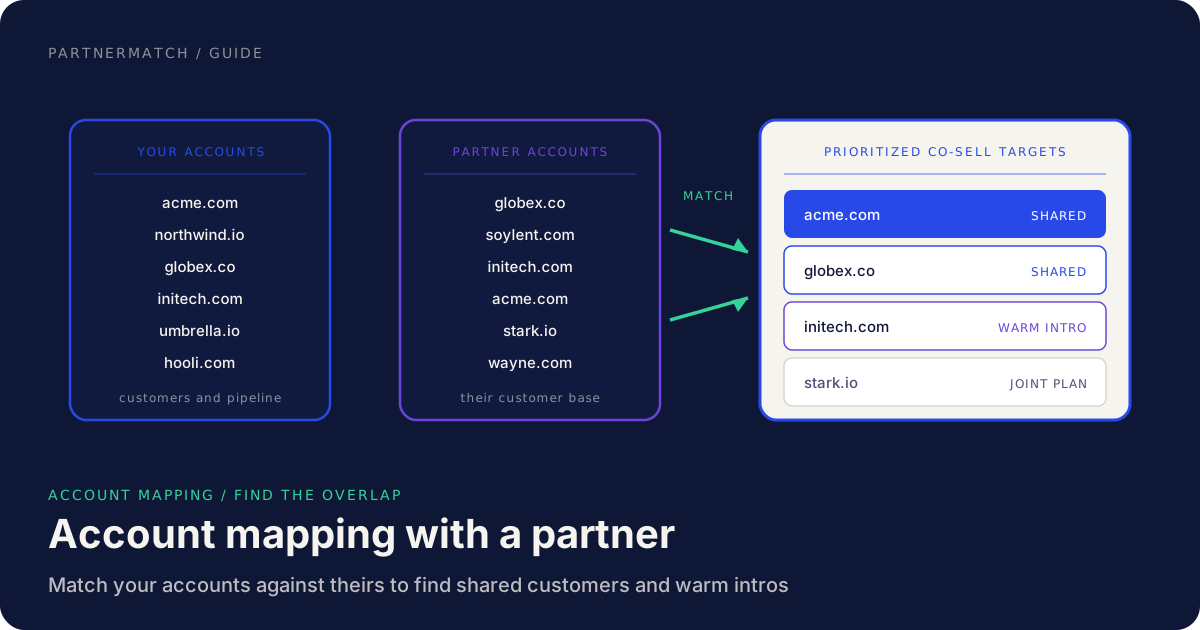
You sign a partner, everyone is excited, and then comes the awkward part: someone has to point at a specific account and say "let's work this one together." Without account mapping, a shared view of who you both touch, that conversation stalls. The partner manager guesses, you guess, and the co-sell motion never gets past a friendly Slack channel.
Account mapping is how you skip the guessing. It is the exercise of matching your accounts and pipeline against a partner's customer base to find the accounts you have in common, the prospects you could warm up for each other, and the targets worth chasing together. Done well, account mapping turns a vague relationship into a named list of accounts where both sides already have a reason to be.
This guide walks through account mapping from scratch: what it is, why it is the foundation of co-selling, the manual process you can run before buying any tool, how to exchange lists without a privacy mess, and how to turn the map into action. There is a copyable template you can lift directly.
The 60-second version
If you only read one section, read this one:
- Account mapping matches your accounts and pipeline against a partner's customer base to find shared customers, mutual prospects, and warm intros you can both act on.
- It is the foundation of co-selling. Without a shared account view, co-sell targeting is random; with one, you walk into a QBR with a named list.
- You can run it manually first. Agree on fields, exchange lists safely, match on domain, categorize, prioritize. A spreadsheet is enough at the start.
- The match produces four categories: shared customer, your customer and their prospect, their customer and your prospect, and mutual prospect. Each has a different play.
- Data hygiene and privacy are not optional. Share only the fields the match needs, get an agreement in place first, and never hand over a raw CRM dump.
- The value is in working the list, not building it. Warm intros, co-sell targets, and joint plays come from acting on the map, not admiring it.
- It connects straight to your metrics and GTM model. Account mapping feeds sourced and influenced pipeline, and it looks different in a referral, reseller, or co-sell motion.
- Start small, scale later. Buy a partner ecosystem platform once the manual version is producing deals and the volume justifies it.
What account mapping actually is
Account mapping is the practice of comparing two account lists, yours and a partner's, to find where they overlap. Your list is your customers plus your open pipeline. The partner's is their customer base, at whatever granularity their policy allows. You line the two up, match on a common key, and read the result.
The output is not one list, it is four buckets. Some accounts are customers of both of you. Some are your customer but only a prospect for the partner. Some are the partner's customer but only a prospect for you. And some are accounts neither of you has won yet but both of you want. Each bucket means something different for what you do next.
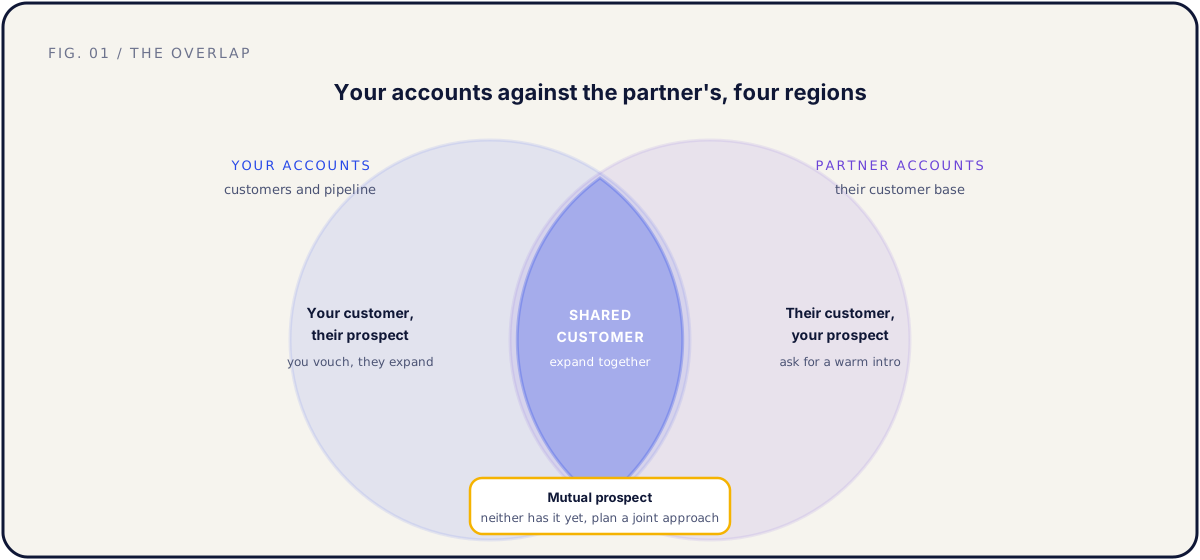
Account mapping matters because it replaces a feeling with a fact. Before the map, a partnership is a sense that "our customers probably overlap." After the map, it is a row in a sheet that says acme.com is a customer of both of you and nobody has built a joint story for them yet. That specificity makes the next conversation productive instead of vague. And because pipelines move and partners win and lose accounts, the map is something you refresh on a cadence, not a project you finish once.
Why account mapping is the foundation of co-selling
Co-selling is the motion where a partner's seller pitches you inside their own deal, and it is the highest-leverage partner motion in B2B SaaS because the partner is already in the room. But that leverage only shows up when both sides know which room. Account mapping is what tells them.
Without a map, co-selling degrades into hope. A partner rep might remember you in a deal where you happen to fit, or might not. With a map, you can hand that rep a specific list: here are five of your accounts where we are already working a deal, here is what we need from you in each. That is the difference between a co-sell program and a co-sell wish. The full system account mapping plugs into is laid out in the co-selling engine guide.
Think of account mapping as the targeting layer underneath every other co-sell component. The joint value proposition tells a seller what to say. Enablement teaches them to say it. Account mapping tells them which accounts to say it about. Skip the map and the other two fire at random targets. It also makes the relationship measurable: a named set of shared accounts you can track shows the partnership touched real pipeline, where a relationship with no map produces influence you cannot trace.
The manual account mapping process, step by step
You do not need a partner ecosystem platform to do your first account mapping. You need two exports, a spreadsheet, and an agreed match key. Here is the process, in the order to run it.
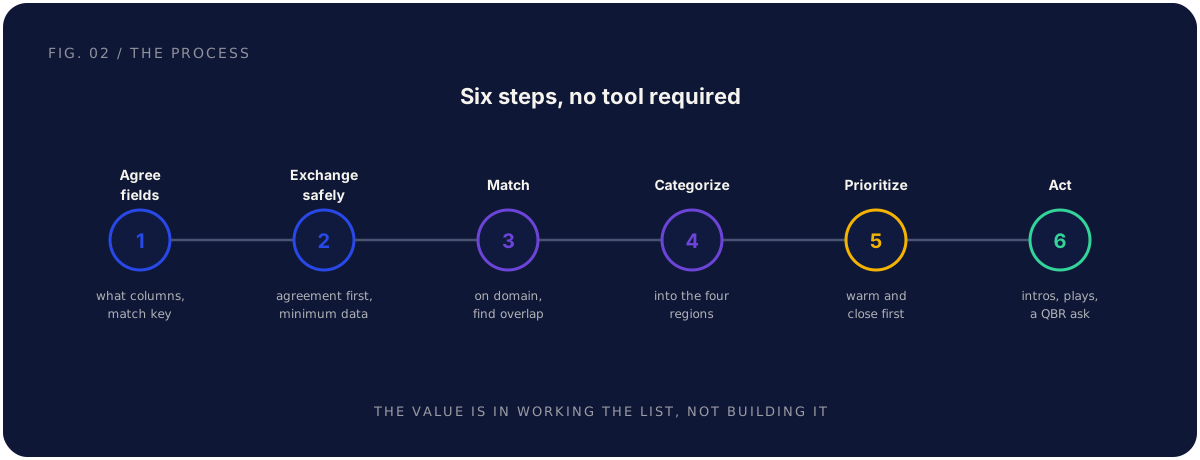
Step 1: agree on fields. Before anyone exports anything, decide with the partner what columns you will each share and what the match key is. Domain is the cleanest key because it is unique and rarely ambiguous; company name is a fallback but invites duplicates like "Acme" versus "Acme Inc." Agree on the minimum set of fields that makes the match work and nothing more.
Step 2: exchange lists safely. Get an agreement in place, then each side shares only the agreed fields. This is the step where account mapping goes wrong most often, so it gets its own section below. The short version: minimum data, agreement first, no raw dumps.
Step 3: match on domain. Put both lists in one spreadsheet and match rows on the domain key. A lookup formula that flags whether each of your accounts appears in the partner's list, and vice versa, is enough. The rows that appear on both lists are your overlap.
Step 4: categorize. For every account, decide which of the four buckets it belongs to. Is it a customer of both, a customer of one and a prospect of the other, or a prospect of both? This is where the raw match becomes a map you can act on.
Step 5: prioritize. Not every overlapping account deserves equal effort. Sort by how warm the account is, how close to a buying moment it sits, and how much both sides stand to gain. Shared customers and live deals where the partner already has a relationship rise to the top.
Step 6: act. Take the top accounts into a QBR with a specific ask per account. This is the step that turns the map into pipeline, and the one most teams skip after the satisfying work of building the sheet.
| Step | What you do | The output |
|---|---|---|
| 1. Agree fields | Pick the columns and match key with the partner | A shared schema, domain as key |
| 2. Exchange safely | Share only agreed fields, under an agreement | Two clean, minimal lists |
| 3. Match | Line up both lists on domain | A flagged overlap |
| 4. Categorize | Sort each account into one of four buckets | A categorized map |
| 5. Prioritize | Rank by warmth, timing, and mutual upside | A ranked target list |
| 6. Act | Bring the top accounts to a QBR with asks | Warm intros and co-sell plays |
Data hygiene and privacy when you exchange lists
Exchanging customer lists with another company is exactly as sensitive as it sounds. Both lists are confidential, and a sloppy exchange can breach a contract or a privacy obligation before a single deal is mapped. Three rules keep it clean.
First, share only what the match needs. The match runs on domain. It does not need contact names, email addresses, deal sizes, contract terms, or notes. Every field beyond the match key is risk for no benefit, so strip the export to the minimum before it leaves your systems.
Second, have an agreement in place before anything moves. A mutual NDA or a data-sharing clause should cover what each side can do with the other's list, how long they can keep it, and that it cannot be used beyond the mapping exercise. Map first, paperwork second is how partnerships end up in legal.
Third, no raw dumps. Do not hand over a full CRM export and let the other side sort it out. Prepare a purpose-built list with only the agreed fields, for only the agreed accounts. A tool that compares without either side seeing the other's full list is better still, but a disciplined manual exchange is fine at the start.
| Do | Do not |
|---|---|
| Share domain and category only | Share contacts, deal values, or notes |
| Sign an agreement before exchanging | Map first and paper it later |
| Prepare a purpose-built minimal list | Hand over a raw CRM export |
| Agree retention and use limits up front | Leave use of the list undefined |
| Refresh on an agreed cadence | Keep stale copies floating around |
A good test before you send anything: if this exact file leaked, would it embarrass you or breach a commitment? If yes, you are sharing too much. Trim it until the answer is no.
Categorizing the overlap, and the action for each
Once the match is done, every overlapping account falls into one of four categories, and each category points to a different action. This is the heart of account mapping, because the category is what tells a seller what to actually do with the account.
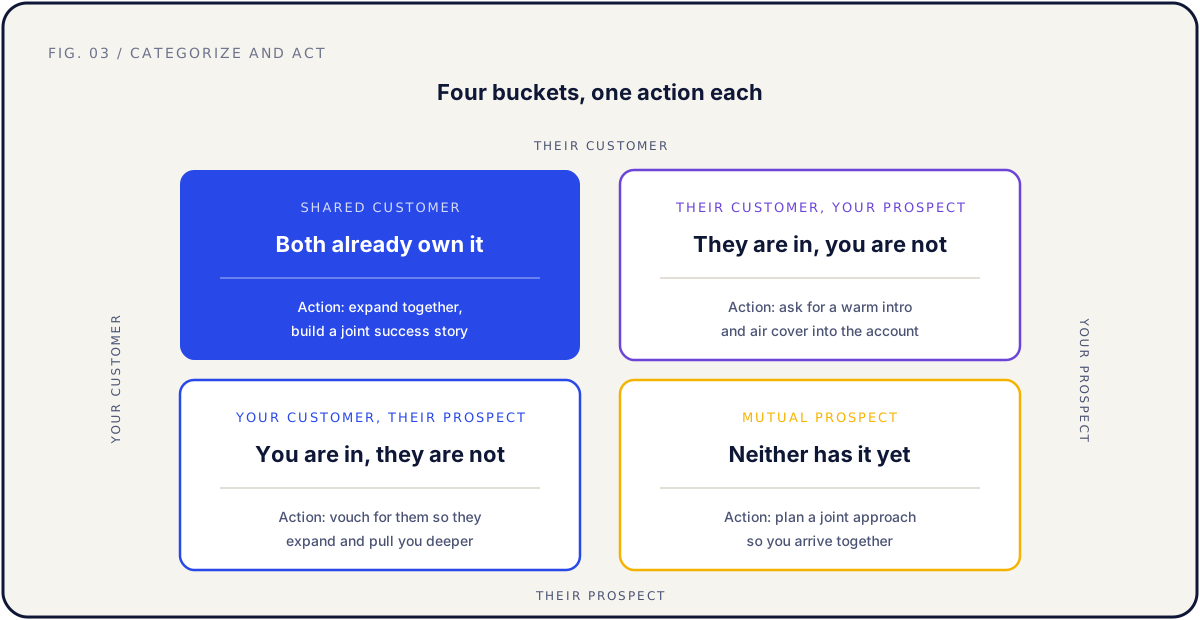
Shared customer. Both of you already serve this account. The play is to expand together: build a joint success story and use the account as proof for the next prospect. These are your warmest accounts because both sides already have trust and access.
Your customer, their prospect. You serve the account and the partner is trying to win it. The play is to vouch. A genuine reference helps the partner land or expand, and when they grow inside the account, you often get pulled deeper alongside them.
Their customer, your prospect. The partner serves the account and you are trying to win it. The play is to ask for a warm intro and air cover. The partner's seller is already inside and trusted, and can introduce you at the right moment, which is the whole leverage of co-selling.
Mutual prospect. Neither of you has the account yet, but both want it. The play is a joint approach: plan how you arrive together so the customer hears one combined story instead of two cold pitches. These take the most coordination, so they sit below the warmer categories in priority.
| Category | What it means | The action |
|---|---|---|
| Shared customer | Customer of both | Expand together, build a joint story |
| Your customer, their prospect | Yours to vouch for | Reference them so they expand and pull you in |
| Their customer, your prospect | Theirs to introduce | Ask for a warm intro and air cover |
| Mutual prospect | Neither has won it | Plan a joint approach so you arrive together |
The mistake to avoid is treating all four the same. A shared customer needs a different conversation than a mutual prospect, and a seller who gets a flat list with no category will default to ignoring it. The category is the instruction.
A copyable account-mapping template
Here is a template you can lift directly into a spreadsheet or a shared doc. One row per overlapping account, sorted by priority. Keep it small: the columns below are enough to run a co-sell motion, and every extra column is one more thing nobody updates.
| Account (domain) | Your status | Their status | Category | Next action | Owner | Priority |
|---|---|---|---|---|---|---|
| acme.com | Customer | Customer | Shared customer | Build joint success story | You + partner AE | High |
| initech.com | Open deal | Customer | Their customer, your prospect | Ask for warm intro | Partner AE | High |
| globex.co | Customer | Open deal | Your customer, their prospect | Vouch, support expansion | Your AE | Medium |
| stark.io | Open deal | Open deal | Mutual prospect | Plan joint approach | Both | Medium |
| wayne.com | Prospect | Prospect | Mutual prospect | Watch, revisit next QBR | Partnerships | Low |
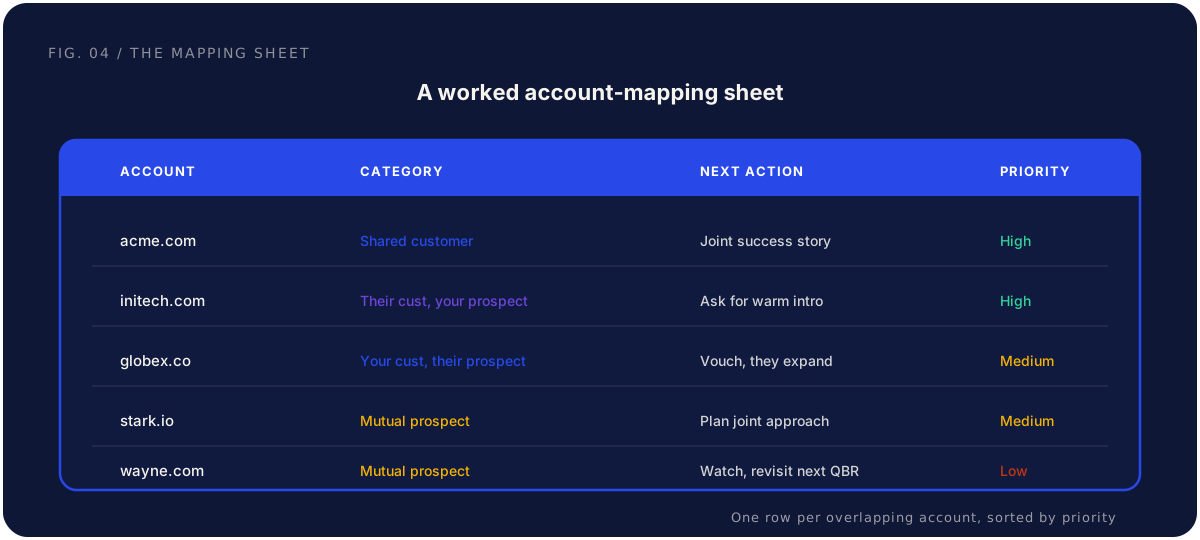
How to use the columns:
- Account (domain). The match key. Use the domain, not the display name, so the same account never appears twice.
- Your status / Their status. Customer, open deal, or prospect on each side. These two determine the category.
- Category. One of the four buckets. This is the instruction for what to do.
- Next action. The single specific thing to do next. Not "engage," but "ask the partner AE for an intro to the VP of Eng."
- Owner. A named person. An action with no owner does not happen.
- Priority. High, medium, or low, based on warmth, timing, and mutual upside. Sort by this so the top of the list is where the work goes.
Keep the working version to the top ten or fifteen accounts. A mapping sheet with two hundred rows is a database nobody acts on; a sheet with twelve prioritized accounts and named owners is a plan.
Turning the map into action
A finished map is worth nothing until someone works it. The point of account mapping is the action it enables, and three plays come straight off the sheet.
Warm intros. For every "their customer, your prospect" account, the action is an introduction. The partner's seller is already inside and trusted, so an intro lands you warm and well-timed. Bring a short list to the partner with a specific person to be introduced to in each account, not a vague "can you connect us somewhere."
Co-sell targets. For shared customers and live deals where both sides have a relationship, the action is a joint motion. Agree who leads, what each side says, and what the combined story is. These are the accounts where co-selling produces the biggest, fastest deals, because the trust and the timing are already there.
Joint plays. For mutual prospects, the action is a planned approach: a joint outreach, a co-hosted session, or a shared point of view you take to the account together. These take more setup, but they are how a partnership creates demand rather than just riding existing deals.
The forcing function for all three is the QBR. Bring the top of the mapped list to every partner business review with a specific ask per account, and the map turns into pipeline on a schedule. A QBR with a named account list is a working session; a QBR without one is a status update.
How account mapping connects to metrics and GTM
Account mapping does not live in isolation. It feeds the numbers you report and changes shape depending on the go-to-market model you run with the partner.
On the metrics side, the map makes partner-attributed pipeline traceable. When the partner introduces you to one of their customers, that is a sourced or influenced deal you can tag back to the mapping exercise, and a co-sell on a shared account leaves the map as the paper trail that shows the partner touched it. The cleanest way to define and report those numbers is covered in the partnership metrics guide; account mapping is where the data starts.
On the GTM side, the map means different things in different models. In a referral motion, it mostly surfaces "their customer, your prospect" accounts for the partner to introduce. In a co-sell motion, the shared customers and overlapping live deals matter most. In a reseller motion, the partner owns the customer, so the map is more about coverage than warm intros. The differences between those models, and how to pick one, are laid out in the referral, reseller, and co-sell guide.
| GTM model | What the map is for | The accounts that matter most |
|---|---|---|
| Referral | Surfacing accounts the partner can introduce | Their customers, your prospects |
| Co-sell | Targeting joint deals and shared accounts | Shared customers, overlapping live deals |
| Reseller | Coverage and territory planning | The partner's full base, since they own the customer |
The takeaway: account mapping is a shared input, not a standalone task. It feeds the metrics that keep the program funded and adapts to the GTM model you chose, which is why it is worth doing carefully rather than as a one-off favor to a partner.
Doing account mapping at scale, later
The manual process works, and it is the right place to start. But it has a ceiling. Matching two lists in a spreadsheet is fine for one partner and a few dozen accounts. It does not hold up across ten partners, refreshed monthly, with thousands of accounts on each side.
When you hit that ceiling, a partner ecosystem platform earns its cost. These tools automate the match, refresh it continuously as pipelines move, and let both sides share without either one seeing the other's full list. The signal that you are ready is simple: the manual version is producing real deals, and the volume has outgrown the spreadsheet.
The order matters. Buy the tool to scale a motion that already works, not to create one. A platform applied to a partnership with no joint value prop and no co-sell process just automates the production of a list nobody acts on. Prove the motion by hand first, then automate. Until then, the spreadsheet is not a compromise, it is the correct tool, because the value was never in the software. It was in the named accounts and the actions next to them.
Common mistakes, and the fix
Building the map and never working it. The fix: end every mapping session by assigning owners and actions to the top ten accounts, and put them on the next QBR agenda. A map with no actions next to it is a spreadsheet, not a plan.
Sharing too much data in the exchange. The fix: share only the match key and category, under an agreement, never a raw CRM dump. If the file leaking would breach a commitment, you are sharing too much. Trim it until it would not.
Treating all four categories the same. The fix: tag every account with its category and the specific action that category implies. A flat list with no categories tells a seller nothing, so it gets ignored.
Mapping once and letting it go stale. The fix: refresh the map on a cadence, monthly or quarterly, because pipelines and partner accounts move. Last quarter's overlap is not this quarter's overlap.
Buying a platform before the motion works. The fix: run the manual version until it produces deals, then automate. A tool scales a working motion; it cannot create one, and it will happily automate a list nobody acts on.
FAQ
What is account mapping in partnerships? Account mapping is matching your accounts and pipeline against a partner's customer base to find where you overlap. The result sorts accounts into shared customers, accounts where one of you is a customer and the other a prospect, and mutual prospects. Each category points to a different action, which makes account mapping the targeting layer underneath co-selling.
How do I do account mapping without a tool? Agree on the fields and match key, exchange minimal lists under an agreement, then match the two lists on domain in a spreadsheet. Categorize each overlapping account into one of four buckets, prioritize by warmth and timing, and bring the top accounts to a QBR with a specific ask each. A spreadsheet is enough until the volume outgrows it.
What is the best key to match accounts on? Domain, in almost every case. It is unique, rarely ambiguous, and avoids the duplicate problem that company name creates, where "Acme," "Acme Inc.," and "Acme Corp" all look like different companies. Use company name only as a fallback when a domain is missing, and clean it carefully if you do.
Is it safe to share customer lists with a partner? It is safe with discipline. Share only the fields the match needs, usually just the domain and a category, never contacts, deal values, or notes. Put an agreement in place that limits how each side can use and retain the list before anything is exchanged, and never hand over a raw CRM export. A tool that compares lists without either side seeing the other's full data is better still.
What are the four account-mapping categories? Shared customer, where both of you serve the account; your customer and their prospect, where you vouch so they can expand; their customer and your prospect, where you ask for a warm intro; and mutual prospect, where neither has won it and you plan a joint approach. The category determines the action, which is the whole reason to categorize rather than keep a flat list.
How often should we refresh the account map? On a regular cadence, monthly or quarterly, tied to your QBR rhythm. Pipelines move and partners win and lose accounts, so a map built once and never refreshed goes stale fast. Refreshing it before each partner business review keeps the working list current and gives the meeting a concrete agenda.
How does account mapping relate to co-selling? Account mapping is the targeting layer that makes co-selling work. Co-selling is a partner's seller pitching you inside their deal, and the map tells them which accounts to do that in. Without a map, co-sell targeting is random; with one, you hand the partner a named list of accounts where you both already have a foot in the door.
When should we buy an account-mapping platform? When the manual version is producing real deals and the volume has outgrown a spreadsheet. A platform automates the match, refreshes it continuously, and lets both sides share without exposing full lists. Buy it to scale a motion that already works, not to create one, because a tool will happily automate a list nobody acts on.
The short version
Account mapping is the simple, high-leverage exercise of matching your accounts and pipeline against a partner's customer base to find shared customers, mutual prospects, and the accounts where a warm intro is one ask away. It is the foundation of co-selling, because it turns a vague relationship into a named list of accounts where both sides already have a reason to be.
Run it by hand first. Agree on fields, exchange minimal lists under an agreement, match on domain, categorize into the four buckets, prioritize by warmth and timing, and act through your QBRs. Share only what the match needs, refresh the map on a cadence, and remember that the value is in working the list, not building it. Buy a platform later, once the motion works and the volume justifies it.
If you want the whole partnership engine handled, from strategy and a partner-ready API through shipped integration code, enablement, and the co-sell motion that account mapping feeds, that is exactly what a Partner Audit is for. We review your product, API, and partner potential, then define what to build, who to approach, and how to ship and sell it together.