How to define your ideal technology partner (partner ICP)
A partner ICP for B2B SaaS. The dimensions that define a great technology partner, how to score fit against them, and the anti-patterns that waste a quarter.
Most partnership programs do not fail because the team picked a bad partner. They fail because the team never wrote down what a good partner looks like, so every partner looked plausible in the moment. A charming partner manager, a logo everyone recognizes, an integration a single prospect asked for once: without a definition of fit, each of these reads as opportunity. You chase all of them, spread your engineering weeks thin, and a quarter later you have three half-built integrations and no adoption.
The fix is the same one your sales team already uses for customers. You define an ideal customer profile so reps stop chasing deals that will never close. A partner ICP does the same job for partnerships. It is a written, scored definition of the technology partner most likely to produce shipped, adopted integrations for your specific business. This post covers the dimensions that make up a partner ICP, how to score a candidate against them, and the anti-patterns that quietly wreck a program.
The 60-second version
If you only read one section, read this one:
- A partner ICP is the partnership version of an ideal customer profile. It defines the technology partner most likely to produce shipped, adopted integrations for you, so you stop chasing every plausible logo.
- Score on six dimensions: customer overlap, product complementarity, distribution reach, technical readiness, commercial alignment, and strategic fit.
- Customer overlap is the heaviest weight. The best partners already sit in your customers' workflow. Everything else is secondary to shared customers with a real reason to connect the two products.
- Product complementarity beats similarity. You want a partner that completes a workflow you start, not one that competes for the same job.
- Score each dimension one to five, weight it, and total. A written score turns partner selection into a decision you can defend and repeat.
- A high score is necessary, not sufficient. Run the top scorers through anti-pattern checks before you commit engineering.
- Watch the anti-patterns: the vanity logo, the competitor in disguise, the single-prospect request, the dead API, and the enthusiastic contact with no mandate.
- Revisit the profile yearly. Your ICP moves as your customer base and product move, and the partner ICP should move with it.
Why you need a partner ICP at all
Partnership opportunities do not arrive labeled with their value. They arrive as interest, and interest is cheap.
A partner manager emails because ecosystem activity is their quarterly goal. A founder forwards a conference intro because it costs nothing to forward. A single prospect mentions a tool they use and asks whether you connect to it. Each of these feels like a lead. None of them tells you whether building the integration will pay for the engineering weeks it consumes. Without a definition of fit, the loudest or most flattering opportunity wins, which is exactly the wrong selection rule.
Your sales team solved this problem years ago. Rather than chase every inbound, they defined an ideal customer profile, the traits that describe the accounts most likely to buy, expand, and stay. The ideal customer profile is a specific application of market segmentation, and it works because it converts a vague sense of "good fit" into criteria a rep can check before spending time. A partner ICP applies the same logic to the partner pipeline. It is a written, scored definition of the technology partner most likely to produce a shipped integration that customers actually adopt, so your one or two deep-build slots per quarter go to partners that clear a real bar rather than partners that happened to email on a slow week.
The partner ICP is upstream of everything else in your program. It feeds triage, it feeds outreach, and it feeds the roadmap. Get it wrong and every downstream decision inherits the error.
The dimensions of a partner ICP
A partner ICP is built from a small set of dimensions, each answering a different question about whether this partner will produce value. Six dimensions cover the field for a B2B SaaS integration program. Score each one, weight it by how much it predicts a partnership worth building, and you have a repeatable profile.
| Dimension | Weight | The question it answers |
|---|---|---|
| Customer overlap | 30 | Do our customers already use this product together with ours? |
| Product complementarity | 20 | Does the partner complete a workflow we start, rather than compete? |
| Distribution reach | 20 | Can the partner send us installs, leads, or visibility at scale? |
| Technical readiness | 15 | Is the API stable, documented, and cheap to build against? |
| Commercial alignment | 10 | Are the business models and incentives compatible? |
| Strategic fit | 5 | Does this point at the segment or motion we want to win this year? |
The weights are a starting point, not scripture. The dimensions are stable across companies; the weights should reflect your strategy. A retention-focused team weights customer overlap and product complementarity higher, a growth-focused team weights distribution reach higher. Set the weights once a year and hold them between reviews so you are not relitigating the model every time a partner is charming on a call.
Customer overlap
This is the dimension that predicts adoption, which is why it carries the most weight. The best technology partners are the ones your customers already use alongside your product, with a manual workflow between the two that an integration would remove. When five customers describe the same copy-paste dance between your product and a partner's, you are not guessing at demand. You are reading it directly.
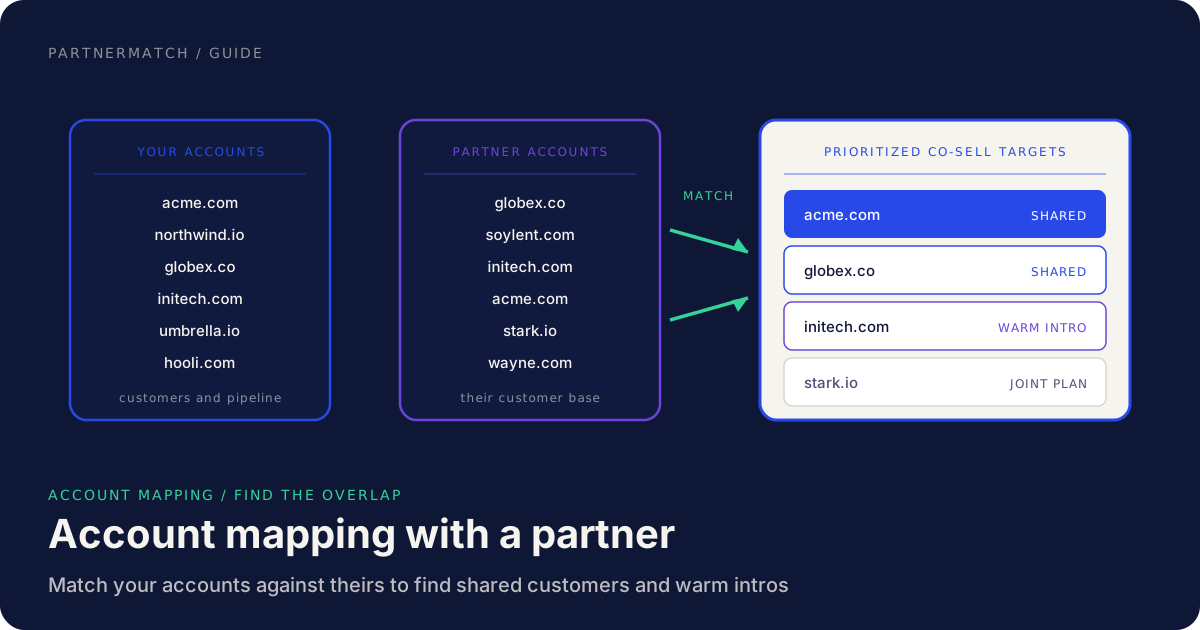
Measure overlap concretely. How many current customers use both products? How many named deals stalled or churned because the integration did not exist? Account mapping, comparing your customer list against a partner's, is the cleanest way to quantify this, and it is worth doing before you commit to any build. Our account mapping guide walks through how to run the overlap analysis without sharing a raw customer list.
Product complementarity
A great partner completes a job your product starts; a poor one competes for the same job. If you sell project management and the partner sells time tracking, the two products chain into one workflow, and the integration makes both stickier. If the partner sells a competing project tool, no amount of customer overlap makes the integration a good idea, because you would be helping a customer stand with one foot in each product.
Complementarity also predicts whether the partner wants to build with you. Two products that complete a workflow have aligned incentives: both win when the customer succeeds. Two products that overlap have a zero-sum edge that surfaces the moment the partnership needs real investment.
Distribution reach
Some partners are also channels. A partner that runs an active marketplace, an app directory, or a partner program can send you installs and qualified leads long after the integration ships. That turns a one-time build into a durable acquisition source, which is why distribution reach earns a partner deep-lane treatment more easily than a comparable partner with no channel.
Be honest about whether the channel is real. A marketplace with thousands of listings and no merchandising is a parking lot, not distribution. A curated directory where your integration gets a category page and a launch email is. Ask what the partner has actually done to drive installs for a comparable integration before you count the reach.
Technical readiness
Every point of build cost you avoid is a point you can spend elsewhere. A partner with a stable, well-documented API, a sandbox, and a predictable app-review process is cheap to build against. A partner with an undocumented API, no sandbox, and a review process that runs through one overloaded engineer is expensive, and the expense is mostly hidden until you are three weeks into email threads.
Score readiness on the artifacts you can inspect before committing: public API docs, a developer portal, a sandbox, a changelog, and a clear path to production. If those exist, the build is a known quantity. If they do not, assume the build costs more than you think and price that into the score.
Commercial alignment
Even a technically clean, high-overlap partner can be a poor fit if the business models collide. A partner that sells to enterprises through a heavy field-sales motion may have no interest in co-marketing a self-serve integration to your SMB base. A partner whose pricing assumes they own the customer relationship may resist an integration that makes you the system of record. Alignment is about whether both sides win in a way each can act on, not just whether the products fit.
Strategic fit
The lightest weight, but not zero. A partner can score well on every operational dimension and still point at the wrong segment or geography for where you are trying to grow this year. Strategic fit is the tiebreaker: when two partners score similarly on the heavy dimensions, the one aligned with this year's motion wins the slot.
Scoring a candidate against the profile
The dimensions become a tool the moment you attach numbers. Score each dimension from one to five, multiply by its weight, and total. Here is a worked hypothetical comparing two candidates so the math is concrete.
| Dimension | Weight | A workflow tool your customers already use | A well-known logo with little overlap |
|---|---|---|---|
| Customer overlap | 30 | 5 (150) | 2 (60) |
| Product complementarity | 20 | 5 (100) | 3 (60) |
| Distribution reach | 20 | 3 (60) | 4 (80) |
| Technical readiness | 15 | 4 (60) | 3 (45) |
| Commercial alignment | 10 | 4 (40) | 2 (20) |
| Strategic fit | 5 | 4 (20) | 3 (15) |
| Total | 430 / 500 | 280 / 500 |
The workflow tool clears a deep-build bar. It sits in your customers' daily work, completes a real workflow, and is cheap enough to build against. The well-known logo does not, despite the recognizable name and the bigger marketplace, because the customer overlap is thin and the commercial incentives are misaligned. That gap is exactly the trap a partner ICP exists to catch: recognition is not fit.
Set thresholds once and hold them. A reasonable starting line: 380 and above is deep-build eligible, 250 to 379 is a lightweight or fast-lane candidate (a directory listing or a shallow connector), and below 250 is a pass. The exact cutoffs matter less than the discipline of scoring before you decide, so the decision survives the next charming call. For how the deep, fast, and no lanes work once a partner clears or misses the bar, see our partnership prioritization framework.
A high score is necessary but not sufficient. It earns a candidate a closer look, not an automatic build. Before you commit engineering, run the top scorers through the anti-pattern checks below, because a few failure modes can hide behind a respectable total.
Anti-patterns: partners that look good and are not
A scorecard catches most bad fits, but a handful of anti-patterns slip through because they inflate the wrong dimension or hide their weakness. Learn to spot them by name.
| Anti-pattern | How it looks | Why it fails | The check |
|---|---|---|---|
| The vanity logo | A recognizable brand everyone wants on the site | Recognition is not customer overlap; adoption stays flat | Demand real usage data, not brand recall |
| The competitor in disguise | High overlap, adjacent product | You help customers straddle two rival tools | Map the workflow; confirm it completes rather than competes |
| The single-prospect request | One deal asks for the integration | Sample size of one is not demand | Require the request across multiple deals or renewals |
| The dead API | Impressive marketing, thin developer docs | Build cost balloons in hidden email threads | Inspect docs, sandbox, and changelog before scoring readiness |
| The enthusiastic contact | One excited person, no mandate | The work dies at their next reorg | Confirm a named owner and a real program on their side |
The vanity logo. The most common and most expensive mistake. A recognizable brand feels like a win regardless of the numbers, and the pull to build "so we can say we integrate with them" is strong. But recognition is not customer overlap. If few of your customers use both products, the integration ships to silence. Demand real usage data before you let a logo override a low overlap score.
The competitor in disguise. High customer overlap can mask a product that competes rather than complements. The overlap is real, but building the integration helps your customers keep one foot in a rival product, which weakens your position over time. Map the actual workflow and confirm the two products chain together rather than substitute for each other.
The single-prospect request. One prospect asks whether you integrate with a tool, and it feels like a signal. It is a sample of one. Real demand is the same integration named across multiple deals, renewals, or churn conversations. Treat a single request as a prompt to check for a pattern, not as the pattern itself.
The dead API. Slick partner marketing can hide a developer experience that does not exist. No sandbox, sparse docs, and a review process that runs through one person turn a "quick build" into a quarter of blocked threads. Inspect the technical artifacts before you score readiness, and when they are thin, price the hidden cost in.
The enthusiastic contact. One motivated person at the partner, with no program and no mandate, is not a partnership. When they change roles or the partner reorganizes, the work stalls with no one to inherit it. Confirm there is a named owner, a real partner program, and a documented process before you rely on a single enthusiast.
None of these show up as a single low number, which is why the anti-pattern pass matters. Score the candidate, then interrogate the score for the failure mode hiding inside it.
Keeping the partner ICP alive
A partner ICP is not a document you write once and file. It is a model of what a great partner looks like for the business you are today, and the business moves.
Your customer ICP shifts as you move upmarket, add a segment, or sharpen your positioning, and the partner ICP has to follow, because customer overlap, the heaviest weight, is defined relative to the customers you are actually winning now. A partner that scored a five on overlap for your SMB base a year ago may score a two once you are selling to mid-market. Revisit the profile at least yearly, ideally as part of the same review where you reset your customer ICP, and re-score any partner still sitting in your active pile against the current model.
The profile also connects to the rest of your program. The dimensions you weight should match the partner thesis you set when you decided what partnerships are for, and the top scorers should feed a real sourcing and outreach motion rather than sitting in a spreadsheet. Our guide on how to source technology partners picks up where the ICP leaves off, turning a scored profile into a pipeline of candidates worth scoring.
Common mistakes, and the fix
Skipping the profile entirely. The fix: write it down before you evaluate a single partner. An unwritten ICP defaults to whoever is loudest, which is the opposite of selection.
Weighting logo recognition over customer overlap. The fix: make customer overlap the heaviest dimension and demand usage data. A recognizable partner with thin overlap is a vanity build, not a strategic one.
Confusing a single request for demand. The fix: require the same integration to show up across multiple deals or renewals before it moves your overlap score. One prospect is a prompt to investigate, not a mandate to build.
Ignoring technical readiness until you are mid-build. The fix: inspect docs, sandbox, and app review before scoring, and price hidden build cost into the number. The dead API is only cheap to avoid before you start.
Treating a high score as a decision. The fix: run top scorers through the anti-pattern checks. The score earns a closer look; the anti-pattern pass earns the build.
Freezing the profile forever. The fix: revisit yearly alongside your customer ICP. Overlap is measured against today's customers, and today keeps changing.
FAQ
What is a partner ICP, in one line? It is a written, scored definition of the technology partner most likely to produce shipped, adopted integrations for your business, the partnership equivalent of a sales team's ideal customer profile.
How is a partner ICP different from a customer ICP? A customer ICP describes the accounts most likely to buy and stay. A partner ICP describes the technology partners most likely to produce integrations your customers adopt. They share the same logic, converting a vague sense of fit into scored criteria, but they score different things, and the partner ICP depends on the customer ICP because customer overlap is measured against the customers you win.
Which dimension matters most? Customer overlap. The best partners already sit in your customers' workflow with a manual step between the two products that an integration removes. Distribution and product fit matter, but overlap is the strongest predictor of whether the integration gets adopted after it ships.
How many dimensions should we score? Six covers a B2B SaaS integration program well: customer overlap, product complementarity, distribution reach, technical readiness, commercial alignment, and strategic fit. Fewer and you miss a failure mode; many more and the model gets unwieldy without adding predictive power.
Should the weights be the same for every company? No. The dimensions are stable, but the weights should reflect your strategy. Retention-focused teams weight overlap and complementarity; growth-focused teams weight distribution. Set the weights once a year and hold them between reviews.
Can a partner with a low score ever be worth it? Rarely as a deep build, but often as a lightweight one. A mid-scoring partner with modest overlap and a cheap build is a fine fast-lane candidate, a directory listing or a shallow connector, without earning a full engineering investment.
How do we handle a well-known partner our customers do not actually use? That is the vanity logo anti-pattern. Score it honestly on customer overlap, which will be low, and resist the pull to build for brand recognition. If you want the association, a lightweight listing captures most of the perceived value at a fraction of the cost.
How often should we update the partner ICP? At least yearly, and ideally whenever your customer ICP shifts. Because customer overlap is measured against the customers you are winning now, a change in who you sell to changes which partners score well.
Further reading
- Market segmentation on Wikipedia, for the broader discipline that the ideal customer profile draws from.
- Target market on Wikipedia, on defining the specific group a product is built to serve.
- Personas study guide from Nielsen Norman Group, on building profiles from real evidence rather than assumptions.
- The value of keeping the right customers in Harvard Business Review, on why fit and retention beat raw acquisition.
- Customer lifetime value on Wikipedia, for quantifying the long-run worth of a well-matched relationship.
The short version
You do not have a shortage of partner opportunities. You have a shortage of a definition for which ones are worth building. A partner ICP supplies that definition: a written, scored profile of the technology partner most likely to produce a shipped, adopted integration for your business.
Score candidates on customer overlap, product complementarity, distribution reach, technical readiness, commercial alignment, and strategic fit, with overlap carrying the most weight. Hold your thresholds, run the top scorers through the anti-pattern checks so no vanity logo or dead API slips through, and revisit the profile every year as your customer base moves. Then point your sourcing and outreach at the partners that clear the bar.
If you want help building your partner ICP and turning it into a ranked pipeline, that is what a Partner Audit is for. We review your product, API, and customer base, then tell you which technology partners fit, which to pass on, and how to get the top ones scoped, built, and launched.