How to source technology partners: inbound, outbound, customer-led
How to source technology partners for B2B SaaS. The three sourcing channels, how to mine customer requests for signal, and how to run outreach that gets replies.
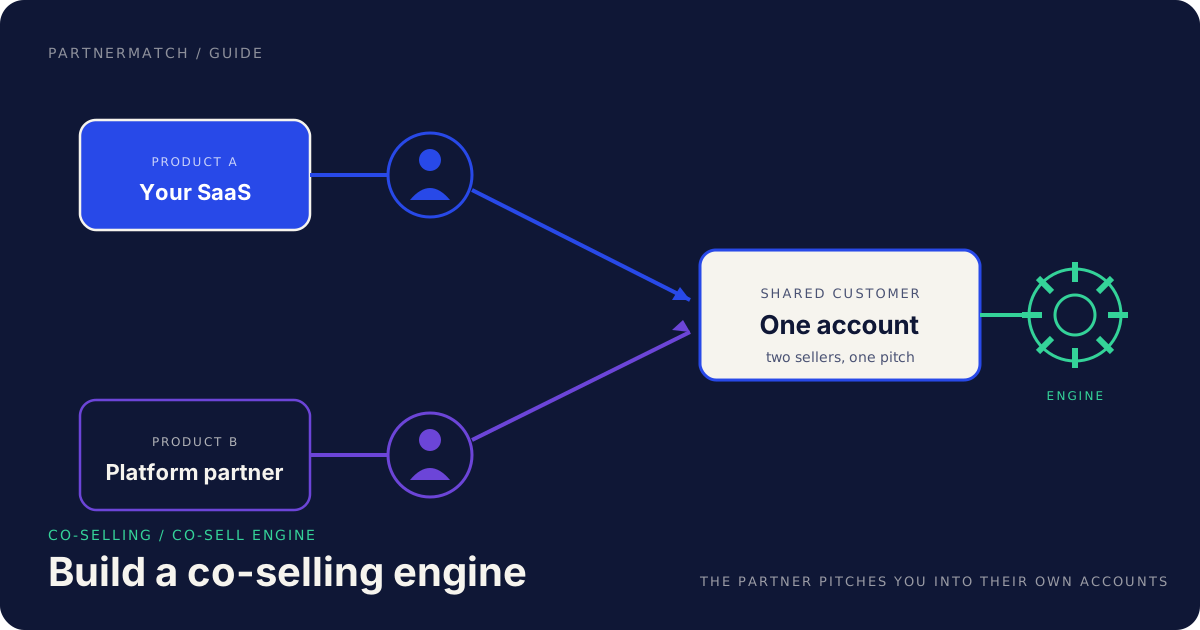
Ask a founder where their partners came from and you usually get one of two answers. Either "they reached out to us," which means the pipeline is whatever happened to land in the inbox, or "we don't really have a process," which means the same thing said honestly. Both leave the most valuable partnerships unbuilt, because the partners worth having rarely email first. They are busy, they have their own roadmap, and they will not find you by accident.
Sourcing technology partners is the deliberate work of building a pipeline of candidates worth evaluating, rather than waiting for one to appear. There are exactly three channels that feed that pipeline: inbound, outbound, and customer-led. Most teams lean entirely on inbound because it requires no effort, and inbound is also the weakest of the three. This post covers all three channels, how to mine customer requests for the highest-quality signal you will find anywhere, and how to run outbound that actually gets a reply.
The 60-second version
If you only read one section, read this one:
- Sourcing is a pipeline problem, not a luck problem. The partners worth having rarely email first, so a program that runs on inbound alone is sourcing the wrong partners.
- There are three channels: inbound (they come to you), outbound (you go to them), and customer-led (your customers point you to them).
- Customer-led is the highest-signal channel. A partner your customers keep asking for already has proven demand and a workflow attached before you spend a dollar.
- Inbound is convenient and weak. It over-represents partners chasing their own ecosystem quota and under-represents the partners your customers actually use.
- Outbound reaches the partners who will never find you, which is often the best ones. It takes real work and a reason for the partner to care.
- Mine customer requests systematically. Tag every integration ask in support, sales, churn, and renewal conversations, then count by frequency to rank candidates.
- Score every sourced candidate against your partner ICP before you invest. Sourcing fills the funnel; the ICP decides what gets built.
- Run all three channels, weighted toward customer-led. A healthy pipeline is mostly customer-driven, topped up with targeted outbound, with inbound triaged rather than trusted.
Why inbound alone is not a sourcing strategy
The default partnership pipeline is whatever showed up uninvited, and that is a selection problem hiding as a convenience.
Inbound partner interest is dominated by partners whose job is to generate ecosystem activity. A partner manager reaches out because their quarterly goal is a number of new integrations, not because your specific customers need to connect the two products. That does not make them bad partners, but it does make inbound a biased sample. The partners who email you are, by definition, the ones actively working their own outbound. The partners your customers actually depend on are often heads-down on their product and will never think to contact you first. If your entire pipeline is inbound, you are systematically over-weighting the eager and under-weighting the essential.
A real sourcing strategy treats inbound as one channel among three, and the weakest one at that. It adds two channels the inbox cannot supply: outbound, which reaches the partners who will never find you, and customer-led, which surfaces the partners your customers are already telling you about. The goal is a pipeline built on demand and fit, not on who happened to be running a campaign the week you checked your email.
The three sourcing channels
Every technology partner you could work with reaches your pipeline through one of three channels. Understanding what each channel is good and bad at tells you how much to lean on it.
| Channel | Who initiates | Signal quality | Effort | Main risk |
|---|---|---|---|---|
| Customer-led | Your customers | Highest | Low to medium | Under-mined; requests go untracked |
| Outbound | You | High when targeted | High | Ignored without a real reason to care |
| Inbound | The partner | Low to medium | Lowest | Biased toward ecosystem-quota partners |
Customer-led. Your customers tell you which tools they use alongside your product, and which manual workflows they would pay to remove. This is the highest-signal channel because the demand is proven before you spend anything: real customers, a real workflow, a real reason to connect. The catch is that the signal is usually scattered across support tickets, sales calls, and renewal conversations, and nobody is collecting it. The channel is not weak; it is under-mined. The next section is about fixing that.
Outbound. You identify partners that fit your profile and reach out to them directly. This is the channel that reaches the partners who will never appear in your inbox, which is frequently where the best ones are. It is also the most effortful, because a cold approach to a partner with their own roadmap needs a concrete reason for them to care. Done well, outbound is how you turn a scored partner ICP into actual conversations. Done as a mass "want to integrate?" blast, it gets ignored.
Inbound. Partners come to you. It costs nothing and it will never stop, which is exactly why it is dangerous to rely on. Inbound is worth triaging, because occasionally a genuinely great partner does reach out, but it should be treated as a lead to qualify against your profile, not as a pipeline to trust. A charming inbound with thin customer overlap is still a poor fit; the channel does not change the criteria.
The mix matters. A healthy pipeline is weighted toward customer-led, topped up with targeted outbound, and triaged, not trusted, on inbound. A pipeline that is all inbound is sourcing the wrong partners with confidence.
Mining customer requests for signal
Customer-led sourcing sounds obvious and is almost never done, because the signal arrives one fragment at a time and nobody is assigned to collect it. A prospect mentions a tool on a sales call. A customer files a ticket asking whether you connect to something. A churned account cites a missing integration in the exit survey. Individually, each is easy to forget. Collected and counted, they are the highest-quality partner pipeline you will ever build.
The voice of the customer is a well-established discipline in product and marketing, and integration requests are one of its cleanest signals, because a customer asking to connect two products is telling you exactly where their workflow breaks. The work is to capture that signal systematically rather than anecdotally.
Set up a simple capture system across every place a request can surface.
| Source | What to capture | Who captures it |
|---|---|---|
| Support tickets | Every "do you integrate with X" question | Support, via a tag |
| Sales calls | Tools the prospect uses and asks to connect | Sales, in the CRM |
| Churn and exit surveys | Missing integrations cited as a reason to leave | Success or ops |
| Renewal conversations | Integrations requested to justify staying | Account managers |
| Public review sites | Recurring integration requests in feedback | Marketing or product |
The mechanism can be low-tech: a single field in your CRM, a tag in your help desk, a shared sheet. What matters is that every request lands in one place with the partner named, so you can count. Once a quarter, tally the requests by partner and rank them by frequency. The partners named most often, especially across multiple sources, are your strongest customer-led candidates, and the count is itself the evidence of demand.
This ranked list does two jobs. It tells you which partners to prioritize, and it gives you the single most persuasive line in any outreach: "a number of our shared customers have asked us to connect our products." That is not a cold pitch. That is a demand signal you can put in the first sentence, which is what makes customer-led sourcing feed straight into effective outbound.
Running outbound that gets a reply
Outbound is where most sourcing efforts die, because they read as spam. "We love your product, want to explore an integration?" gives the partner no reason to spend time on you, so they do not. Effective outbound is specific, gives the partner a concrete reason to care, and leads with evidence.
The strongest reason to care is shared customer demand, which is why the customer-led channel and the outbound channel work best together. If your request mining shows that twelve of your customers also use a partner's product and have asked you to connect them, your outbound writes itself. You are not asking for a favor; you are surfacing a mutual opportunity backed by named accounts.
A good outbound message does four things:
- Leads with the demand signal. Open with the shared-customer evidence, not with a compliment. "We have twenty-plus mutual customers, and several have asked us to integrate" earns a reply that "we admire your product" never will.
- Names the specific workflow. Describe the exact manual step the integration would remove, so the partner sees a real use case rather than a vague ambition.
- Makes the ask small and concrete. Propose a short scoping call, not a signed partnership. The first yes should be cheap.
- Reaches the right person. A partnerships or product owner, not a generic sales inbox. Getting to the right person is half the battle, and warm intros through mutual customers or investors beat cold every time.
The mechanics of a cold approach matter too. Keep it short, make the subject line about the mutual customers, and follow up once or twice with new information rather than a nudge. The norms of cold email apply directly: relevance and brevity beat volume, and a message that respects the reader's time is the one that gets answered. Broader lead generation practice says the same thing, that targeted outreach to a qualified list outperforms a wide, generic blast.
Warm paths deserve special mention. A referral from a mutual customer, an investor, or a shared connection turns a cold outbound into a warm one, and the reply rate difference is large. This is the same dynamic that makes referral marketing effective in customer acquisition: a trusted introduction carries credibility that no cold message can manufacture. When your request mining surfaces a high-value partner, check whether any shared customer or investor can make the introduction before you send anything cold.
From sourced candidates to a real pipeline
Sourcing fills the funnel. It does not decide what to build. The discipline that keeps a full funnel from becoming a full backlog is scoring every sourced candidate against your partner ICP before you commit engineering.
A candidate from any channel, a customer request named twenty times, a promising outbound reply, a charming inbound, gets the same treatment: score it on customer overlap, product complementarity, distribution reach, technical readiness, commercial alignment, and strategic fit. The channel that produced the candidate is a hint about signal quality, not a substitute for the score. A customer-led candidate usually scores high on overlap because the demand is proven, but it still has to clear the bar on the other dimensions. Our guide on how to define your partner ICP covers the scoring model in full; sourcing is the step that feeds it candidates worth scoring.
Once scored, candidates flow into the same triage every partnership goes through: a small number worth a deep build, more worth a lightweight listing, and the rest a clean pass. Sourcing does not change that math; it just ensures the top of the funnel is full of the right kind of candidate. Our partnership prioritization framework covers how the deep, fast, and no lanes work once a scored candidate is ready to sort.
| Stage | What happens | Output |
|---|---|---|
| Source | Fill the funnel from three channels | A list of named candidates |
| Score | Rate each against the partner ICP | A ranked shortlist |
| Triage | Sort into deep, fast, or no | A committed build plan |
The pipeline is healthy when the sourcing step keeps the funnel full of customer-led and targeted-outbound candidates, the scoring step is honest, and the triage step respects capacity. Skip the sourcing step and the funnel fills with whatever inbound arrived, which is the problem this whole post exists to solve.
Common mistakes, and the fix
Running on inbound alone. The fix: treat inbound as one channel of three, and the weakest. Add outbound and customer-led so the pipeline reflects demand and fit, not who happened to email.
Letting customer requests evaporate. The fix: tag and capture every integration request across support, sales, churn, and renewals, then count by frequency each quarter. The signal is worthless scattered and priceless collected.
Sending generic outbound. The fix: lead with shared-customer evidence, name the specific workflow, and make the first ask a short call. A cold "want to integrate?" earns silence; a demand-backed message earns a reply.
Ignoring warm paths. The fix: check for a mutual customer or investor who can introduce you before sending anything cold. A warm intro outperforms the best cold message.
Confusing a full funnel with a good pipeline. The fix: score every sourced candidate against your partner ICP before committing. Sourcing fills the funnel; the ICP and triage decide what gets built.
FAQ
What does it mean to source technology partners? It is the deliberate work of building a pipeline of partner candidates worth evaluating, rather than waiting for partners to appear in your inbox. Sourcing runs through three channels, inbound, outbound, and customer-led, and feeds candidates into scoring and triage.
What are the three sourcing channels? Inbound, where partners come to you; outbound, where you reach out to partners that fit your profile; and customer-led, where your customers point you to the tools they already use. Customer-led is the highest-signal channel; inbound is the weakest.
Why is inbound the weakest channel? Because it over-represents partners chasing their own ecosystem-activity quota and under-represents the partners your customers actually use, who are usually too heads-down on their product to email you first. Inbound is worth triaging but not trusting.
How do we mine customer requests for partner signal? Capture every integration request across support tickets, sales calls, churn surveys, and renewal conversations, with the partner named, in one place. Count by frequency each quarter. The partners named most often, especially across multiple sources, are your strongest candidates, and the count is your demand evidence.
What makes outbound to a partner actually work? Leading with shared-customer demand rather than a compliment, naming the specific workflow the integration would remove, making the first ask a short scoping call, and reaching the right owner, ideally through a warm introduction. Generic "want to integrate?" outreach gets ignored.
How is sourcing partners different from scoring them? Sourcing fills the funnel with candidates; scoring decides which ones are worth building. Every sourced candidate, from any channel, should be scored against your partner ICP before you commit engineering. The channel is a signal-quality hint, not a substitute for the score.
Should we run all three channels at once? Yes, weighted toward customer-led. A healthy pipeline is mostly customer-driven, topped up with targeted outbound, with inbound triaged rather than relied on. Running only inbound means sourcing the wrong partners with confidence.
Who owns sourcing at an early-stage company? Usually a founder or the first partnerships hire, running the request-mining system and the outbound directly. It does not require a team; it requires a place to capture requests, a quarterly count, and the discipline to send targeted outbound rather than wait.
Further reading
- Lead generation on Wikipedia, on building a qualified pipeline through targeted outreach.
- Referral marketing on Wikipedia, on why trusted introductions outperform cold approaches.
- Voice of the customer on Wikipedia, on capturing customer signals systematically.
- Cold email on Wikipedia, on the norms that make direct outreach land.
- The value of keeping the right customers in Harvard Business Review, on why demand-led selection beats volume.
The short version
The partners worth having rarely email first, so a pipeline that runs on inbound alone is sourcing the wrong partners. Sourcing technology partners is the deliberate work of filling the funnel through three channels: inbound, outbound, and customer-led.
Lean hardest on customer-led, because a partner your customers keep asking for arrives with demand already proven. Mine those requests systematically, tag every integration ask across support, sales, churn, and renewals, and count by frequency. Use that demand signal to power targeted outbound that leads with shared customers and names a real workflow, and favor warm introductions over cold. Triage inbound rather than trusting it. Then score every sourced candidate against your partner ICP so a full funnel becomes a real pipeline.
If you want help turning your customer signals into a ranked partner pipeline and running the outreach, that is what a Partner Audit is for. We mine your customer requests, source and score the candidates that fit, and take the top ones from first conversation to shipped integration.