Turning marketplace installs into pipeline
An independent guide to marketplace attribution. How to track installs to opportunities and revenue, connect activation to expansion, and build a model that tells you which installs are worth more.
You have installs now. The counter is climbing, the reviews are landing, the rank is moving, and then someone in the room asks the question that stops the meeting: how much revenue did any of this produce. If the honest answer is a shrug, the marketplace program is in danger, not because it is failing, but because nobody can prove it is working. Installs are easy to count and easy to celebrate, and they are also the last number that matters on its own. What matters is whether an install becomes an active customer, an opportunity, and eventually expansion, and whether you can see that chain clearly enough to fund more of it.
This is an independent guide to marketplace attribution, whatever platform you launched on. The specific analytics differ across marketplaces, and each exposes a different set of install and usage events, so treat the platform details as things to confirm in that marketplace's current documentation. What does not change is the problem: an install is the top of a funnel, not the bottom, and the work is to connect that install through activation to a tracked opportunity and to the expansion that follows, so you can tell which installs are worth more and put your effort there. A program that counts installs and stops is flying blind, no matter how good the counter looks.
It pairs with our guide to how marketplaces rank apps, our playbook for driving installs in the first 90 days, and our guide to influenced versus sourced pipeline, so you can place attribution inside the wider work of getting found, getting installed, and getting paid.
The 60-second version
- An install is the top of a funnel, not the bottom. Counting installs without tracking what they become tells you volume, not value, and volume alone does not fund a program.
- The chain is install to activation to opportunity to expansion. Attribution is the work of connecting each step to the next so you can see the whole path from a tile click to revenue.
- Instrument the join early. You cannot attribute what you did not capture, so pass an identifier at install time that lets you connect the marketplace event to the account in your CRM.
- Activation is the hinge. An install that never activates almost never becomes pipeline, so activation is both a product signal and the first real predictor of revenue.
- Choose an attribution model you can defend. Sourced, influenced, and assisted are different claims. Pick one you can explain and apply it consistently, rather than taking full credit everywhere.
- In-app upsell is where installs pay off. The expansion moment lives inside the workflow the install created, so meet the customer there with the next step, not in a separate campaign.
- Report the chain, not the counter. A dashboard that shows installs, activation, opportunities, and expansion together earns the program its next round of investment.
Why the install is the top of the funnel, not the bottom
An install is a click that says a customer is willing to try. It is genuinely good news, and it is also the least committed thing a customer can do. Treating the install as the outcome is like treating a free-trial signup as revenue: it counts the intent and ignores everything that has to happen for the intent to turn into money. Most installs, left alone, do not become customers. They connect the app, poke at it, and either activate or drift away, and only a fraction reach the point of paying more. If your reporting stops at the install, you cannot tell the difference between a program producing revenue and one producing abandoned connections, and the two look identical on the counter.
This matters because the install count is the number most likely to get a marketplace program defunded. It goes up, everyone is happy for a quarter, and then someone connects the marketing spend to the revenue and finds no line between them. The problem was never the installs. It was that nobody tracked what the installs became, so there was no way to show that the program produced pipeline, and a program that cannot show pipeline loses the argument for its budget to one that can. Attribution is how you win that argument, not by inflating the numbers, but by making the real chain from install to revenue visible.
The chain has four links, and each one loses some customers, which is the ordinary shape of a conversion funnel: more installs than activations, more activations than opportunities, more opportunities than expansions. The job of attribution is to instrument every link so you can see where customers fall out and how much revenue survives to the end. Once you can see the funnel, you can improve it. Until you can, you are guessing.
| Link | What it measures | Why it is not the end |
|---|---|---|
| Install | A customer connected the app | Most installs never activate on their own |
| Activation | The customer reached the promised outcome | An activated customer still has to buy or expand |
| Opportunity | A tracked deal tied to the install | An opportunity is a chance at revenue, not revenue |
| Expansion | The install drove more spend | This is the number that funds the program |
Instrument the join before you need it
The single most common attribution failure is not a bad model. It is missing data. You cannot connect an install to an opportunity if, at install time, you never captured anything that ties the marketplace event to the account in your CRM. Teams discover this months later, when someone asks for the revenue number and the answer is that the two systems were never joined, so the install records and the deal records sit in separate silos with no key between them. By then the early installs are unrecoverable. The lesson is to instrument the join before you launch, not after someone asks for the report.
The mechanics vary by marketplace, but the shape is consistent. When a customer installs, you receive some event, an OAuth callback, a webhook, a redirect with parameters, that identifies the installing account or user. Capture that identifier and carry it into your own systems so the same customer can be recognized on both sides. From there you can match the marketplace install to the CRM account, and every downstream event, activation, opportunity, expansion, hangs off that match. Without the identifier captured at the moment of install, the whole chain is broken at link one.
A short instrumentation checklist that pays for itself the first time you run a report:
- Capture an install identifier at install time. Whatever the marketplace hands you at connect, store it against the account so you can join later. This is the load-bearing step.
- Record an activation event. Fire an internal event when the customer reaches the promised outcome, not just when they connect, so activation is a queryable milestone rather than a guess.
- Stamp the source on the CRM record. When an install becomes a lead or opportunity, mark that it came from the marketplace, and which one, so sourced pipeline is a field, not a reconstruction.
- Keep the identifier consistent across systems. Use one key for the same customer in the marketplace data, the product analytics, and the CRM, or the join quietly breaks and nobody notices until the numbers disagree.
- Log timestamps for each step. Time from install to activation to opportunity is one of the most useful things you can report, and it costs nothing if you capture it as you go.
Getting this right up front is unglamorous and it is the difference between a program you can prove and one you can only assert. Attribution in marketing is fundamentally a data-joining problem before it is a modeling problem, and the join has to exist in the data or no model can recover it.
Activation is the hinge between install and revenue
Of the four links in the chain, activation is the one that predicts everything after it. An install that never activates almost never becomes an opportunity, because a customer who never reached the promised outcome has no reason to buy more of something that did not work for them. An install that does activate, by contrast, has felt the value firsthand, which is the precondition for every expansion conversation that follows. That makes activation both a product signal, which we treat as a growth job in the first 90 days, and the first real revenue predictor in your attribution model.
Practically, this means activation deserves its own event and its own place in the report, sitting between install and opportunity. Watching activation rate tells you how much of your install volume is even eligible to become pipeline. If activation is low, no attribution model will save you, because there is nothing downstream to attribute; the fix is upstream, in the first run. If activation is healthy, then activation becomes the qualified pool you focus your pipeline efforts on, because those are the customers who have already seen what the product does. Nielsen Norman Group on analytics and user experience makes the connected point that behavioral analytics are only as useful as the qualitative understanding behind them, so pair the activation number with an understanding of why customers stall, or you will optimize the metric without moving the revenue.
Reading activation as a cohort rather than a lump is where it gets useful. Grouping installs by the week or the channel they arrived through, then following each group's activation and opportunity rate over time, is ordinary cohort analysis applied to a marketplace, and it answers questions the aggregate hides. Did the co-marketing burst produce installs that activated as well as the seeded ones, or did it inflate the install count with browsers who never reached value. The aggregate says installs went up. The cohort says whether they were worth anything.
Choosing an attribution model you can defend
Once the chain is instrumented, you have to decide how to assign credit, and this is where marketplace programs most often overreach. The temptation is to claim every deal an install ever touched as sourced by the marketplace, which is both indefensible and self-defeating, because the moment a skeptical colleague finds one deal that would have closed anyway, the whole number loses credibility. The durable approach is to pick a model you can explain, apply it consistently, and be honest about what it does and does not claim.
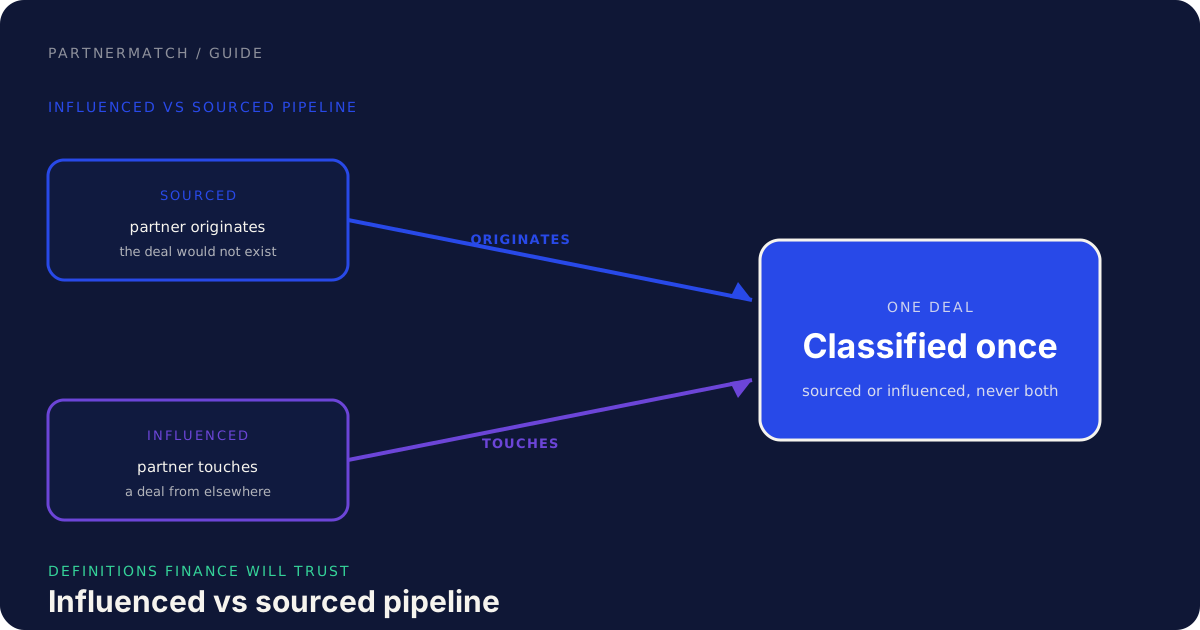
The distinction that matters most is between sourced and influenced, which we cover in depth in influenced versus sourced pipeline. A sourced opportunity is one the install created, where without the marketplace there would be no deal. An influenced opportunity is one the install touched or accelerated but did not originate. Both are real, and they are different claims. Reporting them separately is more credible than blending them into one inflated number, and it is more useful, because the two respond to different investments.
| Model | The claim it makes | When it fits | The risk if misused |
|---|---|---|---|
| Sourced | The install created the deal | The opportunity would not exist without the marketplace | Claiming deals that were already in flight |
| Influenced | The install touched or sped up the deal | The marketplace was one of several factors | Taking full credit for a shared effect |
| Assisted | The install played a supporting role | A light-touch contribution worth noting | Double-counting across teams |
The right model also depends on who reads the report. A finance audience wants sourced revenue, the conservative number they can put in a plan. A partnerships audience wants influenced pipeline, because it captures the fuller effect of the ecosystem. The mistake is using the generous number with the conservative audience, which reads as spin and costs you trust. Match the model to the claim, state which one you are using, and let the same install roll up differently for different readers rather than picking one inflated figure for everyone.
In-app upsell: where installs become expansion
The last link, expansion, is the one that actually funds the program, and it lives in a specific place: inside the workflow the install created. A customer who installed your app and activated it is now using the joined workflow every day, and that is exactly where the next step should meet them, in the app, at the moment the next step is relevant, rather than in a separate email campaign they will ignore. The install did the hard work of putting you inside the customer's daily tools. In-app upsell is collecting on that position.
The reason in-app beats out-of-app for this is context. A customer hitting the limit of the free tier, or trying to do the thing the paid plan enables, is at the moment of highest intent, and an upsell that appears right there, tied to what they were doing, converts far better than a generic message sent later. This is the same logic as meeting a buyer where they already are, applied to expansion: the workflow is the context, and the upsell is the natural next step within it. Value that the customer has already felt, offered at the moment they want more of it, is a much easier yes than value described to them in the abstract.
A few principles keep in-app upsell effective without making the product feel like a billboard:
- Tie the offer to the moment. Surface the upsell when the customer hits the boundary of what they have, not at a random interval, so the offer answers a need they are feeling right now.
- Lead with the value they already know. The best upsell extends a workflow the customer already relies on, so frame it as more of a good thing rather than a new thing to learn.
- Make the next step small. A single clear action to expand converts better than a plan comparison that sends the customer off to think about it.
- Instrument the upsell too. The in-app expansion event belongs in the same attribution chain as the install, so the report can show the full path from tile click to expanded spend.
- Do not crowd the workflow. An upsell that interrupts the job the customer came to do costs more goodwill than it earns. Offer, do not nag.
Because expansion is the number that funds the program, it is also the number that most justifies keeping activation and retention healthy. Retaining and expanding an existing customer is cheaper than acquiring a new one, a point HBR makes about keeping the right customers, and the marketplace install is what put you in the position to do it.
Common mistakes, and the fix
Stopping the report at installs. The fix: report the whole chain, install to activation to opportunity to expansion, together. The install count tells you volume, not value, and a program that cannot show pipeline loses its budget to one that can.
Instrumenting the join too late. The fix: capture an install identifier at install time and carry it into your CRM before you launch. You cannot attribute what you never captured, and the early installs are unrecoverable once the moment passes.
Ignoring activation in the model. The fix: treat activation as its own event and the first revenue predictor, sitting between install and opportunity. An install that never activates almost never becomes pipeline, so a low activation rate is an upstream problem no model can fix.
Claiming every deal as sourced. The fix: separate sourced, influenced, and assisted, apply one model consistently, and match it to the audience. One indefensible claim discovered by a skeptic costs the credibility of the whole number.
Upselling outside the workflow. The fix: meet the customer in the app, at the moment the next step is relevant, tied to the value they already feel. A generic out-of-app campaign ignores the context the install gave you and converts far worse than an in-context offer.
Reading activation as a lump. The fix: read it as cohorts by week and channel, so you can see whether a given source produced installs that activated or just inflated the count. The aggregate hides the difference the cohort reveals.
FAQ
Why is counting installs not enough? Because an install is the top of a funnel, not the bottom. It measures that a customer was willing to try, which is the least committed thing they can do, and most installs never activate or expand on their own. A report that stops at the install count cannot distinguish a program producing revenue from one producing abandoned connections, and that is exactly the ambiguity that gets a marketplace program defunded when someone finally connects the spend to the revenue.
What do I need to capture to attribute installs to revenue? At minimum, an identifier at install time that ties the marketplace event to the account in your CRM, plus an activation event and a source stamp on the resulting opportunity. Attribution is a data-joining problem before it is a modeling problem, so the identifier has to exist in the data at the moment of install or no model can recover the connection later. Instrument this before you launch, because the early installs cannot be joined retroactively once the moment has passed.
Why is activation so central to attribution? Because activation is the strongest predictor of everything downstream. An install that never reached the promised outcome almost never becomes an opportunity, since the customer has no felt reason to buy more, while an activated customer has experienced the value that every expansion conversation depends on. That makes activation both a product signal and the qualified pool you focus pipeline efforts on, and it means a low activation rate is an upstream problem no attribution model can paper over.
What is the difference between sourced and influenced pipeline? A sourced opportunity is one the install created, where without the marketplace there would be no deal. An influenced opportunity is one the install touched or accelerated but did not originate. Both are real and they are different claims, so reporting them separately is more credible and more useful than blending them into one number. We cover the distinction in depth in influenced versus sourced pipeline, and the short version is to match the model to the audience and state which one you are using.
Where should in-app upsell appear? Inside the workflow the install created, at the moment the next step becomes relevant, rather than in a separate campaign. A customer hitting the boundary of their current plan or trying to do the thing the paid tier enables is at peak intent, and an offer tied to that moment converts far better than a generic message sent later. The install put you inside the customer's daily tools, and in-app upsell collects on that position by extending value the customer already feels.
How does attribution connect to ranking and the first 90 days? The first 90 days manufactures installs and activation, and ranking compounds the visibility that produces more of them. Attribution is the layer that turns all of that into a revenue story you can defend, by connecting each install through activation to a tracked opportunity and expansion. Without attribution, the install and rank numbers look good but cannot be tied to money; with it, the whole program becomes a chain you can show and therefore a chain you can fund.
Further reading
- How marketplaces rank apps for the flywheel that produces the installs you are attributing.
- Driving installs in the first 90 days for the seeding and activation work that feeds the top of this funnel.
- Influenced versus sourced pipeline for the attribution model distinction this guide relies on.
- Nielsen Norman Group on analytics and user experience for why behavioral metrics need qualitative understanding behind them.
- Attribution in marketing on Wikipedia for the general models of assigning credit across touchpoints.
- Sales funnel on Wikipedia for the funnel shape that install-to-expansion follows.
- Cohort analysis on Wikipedia for reading activation and opportunity rates by the group installs arrived in.
- HBR on the value of keeping the right customers for why expansion of an existing install beats chasing a new one.
The short version
An install is the top of a funnel, not the bottom, and a marketplace program that counts installs without tracking what they become measures volume rather than value. The work of attribution is to connect the chain, install to activation to opportunity to expansion, so you can show the path from a tile click to revenue and fund more of what works. That starts with instrumenting the join before you launch, capturing an identifier at install time that ties the marketplace event to the account in your CRM, because you cannot attribute what you never captured. Activation is the hinge, the first real predictor of revenue and the qualified pool worth focusing on, so read it as cohorts rather than a lump. Choose an attribution model you can defend, keeping sourced and influenced separate and matching each to its audience rather than claiming every deal. And collect on the install where it put you, inside the customer's workflow, with an in-app upsell tied to the moment the next step becomes relevant. Report the whole chain, not the counter, and the program earns its next round of investment.
If you want help turning installs into a pipeline story you can defend, from instrumenting the join to building the activation-to-expansion report, a Partner Audit reviews your product, your integration, and your marketplace potential, then hands you a concrete plan for tracking installs all the way to revenue.