Developer onboarding: from signup to first call in minutes
Developer onboarding that gets a partner engineer from signup to first successful API call in minutes. The path to first success, the friction points that kill it, and how to measure time to first call.
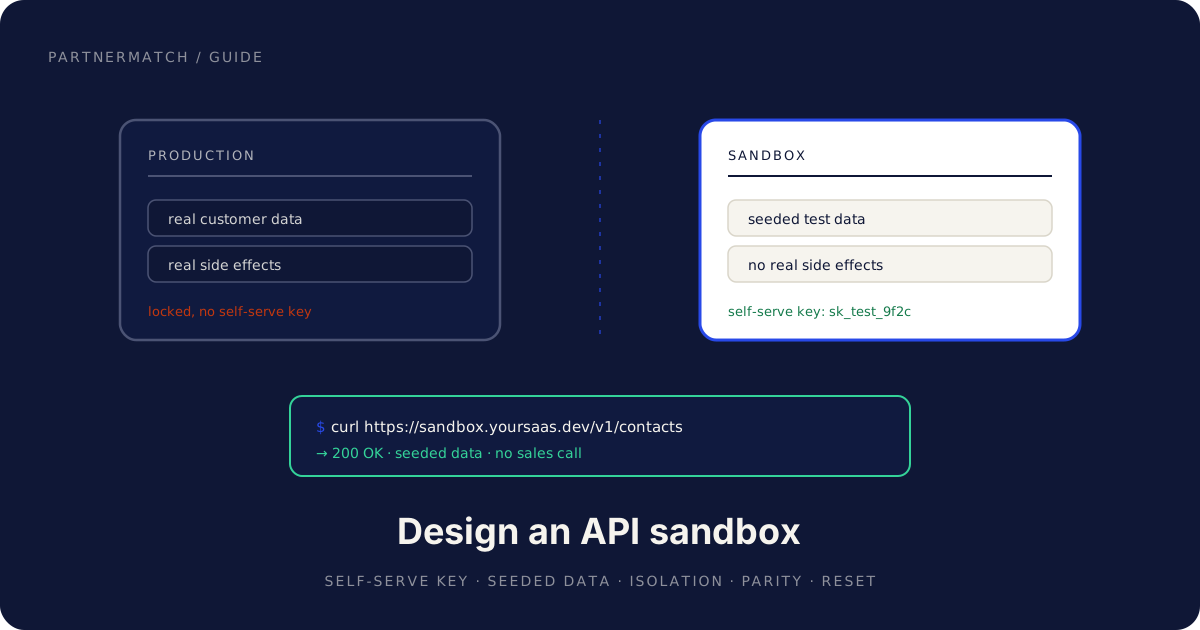
A partner engineer signs up for your API at 9 PM. They have an hour before they lose the thread, and a manager expecting an integration estimate in the morning. The clock that matters to your business starts now, and it is not measured in days or features. It is measured in the minutes between that signup and the first time your API returns a successful response on their machine. Everything good in the partnership is downstream of that first 200 OK, and everything that delays it is quietly costing you the deal.
Most teams obsess over the API surface and underinvest in the path to it. They have endpoints, auth, and a reference, but getting from a cold signup to a first successful call is an obstacle course of unexplained steps, gated credentials, and dead ends. The engineer does not file a complaint. They just decide your API is harder to work with than the alternative on their list, pad the estimate, and your integration drops a tier in their roadmap.
This guide is about developer onboarding as the discipline of getting a developer to first success fast: the path from signup to first call, the friction points that kill it, and the one metric, time to first call, that tells you whether the path works. It pairs with our guide to making your API partner-ready and our guide to API documentation best practices, which cover the surrounding surface a partner engineer evaluates.
The 60-second version
- First success is the whole game. A developer's first
200 OKis the moment they believe your API is real, and everything else is downstream of it. - Measure time to first call with a stopwatch, on a clean machine, as the single headline number for your onboarding.
- The path has four moves: get a key, make a call, create an object, receive an event. Each one ends in proof.
- Self-serve credentials are non-negotiable. Any gate that requires emailing a human resets an evaluating engineer's attention to zero.
- A sandbox with realistic seed data lets a developer build and demo before they have any data of their own.
- Friction hides in the gaps between steps, the unexplained config, the second tab of docs, the value that turns out to be
string. - Onboarding is a product with a funnel. Instrument each step, find the drop-off, and treat it as a bug.
Why first success decides everything
There is a single moment that decides whether a developer keeps going: the first time your API returns a successful response that they made happen. Before that moment, your API is a claim. After it, your API is a thing that works on their machine, and the psychology flips from skeptical evaluation to "what can I build." Nielsen Norman Group's research on onboarding makes the general point that the goal of onboarding is to get a new user to value quickly, and for an API the unit of value is unambiguous: a call that succeeds.
The reason this matters so much for partnerships specifically is that the developer evaluating you is not committed. They are comparing you against other integrations, on a deadline, between other tasks. Their patience is a budget, and every step that spends it without producing a success draws down the account. If they reach first success before the budget runs out, they keep investing. If they do not, they stop, and you never find out why, because nobody emails you to say "I gave up at the auth step."
This also reframes what onboarding is. It is not your signup form, and it is not your welcome email. Developer onboarding is the entire path from "I want to try this" to "it works," including every doc page, every credential, every config value, and every error along the way. The form is a small part of it. The part that actually decides the outcome is whether the engineer can string together a sequence of steps that each end in proof, without stalling, in the time they have budgeted.
There is a newer developer to design for, too. AI coding assistants now read your docs and attempt the onboarding path on a developer's behalf, generating the first call from your quickstart. An onboarding path that a human can follow with a little patience often defeats an agent entirely, because the agent cannot guess at the unexplained config step a human would muddle through. Designing the path to be unambiguous helps both, which is part of why a scriptable surface like a CLI pays off, covered in why your B2B SaaS needs a CLI.
The path from signup to first call
The onboarding path that works is short and every step ends in something the developer can see. It is the same shape as a good quickstart, because the quickstart is the documented version of the onboarding path:
- Get a key. Self-serve, no sales call, no "request access" form. The engineer evaluating you will not email anyone, so credentials behind a human gate end the evaluation before it starts.
- Make a call. A single copy-pasteable request, usually a
GET, that returns200 OKagainst real or seeded data. This is the moment that earns trust, and it should arrive within the first few minutes. - Create an object. A
POSTthat creates a record the developer can see, so they know writes work, not just reads. This is where the API stops being a read-only demo and becomes something they can build on. - Receive an event. An action fires a webhook and they receive it, which proves the integration can stay in sync without polling. This is the step that turns a toy into a plausible production integration.
Each step is a checkpoint, and the design rule is that every step must be self-contained. The developer should never have to open a second tab of docs to complete a step. If making the first call requires reading the auth concepts page, the path has a hidden dependency that will stall a fraction of developers exactly when their patience is thinnest. Fold the context the step needs into the step itself.
The order matters, too. Lead with the read, because a GET that returns data is the fastest possible proof and the lowest-risk first action. Then the write, then the event, in increasing order of how much the developer has to trust you. By the time they have received a webhook, they have seen reads, writes, and sync work end to end, which is enough to estimate a real integration. Everything beyond that belongs in guides and reference, not in the onboarding path. The path's job is first success, not completeness. We cover the wider sandbox requirements this path depends on in the API sandbox guide.
Friction points that kill onboarding
Onboarding rarely dies at a single dramatic wall. It dies in the accumulation of small frictions, each of which loses a fraction of developers, until the path that looked fine on paper converts a fraction of the engineers who started it. The frictions hide in the gaps between the steps above, which is exactly where teams stop looking because each individual step "works."
Here are the friction points that most reliably kill an onboarding path, and the fix for each:
| Friction point | What it does | The fix |
|---|---|---|
| Credentials behind a human gate | Resets attention to zero while the developer waits | Self-serve key generation, no email, no form |
| An empty account | Nothing to read, nothing to demo against | Seed the sandbox with realistic data |
| A step that needs a second tab | Breaks flow exactly when patience is thin | Fold the context into the step |
| An unexplained config value | The developer guesses, guesses wrong, stalls | Show every value with a real example |
Example values like string and 123 |
The developer cannot tell a placeholder from a real value | Use realistic values in every example |
| A first call that fails silently | The developer cannot tell if it is their fault or yours | A clear error with a cause and a fix |
The most expensive friction on that list is credentials behind a human gate, because it fails before the developer has invested anything, when it is easiest to walk away. A "request access" form that promises a response in one to two business days is, for an engineer evaluating you at 9 PM, indistinguishable from a wall. The whole point of self-serve onboarding is that the evaluation happens on the developer's schedule, not yours, and any synchronous dependency on a human breaks that.
The subtlest friction is the unexplained config value: a base URL, a region, an account ID, a content-type header that the example assumes the developer already knows. Each one is a small fork in the path where a fraction of developers take the wrong branch and stall. The principle that helps here is progressive disclosure, which Nielsen Norman Group describes in its article on the technique: show the developer exactly what they need for this step, defer the advanced options to later, and never make them carry context they have not been given. An onboarding path that respects progressive disclosure feels like a guided line; one that does not feels like a maze where every turn assumes knowledge the developer does not yet have.
A reliable way to find your own friction points is to watch a developer who has never seen your product attempt the path while you stay silent. Every place they hesitate, re-read, or guess is a friction point, and the silence is the point: a real partner engineer will not narrate their confusion to you, they will just quietly give up. The places where your test subject stalls are your onboarding backlog, in priority order.
Measuring time to first call
Onboarding feels subjective, so teams argue about it from vibes instead of measuring it. It is more measurable than it looks, and the headline number is time to first call: the elapsed time from the start of signup to the first successful API response. It is the single most honest number about your developer onboarding, because it captures every step and every friction in one figure, and it is exactly what a partner engineer feels.
Measure it the way it will actually be experienced. On a clean machine, with none of your internal tooling installed, with a stopwatch, starting from the moment someone decides to try your API and ending at the first 200 OK. The benchmark to beat is under five minutes. Every minute past five is a minute a developer spends deciding you are harder to work with than the alternative on their list, and the regression from a good number to a bad one is almost always a single new friction point you can find and remove.
Time to first call is the headline, but onboarding is a funnel, and the funnel tells you where the headline number comes from:
| Metric | What it tells you | A bad number looks like |
|---|---|---|
| Time to first call | Whether the whole path is fast enough | Median over ten minutes |
| Signup completion rate | Whether the front door works at all | Drop-off before a key is issued |
| Step-by-step drop-off | Which specific step loses developers | A cliff at the auth or webhook step |
| First-call success rate | Whether the documented call actually works | Many failed first attempts |
| Support tickets per step | Where the docs fail to self-serve | A cluster on one config value |
The most useful of these is step-by-step drop-off, because it converts the abstract complaint "onboarding is bad" into a specific bug: "we lose a third of developers between getting a key and making their first call." That points you straight at the auth step, and usually at a single missing piece of context. Treat each drop-off cliff the way you would treat a crash in production, because that is what it is: a place where developers are abandoning your product, you just cannot see them do it without the instrumentation.
The mindset that ties this together is treating onboarding as a product with a funnel, not a one-time setup task. Each metric converts a subjective argument into a backlog item, and a team that watches the funnel gets a faster onboarding path every release instead of a slowly decaying one. The same lens, measuring developer experience rather than guessing at it, runs through our API documentation best practices guide.
Common mistakes, and the fix
Gating credentials behind a human. The fix: self-serve key generation, no form, no email. An engineer evaluating you at 9 PM will not wait one to two business days, and a credential gate is the cheapest place to lose a developer.
Onboarding into an empty account. The fix: seed the sandbox with realistic data so the developer can read, build, and demo before they have any data of their own. An empty account tests nothing and proves nothing.
Steps that depend on a second tab of docs. The fix: make every step self-contained, folding the context it needs into the step itself. A hidden dependency stalls developers exactly when their patience is thinnest.
Examples with placeholder values. The fix: realistic values in every example, so the developer can tell a real value from a placeholder and copy-paste with confidence. string and 123 make a developer guess, and a guess is a stall.
Never measuring the path. The fix: time to first call on a clean machine as the headline, plus step-by-step drop-off to find where developers leave. Without instrumentation, you are debugging an abandonment you cannot see.
FAQ
What is developer onboarding for an API?
It is the entire path a developer travels from deciding to try your API to their first successful call, including signup, credentials, the quickstart, every config value, and every error along the way. It is not just the signup form or a welcome email. The outcome that matters is first success, the moment your API returns a 200 OK that the developer made happen, because everything good in the relationship is downstream of that moment.
What is a good time to first call? Under five minutes, measured with a stopwatch on a clean machine that has none of your internal tooling installed, starting from the moment someone decides to try your API and ending at the first successful response. Every minute past five is a minute a developer spends deciding you are harder to work with than the alternative they are also evaluating. Treat any regression in this number as a bug, because it almost always traces to a single new friction point.
What are the steps in a good onboarding path?
Four moves, each ending in proof: get a key (self-serve), make a call (a GET that returns 200 OK), create an object (a POST that creates a visible record), and receive an event (a webhook that proves sync works). Lead with the read because it is the fastest, lowest-risk proof, then build up to writes and events in increasing order of trust. Each step must be self-contained, requiring no second tab of docs to complete.
Why are self-serve credentials so important? Because a credential gate fails before the developer has invested anything, when walking away costs them nothing. An engineer evaluating you between other tasks will not fill out a "request access" form and wait one to two business days; for them, that gate is indistinguishable from a wall. Self-serve onboarding means the evaluation happens on the developer's schedule, and any synchronous dependency on a human on your side breaks that and resets their attention to zero.
How do I find the friction in my onboarding? Watch a developer who has never seen your product attempt the path while you stay silent, and note every place they hesitate, re-read, or guess. Then instrument the path and look at step-by-step drop-off to see which specific step loses developers. The friction hides in the gaps between steps, in unexplained config values and examples with placeholder data, which is exactly where teams stop looking because each individual step appears to work.
Is onboarding the same as the quickstart? The quickstart is the documented version of the onboarding path, so they share the same four-move shape, but onboarding is broader. Onboarding includes the signup flow, credential issuance, the sandbox and its seed data, and the error experience when a step fails, not just the prose of the quickstart page. A great quickstart still onboards poorly if credentials are gated or the sandbox is empty, so design the whole path, not just the page that describes it.
Further reading
- Nielsen Norman Group: onboarding: getting new users to value quickly, the principle behind first success.
- Nielsen Norman Group: progressive disclosure: showing users only what they need at each step, applied to an onboarding path.
- MDN: HTTP response status codes: the reference for what a first call's response codes mean.
- OpenAPI Initiative: a single spec that can power your quickstart, reference, and a CLI from one source of truth.
The short version
Developer onboarding is the path from signup to first successful call, and first success is the whole game: a developer's first 200 OK is the moment your API stops being a claim and starts being a thing that works on their machine. The path has four moves that each end in proof: get a key, make a call, create an object, receive an event. Self-serve credentials and a sandbox with realistic seed data are non-negotiable, because a human gate or an empty account ends the evaluation before it starts.
Friction hides in the gaps between steps, the unexplained config and the placeholder values, so watch a real developer attempt the path and treat every hesitation as a bug. Then measure it: time to first call as the headline, step-by-step drop-off to find where developers leave. Onboarding is a product with a funnel, and a team that treats it that way gets a faster path every release.
If you want an outside pair of eyes on exactly that, a Partner Audit reviews your onboarding path, your docs, and your API, then hands you a concrete plan: what to fix, what to seed, and which partners to approach once a developer can reach first success in minutes.