How to make your API partner-ready: docs, auth, sandbox, and developer experience
What a partner-ready API looks like. API documentation, auth, sandbox, and webhooks that pass the ten-minute test partner engineers will run on you.
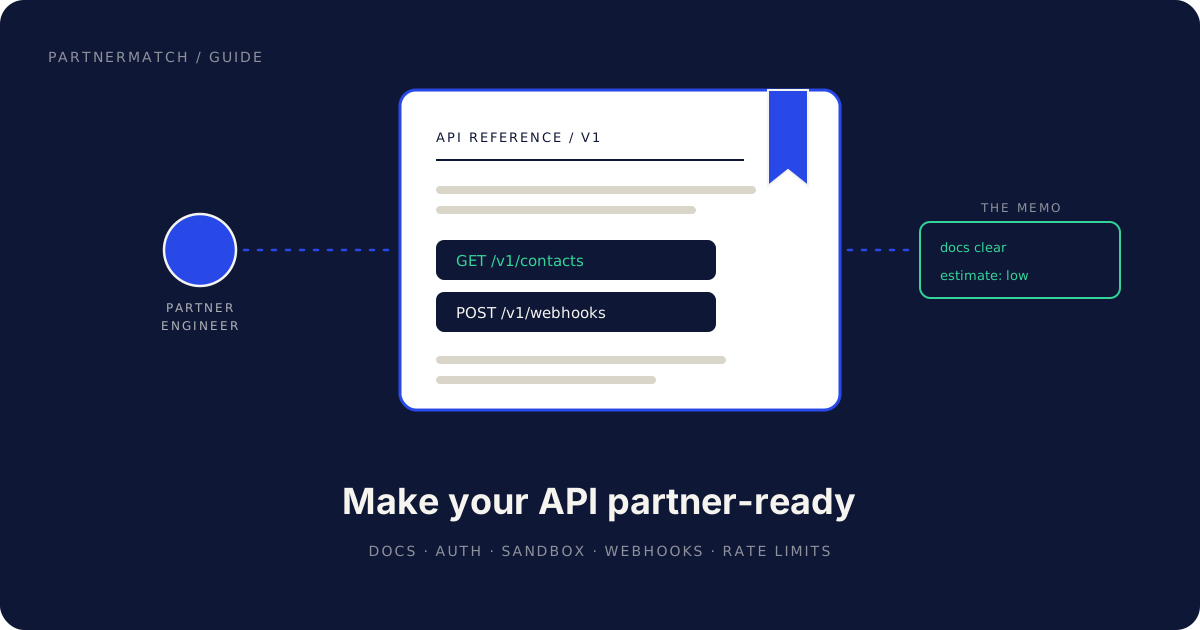
Most partnership deals do not die in a meeting. They die quietly, a few days later, when the partner's engineer opens your API documentation, spends ten minutes trying to figure out what they could build, and writes two sentences in an internal memo: "Docs are thin. Estimate high."
You never see that memo. You just notice that the warm conversation cools, the timeline slips a quarter, and the partner manager stops replying with the same energy. A partner-ready API, and specifically partner-ready API documentation, is how you stop losing deals you never knew you were losing.
This guide covers exactly what partner engineers look for: the documentation anatomy, authentication they can implement without a support thread, a sandbox with no sales gate, webhooks and rate limits as first-class features, and the internal FAQ that lets your whole company talk about the API without guessing.
It pairs with our complete guide to tech partnerships, which covers the full path from partner idea to shipped integration. This post zooms in on step four of that path: API readiness.
The 60-second version
- Partner engineers judge your API in ten minutes: what can we build, how does auth work, where is the value.
- Partner-ready API documentation has five parts: overview, auth, use-case pages, error catalog, changelog.
- Authentication must come with a working end-to-end example and self-serve test credentials.
- A sandbox without a sales call gate is the single highest-leverage asset on this list.
- Webhooks and rate limits are partnership features, not infrastructure trivia. Document delivery guarantees and limits.
- API readiness changes the partner conversation from "trust us" to "see for yourself."
- Write an internal API FAQ so sales and support stop improvising answers about your platform.
The ten-minute test for a partner-ready API
When a potential partner gets serious, the conversation leaves the business track and lands on an engineer's desk. That engineer has a backlog, a skeptical manager, and roughly ten minutes budgeted for your API. In those ten minutes they need to answer three questions:
- What can we build? Which objects and actions does the API expose, and do they cover the workflow the partnership is about?
- How does auth work? Can they see the full flow, from credentials to a successful call, without booking a call with you?
- Where is the value? Is there a concrete use case, with endpoints, that maps to something their customers want?
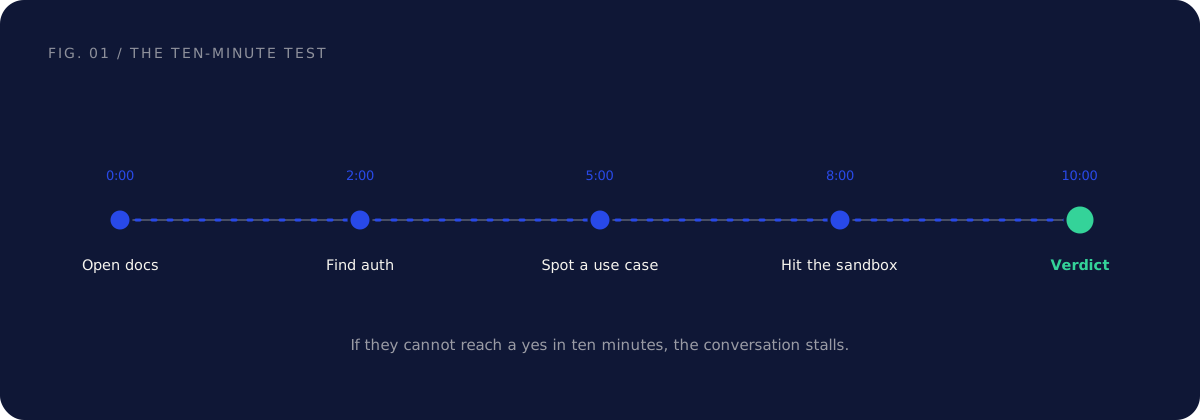
If the answer to any of the three is "unclear," the engineer does not file a bug against your docs. They pad the estimate, flag the risk, and your integration drops a tier in the partner's roadmap. Partner engineers are not grading you out of malice. They are protecting their own timelines, and an API they cannot evaluate quickly is an API they assume will be painful to integrate with.
The good news: the ten-minute test is completely gameable, in the honest sense. Every section below exists to make those three answers obvious.
The anatomy of partner-ready API documentation
Internal API docs and partner-ready API documentation are different documents. Internal docs assume context: your team knows what a "workspace" is and why contacts have two ID fields. Partner docs assume nothing. Here is the anatomy that works:
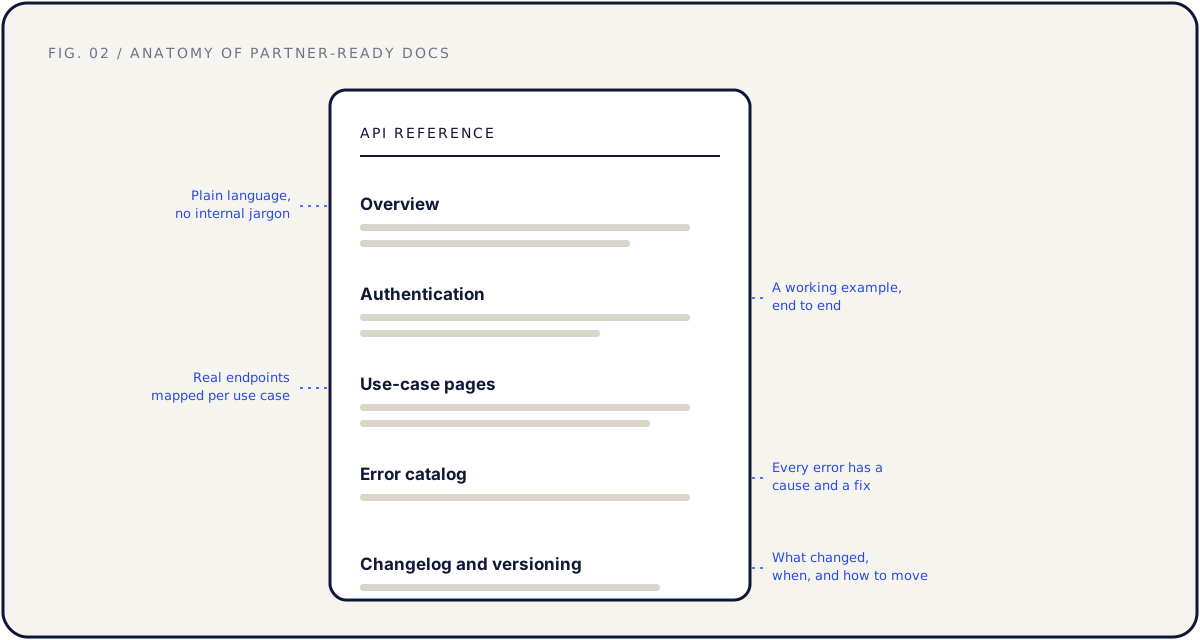
1. A plain-language overview. One page that explains what the API exposes, written for an engineer who has never seen your product. Name the core objects, what they represent in the real world, and how they relate. If your overview opens with pagination conventions, you have buried the lede.
2. Authentication, end to end. Not just "we support OAuth 2.0." The full sequence: how to get credentials, what the authorization flow looks like, a complete working example that ends in a real response, and what token expiry and refresh look like in practice. More on this in the next section, because auth is where most partner evaluations stall.
3. Use-case pages with endpoint maps. Two or three pages, each describing one concrete integration scenario: "Sync contacts into a CRM," "Push events into a data warehouse." Each page lists the endpoints involved, in the order they get called, with example payloads. This is the page a partner engineer screenshots into their memo, so write it for that screenshot.
4. An error catalog. Every error code, what triggers it, and what the caller should do about it. "400 Bad Request" with no body documentation costs your partner a debugging afternoon and costs you credibility. The error catalog is also where rate-limit responses and retry guidance live.
5. A changelog and versioning policy. Partners are signing up to maintain an integration for years. They want to know how you ship changes, how much notice they get before breaking changes, and where deprecations get announced. A dated changelog, even a modest one, signals that you treat the API as a product.
One more asset worth mentioning: a CLI. Nothing proves an API is real faster than a tool a partner engineer can install and run against it in two minutes. We cover that in why your B2B SaaS needs a CLI.
Authentication partners can actually implement
Auth is the first code a partner engineer writes against your API, which makes it your real first impression. The most common failure is not a missing feature. It is documentation that describes the happy path in prose and leaves the engineer to reverse-engineer everything else.
The decision most teams face is API keys versus OAuth:
| API keys | OAuth 2.0 | |
|---|---|---|
| Best for | Server-to-server, one customer's own data | Apps acting on behalf of many users |
| Partner effort | Minutes | Days, if your docs are good |
| Granularity | Usually all-or-nothing | Scopes per permission |
| Revocation | Manual, per key | Per user, standard flows |
| Marketplace requirements | Often not accepted | Usually required for listed apps |
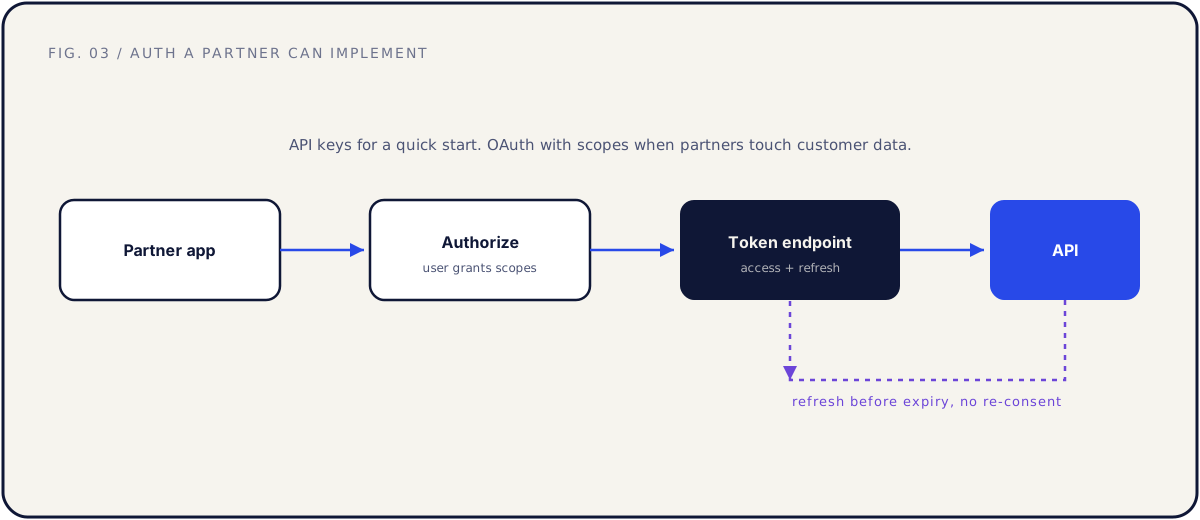
The honest answer for most B2B SaaS startups: support both. API keys let a partner prototype on day one. OAuth is what their production app and most marketplace reviews will require. If you can only ship one for now, ship API keys with scoping, and put OAuth on a public roadmap.
Whatever you support, four things make it implementable:
- Scopes that match real use cases. "read:contacts" and "write:contacts" beat one giant "api.access" scope. Partners want to request the minimum, because their own security reviews ask why they need more.
- Token lifetimes and refresh, documented with numbers. How long does an access token live? When should the partner refresh, and what does an expired-token error look like? Partners should refresh on a schedule, not discover expiry through 401s in production.
- Self-serve test credentials. An engineer evaluating your API at 9 PM should be able to generate a key or register an OAuth client without emailing anyone.
- One complete worked example. From nothing to an authenticated request that returns real data, in copy-pasteable steps. This single page does more for partner velocity than any other documentation investment.
The sandbox requirement
Here is a simple rule: if a partner engineer cannot make a successful API call without talking to your sales team, your API is not partner-ready.
A sandbox is the difference between a partner who evaluates your API and a partner who evaluates your claims about your API. It needs three properties:
- Self-serve signup. No "request access" form, no waiting for an account manager to provision something. The engineers evaluating you are doing it between other tasks, and any gate measured in days resets their attention to zero.
- Realistic seed data. An empty sandbox tests nothing. Pre-load it with a believable dataset: a few hundred contacts, some events, a couple of configured webhooks. The partner should be able to build and demo against it without inventing data first.
- Production-shaped behavior. Same endpoints, same auth, same error responses, same rate-limit headers. A sandbox that diverges from production converts integration bugs into launch-week surprises.
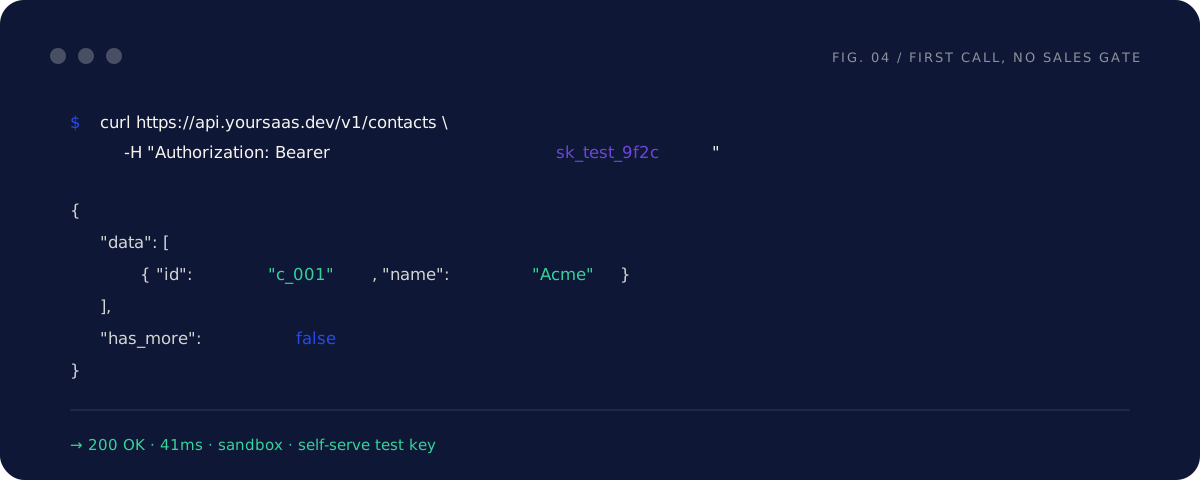
The benchmark to beat: signup to first successful API call in under five minutes. Time it yourself, with a stopwatch, on a machine that has none of your internal tooling installed. Every minute past five is a minute a partner engineer spends deciding you are harder to work with than the other integration on their list.
Webhooks and rate limits as partnership features
Most teams treat webhooks and rate limits as infrastructure concerns. Partners treat them as the core of the product, because integrations live and die on data freshness and predictable throughput.
Webhooks are how partners avoid polling you. Without them, every integration becomes a cron job hammering your list endpoints. Document them like a feature:
- Which events exist, with full example payloads for each.
- Delivery guarantees. At-least-once? Ordered? Partners will design around whatever you promise, so promise precisely.
- Retry policy. How many attempts, on what backoff, and what happens after the last failure. A dead-letter view or redelivery endpoint turns a 2 AM incident into a morning checkbox.
- Signature verification, with sample code, so partners can trust the payloads they receive.
Rate limits are a partnership conversation, not a surprise. Undocumented limits get discovered in the partner's production environment, during their launch. Document the numbers, return them in headers, describe the 429 response in the error catalog, and say what a partner should do when they need more. A documented path to higher limits ("contact us, here is what we ask about") reads as maturity. A silent 429 reads as risk.
One more reason to take this section seriously: your next "partner engineer" may not be human. AI agents and integration platforms increasingly consume APIs directly, and they are even less forgiving of ambiguity than people are. The same discipline that makes docs partner-ready makes them agent-ready, which is the subject of our guide to MCP for SaaS.
How API readiness changes partner conversations
API readiness is not just an engineering nicety. It changes what happens in the room. Every question a partner asks in evaluation maps to an asset you either have or improvise around:
| Question the partner asks | What answers it |
|---|---|
| "What could we actually build together?" | Use-case pages with endpoint maps |
| "How long would the integration take?" | Working auth example plus sandbox: they can prototype instead of estimate |
| "Can our engineer try it this week?" | Self-serve sandbox with seed data |
| "How do we keep data in sync?" | Webhook events, delivery guarantees, retry policy |
| "What happens at our customers' volume?" | Documented rate limits and the path to raise them |
| "Will this break on us in six months?" | Changelog, versioning policy, deprecation notice window |
| "Who do we talk to when something fails?" | A named technical contact and the error catalog |
Read that table from the partner's side and the pattern is obvious: every gap forces them to take your word for something. Every asset lets them verify instead. Partnerships move at the speed of verification.
There is a second-order effect, too. When your API story is solid, the partner conversation skips past feasibility and goes straight to scoping: which workflow, which data, which quarter. That is a conversation about shipping, and it is the one you want to be having. Our guide to tech partnerships for SaaS covers what happens from scoping onward.
Give your own team an internal API FAQ
The last mile of API readiness is not technical. It is the moment a prospect asks your account executive "do you have an API?" and gets a vague "yes, I think so, let me check." Multiply that by every sales call, support ticket, and partner intro, and the cost is real.
Write a one-page internal FAQ and put it where sales and support already live. It should answer, in plain language:
- Do we have a public API, and what can it do? Three sentences, no endpoint names.
- What auth do we support? "API keys today, OAuth in Q3" is a fine answer if it is true.
- Is there a sandbox or trial a technical evaluator can use? With the link.
- What are the rate limits, and what plan tier includes API access?
- Which integrations exist today, and which are on the roadmap? Sales should never guess at this in a live deal.
- Who is the internal owner for API and partnership questions, so unusual asks get routed instead of dropped.
Keep it honest, including the gaps. "We do not have webhooks yet, planned for Q4" is a perfectly good answer that builds trust. A confident wrong answer from sales costs you more in the partner's eyes than any missing feature.
Review it quarterly, ideally alongside the changelog. An internal FAQ that contradicts the public docs is worse than no FAQ at all.
Common mistakes, and the fix
Writing docs for your own team and calling them partner docs. The fix: add the partner layer, an overview in plain language, use-case pages, and an error catalog. Hand the docs to an engineer friend who has never seen your product and watch where they stall.
Gating the sandbox behind a sales call. The fix: self-serve signup with seeded data. The engineers evaluating you will not book a demo, and the ones who are forced to start the relationship annoyed.
Documenting only the happy path of authentication. The fix: document token expiry, refresh, scope errors, and revocation with real response bodies. Auth is the first code partners write, and the first place they judge you.
Treating rate limits and webhook retries as internal details. The fix: publish the numbers, return limits in headers, and write down the retry policy. Partners design their architecture around whatever you document, and around the worst case when you document nothing.
Letting sales improvise answers about the API. The fix: a one-page internal FAQ, reviewed quarterly, owned by whoever owns the API. The whole company talks about your platform whether you prepare them or not.
FAQ
What does "partner-ready API" actually mean? It means a partner's engineering team can evaluate your API without your help: understand what it exposes, authenticate, make a successful call in a sandbox, and map a real use case to endpoints, all within roughly ten minutes of opening the docs.
How is partner-ready different from public API docs? Public docs are often a reference: every endpoint, alphabetized. Partner-ready docs add the evaluation layer: a plain-language overview, use-case pages with endpoint maps, an error catalog, and a changelog. The reference answers "how do I call this." The partner layer answers "should we build on this."
Do we need OAuth before approaching partners? Not always. API keys with scopes are enough for server-to-server integrations and for prototyping. But most marketplaces require OAuth for listed apps that act on behalf of users, so check the requirements of the specific ecosystems you are targeting before you scope the work.
How much does it cost to get an API partner-ready? If the API itself is sound, this is mostly a documentation and developer-experience project: typically a few focused weeks for a small team, not a quarter. The audit usually matters more than the writing, because the gaps are invisible from inside the company.
Is a sandbox really necessary for a small startup? Yes, and it matters more for a small startup, because you have less brand trust to borrow. A sandbox converts "trust us" into "see for yourself," which is the cheapest credibility a seed-stage company can buy.
Should the API docs be public or behind a login? Public, almost always. Hidden docs cannot pass the ten-minute test, because the test happens before anyone asks you for access. Engineers also discover APIs through search, and gated docs are invisible to them and to the AI tools they increasingly ask first.
Who should own API readiness internally? One named owner, usually a product or engineering lead. Docs, sandbox, changelog, and the internal FAQ drift apart fast when they belong to "everyone." Ownership here mirrors what we recommend for the partnership itself in the tech partnerships guide.
How do we know when we are ready? Run the test. Ask an engineer outside your company to start from your docs homepage and reach a successful sandbox call, while you watch silently. If they get there inside ten minutes and can describe a plausible integration, you are ready for partner outreach.
Further reading
- OAuth 2.0 — the industry-standard authorization framework for partner and third-party access.
- OpenAPI Initiative — the spec that powers your reference docs, SDKs, and a CLI from one source of truth.
The short version
Partner engineers decide the fate of your partnership in the first ten minutes they spend with your API. A partner-ready API makes those minutes easy: a plain-language overview, auth with a working end-to-end example, use-case pages mapped to endpoints, an error catalog, a changelog, a self-serve sandbox with realistic data, and documented webhooks and rate limits. Then arm your own team with an internal FAQ so the story stays consistent from sales call to support ticket.
None of this requires a big platform team. It requires looking at your API the way a partner's engineer will, and closing the gaps before outreach instead of after the deal cools.
If you want an outside pair of eyes on exactly that, a Partner Audit reviews your API, docs, and partner potential, then gives you a concrete readiness plan: what to fix, what to write, and which partners to approach once it is ready.