Webhooks vs polling: how to design reliable integration sync
Webhooks vs polling for B2B SaaS integrations. The tradeoffs in latency, load, and reliability, when each wins, and the hybrid pattern that ships.
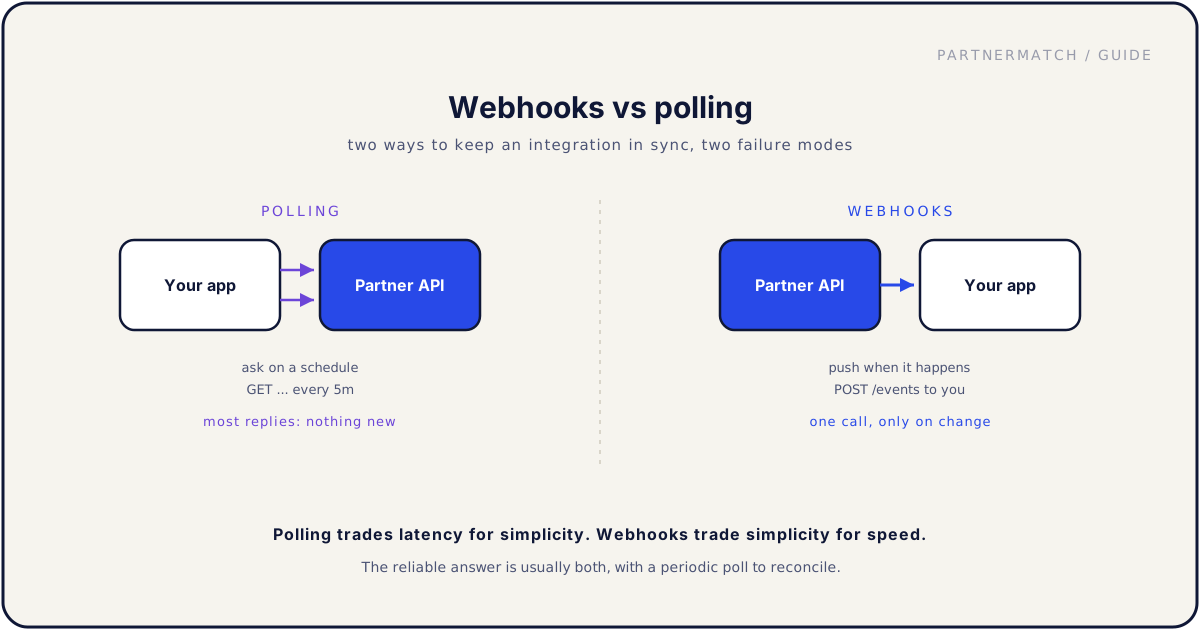
Every integration that keeps two systems in sync answers the same question: how does your product find out that something changed on the other side. The webhooks vs polling choice is how you answer it. You can ask on a schedule, which is polling. Or the other system can tell you the moment it happens, which is a webhook. Most integration bugs that reach a customer trace back to picking the wrong one, or to picking the right one and skipping the reliability work it needs.
This sounds like a low-level engineering detail. It is not. It decides how fresh your customer's data is, how much load you put on a partner's API, how your integration behaves when the network hiccups, and how often someone gets paged at 2am. Get it right and the integration feels invisible. Get it wrong and it shows up as stale records, duplicate writes, and missing data that a customer notices before you do.
This guide defines both patterns, walks the tradeoffs, says when each wins, and then gets practical about the part most teams skip: how to make webhooks reliable, when polling is the smarter call, and the hybrid pattern most production integrations end up needing.
The 60-second version
If you only read one section, read this one:
- Polling means you ask the API on a schedule. Simple to build, self-healing, but late by up to your poll interval and wasteful, since most replies say nothing changed.
- Webhooks mean the API pushes events to you. Near real time and cheap per event, but you now run an endpoint that has to stay up, verify, and never silently drop a message.
- Latency and load favor webhooks. Simplicity and reliability favor polling. The whole webhooks vs polling tradeoff lives in those two pairs.
- Webhooks are not fire-and-forget. They need signature verification, fast acks, idempotency, retries with backoff, a dead-letter queue, and a way to replay.
- Polling is the pragmatic choice more often than people admit: low event volume, no webhook support on the partner side, or a hard requirement that nothing is ever missed.
- The reliable answer is usually both. Webhooks for speed, a periodic reconciliation poll as the safety net that catches anything the push dropped.
- The pattern shows up in every partner integration. It is the same decision whether you are building a native connector, a marketplace app, or a partner-ready API others build on.
What polling and webhooks actually are
The two patterns differ on one thing: who initiates the conversation.
Polling: you ask. On a fixed schedule, your app calls the partner API and asks what changed. Every five minutes, every hour, you send a request like GET /changes?since=last_check and process whatever comes back. The partner API is passive: it answers when asked and does nothing in between. You own the cadence, the load, and the freshness.
Webhooks: they push. You register an endpoint with the partner, and when something happens on their side, they send an HTTP request to your URL describing the event. Your app is passive between events and reacts when one arrives. The partner owns delivery. You own staying reachable and processing what lands.
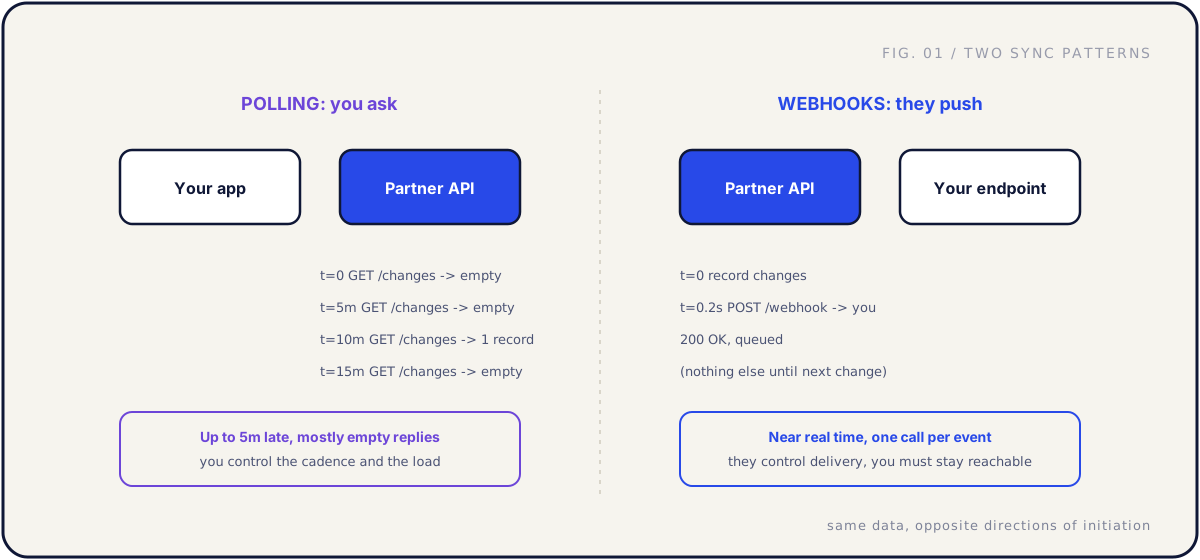
The diagram makes the asymmetry clear. With polling, you send four requests to catch one change and three come back empty. With webhooks, the partner sends exactly one request, the moment the change happens, and nothing in between. That asymmetry is the whole tradeoff: polling spends requests to stay in control, webhooks spend complexity to stay fast. Neither is free, and the cost shows up in different places.
| Term | Polling | Webhooks |
|---|---|---|
| Who starts the call | Your app | The partner API |
| When it happens | On your schedule | On their event |
| Direction | You pull | They push |
| Idle behavior | Keeps asking | Silent until a change |
| You must run | A scheduler | An always-on endpoint |
Webhooks vs polling: the tradeoffs, latency to missed events
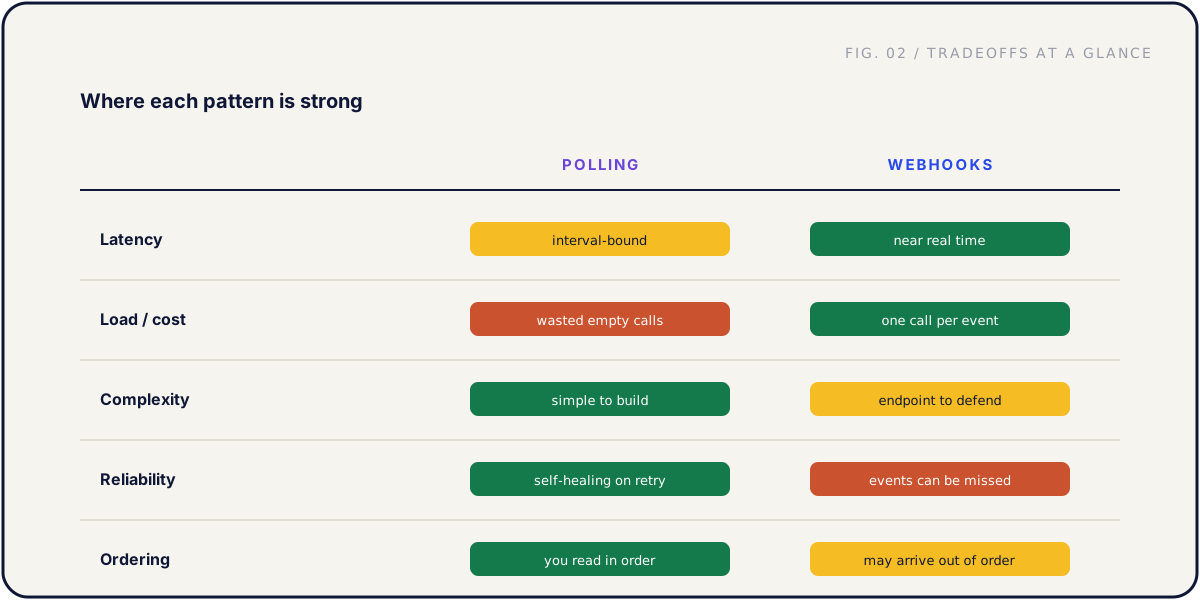
The webhooks vs polling choice comes down to a handful of properties, and each favors a different side.
Latency. Webhooks win, clearly. An event reaches you in roughly one HTTP request, usually under a second. Polling is bounded by your interval: poll every five minutes and a change can sit unseen for almost five minutes. You can shorten the interval, but you pay for it in load.
Load and cost. Webhooks win again. They send one request per actual change. Polling sends a request every interval whether or not anything changed, and on a quiet integration most of those calls come back empty. Multiply that across every customer and you are spending real money, and real partner rate limit, to learn that nothing happened.
Complexity. Polling wins. A poller is a loop, a timestamp, and an API call. A webhook receiver is a public endpoint that has to authenticate requests, respond fast, queue work, dedupe, retry, and handle the partner sending you the same event twice. That is a small system, not a function.
Reliability. Polling wins, and this one surprises people. Polling is self-healing: if a poll fails, the next one picks up everything since the last successful checkpoint, because you are always asking "what changed since X." A webhook is a single delivery attempt. If your endpoint is down for thirty seconds or returns a 500, that event can be lost unless the sender retries and you handle the retry correctly.
Ordering. Polling wins. When you pull a batch of changes, you read them in whatever order you choose, usually by timestamp. Webhooks arrive as independent HTTP requests and can land out of order, especially under retries, so a "deleted" event can arrive before the "created" event it depends on.
Missed events. This is the failure mode that defines the topic. Polling effectively cannot miss a change, because the next poll re-asks. Webhooks can and do miss events: your endpoint was deploying, the delivery timed out, a network blip ate the request. Designing for missed events is the core of reliable webhook work.
| Property | Polling | Webhooks |
|---|---|---|
| Latency | Bounded by interval | Near real time |
| Load on partner API | High, mostly empty | Low, one per event |
| Build complexity | Low | Higher |
| Reliability model | Self-healing | Single delivery, needs retries |
| Ordering | You control it | Can arrive out of order |
| Missed events | Effectively none | Real risk, must design for it |
The pattern jumps out. Webhooks win on the things customers feel day to day, latency and freshness. Polling wins on the things engineers feel at 2am, simplicity and recovery. That tension is why the hybrid pattern exists.
When webhooks win
Reach for webhooks when freshness matters and volume is high enough that polling would be wasteful or slow.
The data needs to be fresh. If a customer expects a change reflected within seconds, a sales rep updating a deal, a payment clearing, a ticket status flipping, polling at any reasonable interval feels broken. Webhooks are the only pattern that delivers near real time without hammering the API.
The event volume is high or bursty. When a lot changes, webhooks scale with the work: more changes, more pushes, each cheap. Polling does the opposite. To keep latency low under high volume you poll frequently, and frequent polling on a busy dataset is a lot of large responses to fetch and diff.
You want to react, not just sync. Webhooks are events, which makes them natural triggers. A new signup fires a webhook that kicks off onboarding. A cancellation starts a winback flow. Polling drives the same flows but with a delay and with you doing the work of detecting the change.
The partner has built webhooks well. If the partner offers signed webhooks with documented retries and a way to list recent events, they have done the hard part. Use it. A mature webhook product usually signals the rest of the API is solid too.
The catch is the same in every case: webhooks only win if you do the reliability work. A webhook integration without retries and reconciliation is faster than polling right up until the day it silently drops an event, and then it is worse, because polling would have caught it on the next cycle.
Making webhooks reliable
This section separates a webhook integration that works in the demo from one that works in production. A naive receiver, accept the POST, write to the database, return 200, loses data the first time anything goes wrong. Here is the shape of a receiver that does not.
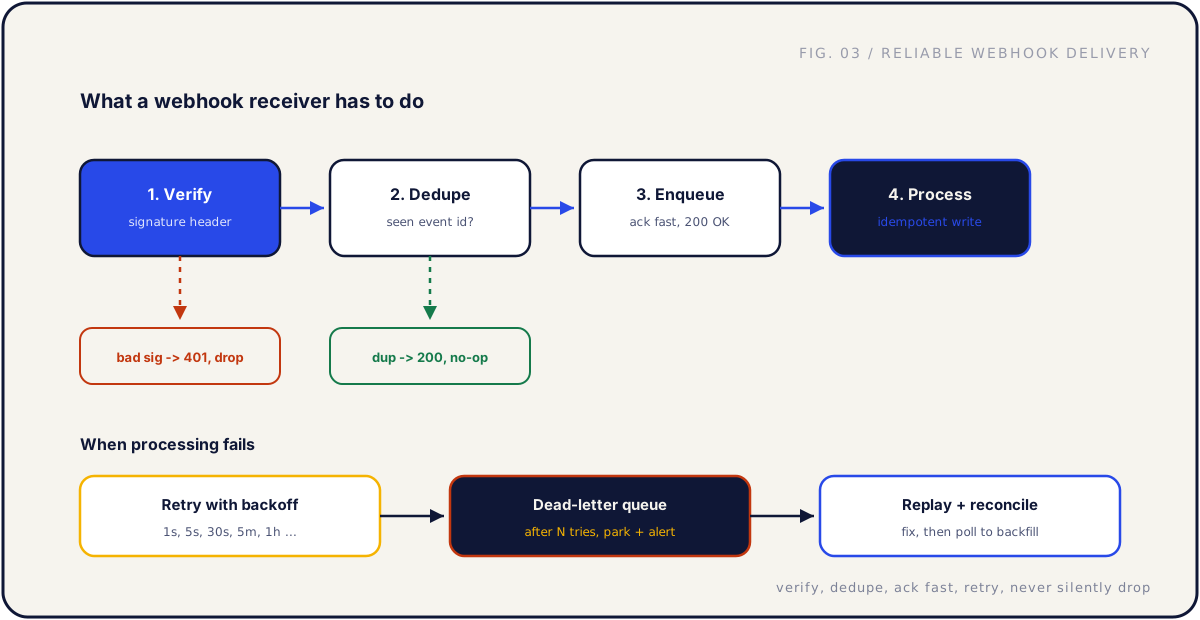
Verify the signature. Your endpoint is public, so anyone can POST to it. The partner signs each payload, usually an HMAC over the raw body with a shared secret, in a header. Verify that signature before you trust a byte of the payload, and reject failures with a 401. This is the difference between a webhook and an open door. Stripe's webhook docs, linked at the end, are a clean reference for signing and verification.
Acknowledge fast, process later. Return 200 as soon as you have verified and durably stored the raw event, ideally on a queue. Do not do the real work, the database writes, the downstream calls, before responding. Senders enforce a timeout of a few seconds, and if you spend that time processing, the sender thinks delivery failed and retries, so now you process the same event twice while looking unreliable.
Be idempotent. Because retries and duplicates are normal, processing the same event twice must produce the same result as processing it once. Key off the event id the partner provides: before you act, check whether you have already handled that id, and if so, return 200 and do nothing. Idempotency is the property that makes retries safe.
Retry with backoff, then dead-letter. When processing fails for a transient reason, retry on an increasing schedule: a second, then five, thirty, minutes, hours. After a set number of attempts, move the event to a dead-letter queue rather than retrying forever or dropping it. A parked event you can replay is recoverable. A dropped one is a support ticket waiting to happen.
Alert on the dead-letter queue. A dead-letter queue nobody watches is just a slower way to lose data. When events land there, page someone. The first person to notice a broken sync should be you, not a customer.
Have a replay and reconciliation path. Even with all of the above, assume some events will not make it. The backstop is a periodic poll that compares your copy of the data against the partner's source of truth and backfills any gaps. That is the hybrid pattern, and it is next.
| Reliability practice | Problem it solves |
|---|---|
| Signature verification | Forged or tampered payloads to a public endpoint |
| Fast ack, then queue | Sender timeouts and accidental duplicate processing |
| Idempotency by event id | Duplicate deliveries and retries corrupting state |
| Retry with backoff | Transient failures dropping events |
| Dead-letter queue + alert | Permanent failures vanishing silently |
| Reconciliation poll | Events that never arrived at all |
None of this is exotic. It is the standard kit for consuming webhooks, and exactly the kind of written convention an integration portfolio should standardize once and apply to every connector, rather than reinventing per partner.
When polling is the pragmatic choice
Webhooks get the attention, but polling is the right answer more often than the discourse suggests. Choose it deliberately in these cases.
The partner has no webhooks. Plenty of APIs, especially older or smaller ones, simply do not offer them. Polling is then not a compromise, it is the only option, and a well-built poller is perfectly reliable.
Event volume is low. If a dataset changes a few times a day, the load argument for webhooks evaporates. A poll every fifteen minutes is cheap and simple, and the small latency does not matter. Standing up a hardened webhook receiver for a handful of daily events does not pay back.
You cannot tolerate any missed event. For financial records or compliance-relevant state, "we think we got everything" is not good enough. Polling's self-healing property, where the next cycle re-asks since the last checkpoint, gives a guarantee pure webhooks cannot. Even teams that use webhooks for speed keep a poll for exactly this assurance.
You cannot host a reliable public endpoint. Webhooks require an always-on, reachable receiver with the full reliability stack. If you cannot operate that yet, polling from inside your own infrastructure is the honest choice. It asks nothing of your uptime that you are not already meeting.
You are batch by nature. If the downstream work runs on a schedule anyway, a nightly export, an hourly rollup, real-time delivery buys you nothing. Poll on the cadence the batch already runs on.
The thing to avoid is polling too aggressively to fake real time. A one-minute poll across thousands of customers is a lot of load and runs into rate limits, the HTTP 429 territory well-behaved clients have to respect. If you are polling that often to chase latency, that is the signal you actually want webhooks, with polling kept as the slower safety net.
The hybrid pattern most integrations need
Here is where experienced teams land: do not choose. Use webhooks for speed and a periodic poll for reconciliation. You get the freshness of push and the reliability of pull, and the two cover each other's weaknesses.
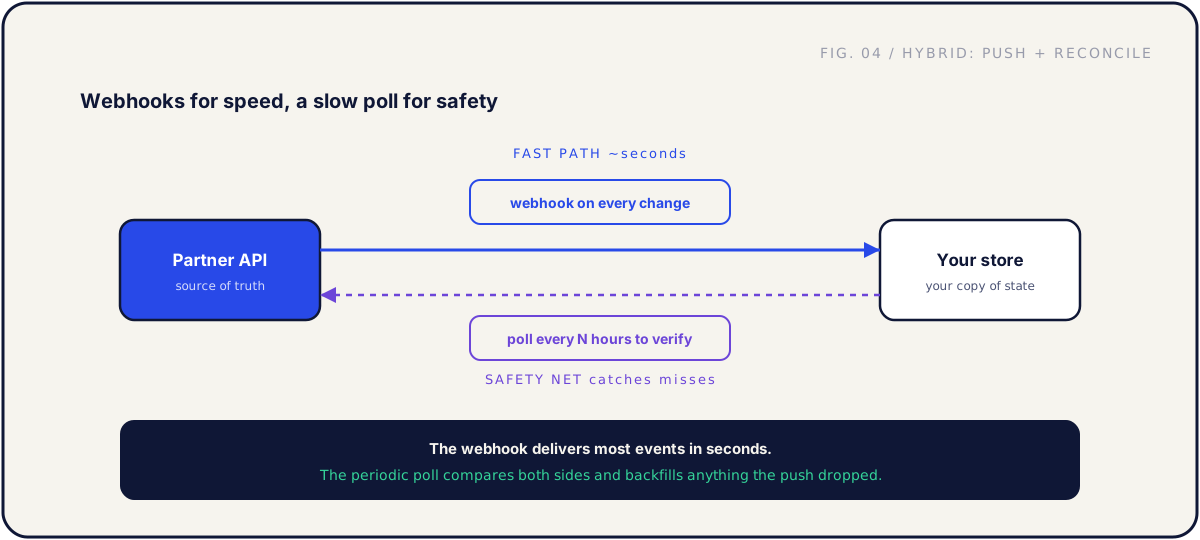
The fast path is the webhook. Most events arrive in seconds, your data stays fresh, and your customer sees changes almost immediately. This is what the integration feels like day to day.
The safety net is a low-frequency reconciliation poll. On a relaxed schedule, every few hours or nightly, your app asks the partner for everything changed since the last reconciliation and compares it against your copy. Anything the webhooks missed, an event dropped during a deploy or a delivery that exhausted its retries, gets caught and backfilled here.
This combination is why the hybrid is the default for serious integrations:
- Latency comes from the webhook, near real time for the common case.
- Reliability comes from the poll, which converges on the partner's truth even if some pushes are lost.
- Load stays modest, because the poll is infrequent. It is a correctness check, not the primary sync.
- Confidence comes from both: you can tell a customer their data is fresh and complete, and mean it.
The reconciliation poll does not need to be clever. Even a daily "pull everything and diff" job turns "we hope no webhooks were dropped" into "we verify nothing stays dropped for more than a day." A far better promise, for the cost of one scheduled job.
| Layer | Pattern | Job | Frequency |
|---|---|---|---|
| Fast path | Webhook | Deliver each change quickly | Per event |
| Safety net | Reconciliation poll | Catch and backfill misses | Every few hours or nightly |
| Recovery | Replay from dead-letter | Reprocess parked events | On alert |
Webhooks vs polling in real partner integrations
This is not an abstract exercise. The webhooks vs polling decision is one of the first real choices in nearly every partner integration, and it shapes how the connector behaves for the life of the partnership.
Across a portfolio of connectors, native, marketplace, iPaaS, and agent-facing surfaces, sync behavior is one of the conventions that has to be consistent. A customer who uses two of your connectors should not get real-time updates from one and hour-late updates from the other with no explanation. Deciding your sync model and standardizing the reliability practices around it is part of designing the surfaces coherently rather than letting each connector drift. We cover that wider design in the guide to connectors, agents, and third-party workflows.
It also shapes the integration project itself. The sync model is a scoping decision with handoffs baked in: the partner has to provide and document webhooks, you have to stand up and verify the receiver, and someone has to own the reconciliation job. Those are exactly the cross-company dependencies where integration timelines slip, so they belong in the scope and the blocker list from kickoff, not discovered in week six when an event goes missing in a demo. Our guide to why integration projects slip is about closing those gaps before they cost you weeks.
It cuts the other way too. If you are the partner exposing the API others build on, whether and how you offer webhooks directly determines how hard you are to integrate with. An API that pushes signed, retried, documented webhooks is a pleasure to build against. One that forces every partner to poll aggressively and reverse-engineer change detection is a tax on everyone who connects to you. The full set of decisions that make your API easy to build on is in our guide to building a partner-ready API.
Whether you are consuming a partner's events or producing your own, the same tradeoffs apply, and the same hybrid usually wins.
Common mistakes, and the fix
Treating webhooks as fire-and-forget. The fix: build the full receiver. Verify signatures, ack fast, dedupe, retry with backoff, dead-letter, and reconcile. A webhook without retries and a reconciliation poll is not reliable sync, it is a hope that nothing ever fails.
Polling every minute to fake real time. The fix: if you need that freshness, use webhooks. Aggressive polling burns the partner's rate limit, runs into 429s, and still lags real time. Keep polling for low volume or as the slow safety net, not as a real-time substitute.
Skipping idempotency. The fix: key every operation off the partner's event id and make reprocessing a no-op. Duplicates and retries are normal, not edge cases, and an integration that double-applies an event will corrupt data the first week it is live.
No reconciliation behind webhooks. The fix: add a periodic poll that compares your data to the partner's source of truth and backfills gaps. This is the single highest-value addition to a webhook integration, because it converts silent permanent loss into temporary, self-correcting lag.
Letting connectors disagree on sync behavior. The fix: standardize the sync model and reliability practices across your whole integration portfolio. One retry convention, one idempotency approach, one reconciliation cadence, so the third connector behaves like the first and support can reason about all of them.
FAQ
What is the difference between webhooks and polling in one sentence? Polling is your app asking a partner API on a schedule whether anything changed, and webhooks are the partner API pushing an event to your endpoint the moment something changes.
Are webhooks always better than polling? No. Webhooks are faster and lighter, but they require an always-on endpoint with verification, retries, idempotency, and dead-lettering, and they can miss events. Polling is simpler and self-healing. The best answer for most production integrations is a hybrid: webhooks for speed, a periodic poll to reconcile.
How do I stop processing the same webhook twice? Make processing idempotent. Use the event id the partner sends, record which ids you have handled, and if one arrives again, return 200 and do nothing. Duplicates happen because of retries and re-sends, so safe reprocessing is a requirement, not an optimization.
What happens if my webhook endpoint is down? Most partners retry failed deliveries on a backoff schedule for some window, so a short outage is usually recoverable if your receiver handles the retried events idempotently. Beyond that window, the reconciliation poll is your backstop: it compares state and backfills whatever the retries did not recover.
How often should I poll? As infrequently as the use case allows. For a poll that is your primary sync, match the freshness the customer needs against the load and rate limits you can afford, often five to fifteen minutes. For a reconciliation poll behind webhooks, every few hours or nightly is plenty, since its job is correctness, not speed.
What if the partner does not offer webhooks? Poll, and build the poller well: checkpoint the last successful sync, request only changes since that checkpoint, handle pagination, and respect 429 responses. A well-built poller is genuinely reliable, and you can add webhooks later if the partner ships them.
Do webhooks guarantee delivery and ordering? No to both. Treat delivery as at-least-once, not exactly-once, which is why idempotency matters, and do not assume events arrive in the order they occurred, which is why you key off ids and timestamps rather than arrival order. The reconciliation poll gives you the eventual completeness guarantee.
Should our own API offer webhooks or just polling? If partners need fresh data and your events have real volume, offer webhooks, signed, retried, and documented, because it makes you far easier to build against. Offer a polling or change-list endpoint too, so partners who cannot host a receiver still have a clean path. Most strong APIs offer both, which is part of being partner-ready.
Further reading
- Stripe webhooks documentation for a clear, production-grade reference on signing, verifying, and retrying webhook deliveries.
- The OpenAPI Initiative for describing your API, including webhook payloads, in one spec partners can build connectors from.
- RFC 6585, additional HTTP status codes which defines 429 Too Many Requests, the response well-behaved pollers have to respect.
The short version
Webhooks vs polling is the decision behind every integration that keeps two systems in sync. Polling means you ask on a schedule: simple, self-healing, and reliable, but late and wasteful. Webhooks mean the partner pushes events to you: fast and cheap per event, but they demand a real receiver with verification, fast acks, idempotency, retries, dead-lettering, and replay, and they can miss events if you skip that work.
Latency and load favor webhooks. Simplicity and reliability favor polling. Most serious integrations stop arguing and use both, because the hybrid covers each weakness: webhooks deliver the speed customers feel, and a periodic reconciliation poll delivers the completeness engineers need. Choose pure polling when volume is low, webhooks do not exist, or you cannot miss a single event.
If you want help deciding the right sync model for a specific integration, designing the reliable webhook stack, or making your own API easy for partners to build against, that is exactly what a Partner Audit is for. We review your product, API, and partner potential, then define what to build, who to approach, and how to ship it.