AI for partner research and qualification
How to research partner fit, enrich accounts, and qualify technology partners with AI, then verify every output before you spend engineering time.
Partner research is the hours between "this logo looks interesting" and "we should take a first call." Someone has to find out what the product does, who it sells to, whether the API is real, whether the company is stable, and whether it matches the profile you said you would use. Done by hand, that is a morning per candidate and a temptation to skip the scorecard because the brand is famous. Done with a model and no check, that is a fluent memo full of facts that were true of a different company.
AI for partner research and qualification is useful when it fills a scorecard you already trust, from sources you can reopen, with a human verify step before anyone books time. It is not useful when it picks the partner for you. Fit is a judgment. This guide covers the pipeline, enrichment, qualification against a partner ICP, and the verify gate. It sits on sourcing technology partners: sourcing fills the funnel, research scores what entered, the ICP decides what gets a call.
The 60-second version
If you only read one section, read this one:
- Research fills a scorecard. It does not pick the partner. Write the ICP first, then gather evidence against those dimensions.
- Collect, extract, score, verify. Never skip verify. Fluent text is not a source.
- Prefer primary sources: the partner's site, docs, filings, job posts, marketplace listing. Treat summaries as pointers back to those pages.
- Enrichment is optional and easy to overdo. A few fields you will use beat a twenty-column profile nobody reads.
- Qualification is a scored recommendation plus open questions, not a yes from the model. A person still decides to take the discovery call.
- Mark every claim with a URL or "unverified." If you cannot reopen the source, drop the claim.
- Do not paste your pipeline or a customer's name into a research prompt unless the tool's policy and your counsel are fine with it.
- AI is a tool. A person owns the qualified list.
What research is for: filling the ICP scorecard
If you have not written a partner ICP, stop and write one. Our partner ICP guide is the scoring model this process assumes: customer overlap, product complementarity, distribution, technical readiness, commercial alignment, and strategic fit. Research without that model produces biographies. Biographies do not tell you whether to spend engineering weeks.
The job of AI here is to gather evidence for each dimension and to flag what is missing.
- Customer overlap. Who do they sell to, in their own words? Case studies, job posts, a marketplace category.
- Product complementarity. What job does the product do, and does it sit before or after you in a workflow? Complementary beats similar.
- Distribution. Marketplace, partner directory, a sales team that could attach you, or only a blog.
- Technical readiness. Public API, sandbox, OpenAPI, changelog, status page. Thin docs are a finding.
- Commercial alignment. Pricing page, who they hire, product company versus services wrapper.
- Strategic fit. Filings, leadership changes, a product direction that would make you a competitor in a year.
None of those questions require a model. The model makes it cheaper to attempt all six for ten candidates instead of deep-diving two. The score still comes from a person who knows your customers.
Sourcing still decides who enters the pile. Customer-led requests beat inbound "let's partner" email, which is why sourcing technology partners weights the channels before research starts. Do not spend a cycle on a logo that failed the ICP on sight.
The research pipeline: collect, extract, score, verify
Do not ask a chat window "is Acme a good partner." That prompt invites a story. Run a pipeline that produces a scorecard with sources.
Collect. Build a source list the model is allowed to use: company site, product and docs URLs, developer portal, marketplace listing, careers, changelog, and a filing search if they are public. The assistant can propose URLs. You open them. A 404 is a useful negative signal.
Extract. Short bullets per dimension, each with a source URL, or "not found." Instruct it not to fill gaps. "Not found: public sandbox" is better than a paragraph that infers a sandbox from "easy integration."
Score. You score, or you let the model propose a 1 to 5 with a reason, then you confirm. Proposed scores without reasons are decoration. Overlap remains the heavy weight.
Verify. Open the URLs. Check that the quote matches the page and that the page is current. This step is not optional.
| Stage | Input | Output | Owner |
|---|---|---|---|
| Collect | Candidate name, ICP dimensions | A list of primary URLs | Researcher, with AI proposals |
| Extract | Those URLs | Bullets per dimension, each sourced | AI assistant |
| Score | Sourced bullets | 1 to 5 per dimension, with reason | Human |
| Verify | Every claim you might act on | Kept, corrected, or dropped | Human |
If you cannot fetch pages into a context you control, treat the model's web memory as a hint list. Google's note on how Search works is a reminder that results are ranked, not gospel. Open the document. Read the date. For U.S. filers, the SEC is where you confirm what was actually reported.
Enriching accounts without treating the web as truth
Enrichment means attaching a few firmographic and product facts so you can sort a list. It is useful in bulk. It is also where teams import fiction into the CRM.
Keep a small schema: name, domain, category, public API (yes/no/unknown), marketplace (yes/no), segment they sell to, source URLs, last verified date. Unknown is a first-class value. Forcing a yes or no on "has a partner program" produces fake precision.
Do not merge enrichment into the CRM as fact until verified. A staging sheet or a "proposed" record is the right landing zone. The same review gate as CRM updates from transcripts applies: the model proposes, a person writes.
Watch stale pages. A 2019 partner program page can outrank a 2025 pricing change. Prefer changelog, docs, and filings when they disagree. You are qualifying a company; you do not need a VP's mobile number to score technical readiness.
| Field | Worth storing | How it goes wrong |
|---|---|---|
| Domain | Yes, it is the key | Guessed from a similar name |
| Public API (Y/N/unknown) | Yes | Inferred from "integrations" marketing |
| Sandbox (Y/N/unknown) | Yes | Confused with a demo video |
| Segment they sell to | Yes, in their words | Copied from a competitor's page |
| Employee count | Maybe, as a band | Treated as exact and current |
| Named contacts | Only if you will outreach | Personal data in a research store |
If a field will not change the score or the outreach, do not collect it.
Qualification: using AI to test fit, not to pick partners
Qualification is the decision to spend a call, or to pass. AI can argue both sides against the ICP. It should not cast the vote.
A useful qualification packet, one page: ICP scores each with one piece of evidence and a URL; the likely joint workflow in one sentence, or "not found"; technical readiness in one sentence; open questions for the discovery call; a recommendation written as the researcher's call, not the model's.
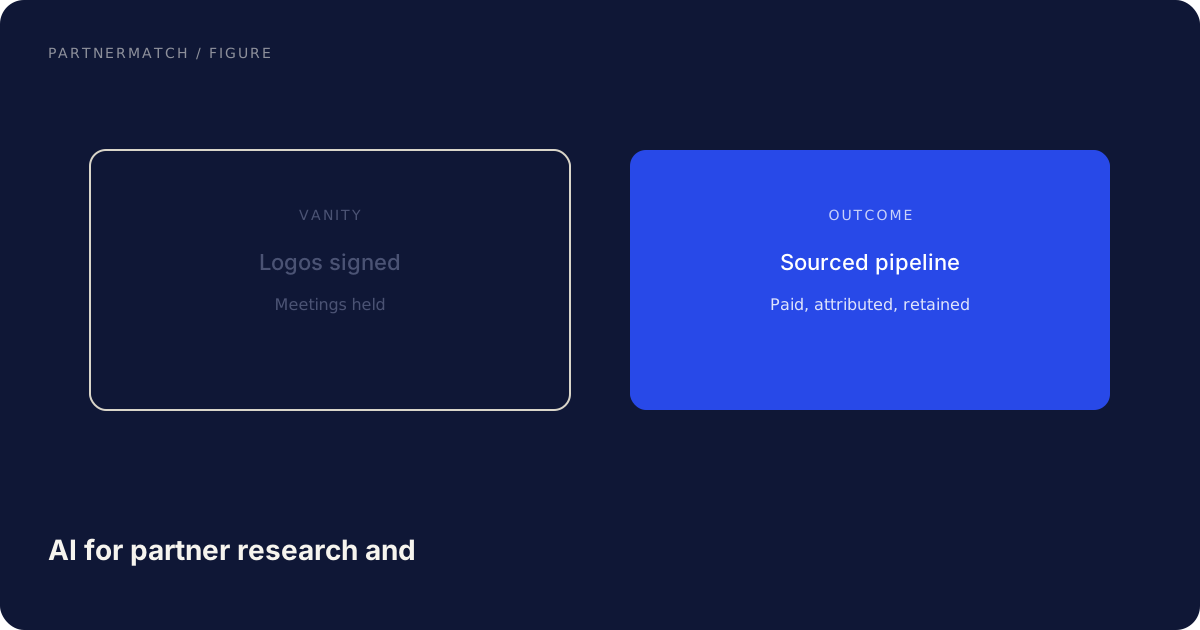
Watch the ICP anti-patterns. A vanity logo still scores low on overlap. A competitor in disguise still looks complementary in a first paragraph. AI is especially willing to steelman a famous brand. Keep the weights honest.
The first call still qualifies in the room. Research can be wrong in both directions: a thin website hiding a strong API, or a beautiful integrations page hiding a services bottleneck. If you take the call, write the partnership one-pager from verified facts, not from the unverified research draft.
The verify gate
This is the control that makes AI partner research safe enough to act on.
For every claim you might spend time on: open the source, confirm the fact is on the page, check the date, then keep, correct, or drop. Drop is the default if the source does not load or does not say that. Batch this. A packet with six sourced, checked bullets beats a five-page brief with mixed fiction.
Numbers (revenue, customer counts, "thousands of integrations") are marketing unless they sit on a filing, a pricing page, or a statement you would accept from a vendor. For material partnerships, use primary filings and counsel, not a model summary of a news item. A chatbot paraphrase of a 10-K is not the 10-K.
Verify also applies in reverse. If the assistant says there is no public API and you did not check the developer subdomain, you may pass on a good partner. "Not found in the URLs we opened" is more honest than "no API."
After the call, update the scorecard so the next cycle is smarter. Keep the store light: candidate, domain, scores, source URLs, last verified date, status. If the sheet is a novel, nobody will update it. A qualified partner is still only the start of the path in tech partnerships for SaaS. Believe the docs and the sandbox more than the about page.
Common mistakes, and the fix
Asking "is this a good partner" and trusting the essay. The fix: extract against ICP dimensions with a URL per bullet, then verify.
Treating enrichment as CRM fact. The fix: proposed fields, human write, unknown allowed.
Scoring famous brands generously. The fix: keep the ICP weights. Overlap and technical readiness do not improve because the logo is known.
Skipping verify because the prose sounds specific. The fix: specific and wrong is worse than vague and honest. Open the page.
Researching everyone in the inbound pile. The fix: source with a bias toward customer-led, drop on-sight ICP fails, research the plausible remainder.
Putting customer names or a partner NDA into the prompt. The fix: public sources for research; anything confidential stays in systems you already control.
FAQ
Can AI qualify partners for us without a human? No. It can fill a scorecard and propose a recommendation. A person confirms the evidence, applies ICP weights, and decides whether a call is worth it. Qualification is a spend decision. That stays human.
What sources should we trust? Primary ones you can reopen: site, docs, sandbox, filings, careers, marketplace listing. Use the model to find and extract, not as the source of record.
How much enrichment is enough? Enough to score the ICP and sort a list: domain, category, API and sandbox flags, segment, sources, last verified. Stop before you collect contacts and headcount you will not use.
How do we keep the model from inventing overlap? Require a source URL on the overlap claim, verify it, and default to "unknown" if the page does not name a shared segment. Do not let "we both serve mid-market" stand without their words and yours.
Where does this sit relative to sourcing? Sourcing fills the funnel. Research scores what entered. The ICP is the filter on both. See sourcing technology partners and the partner ICP.
Is it all right to use AI on public web pages only? Public pages are the right default. Still check the tool's data policy, and do not mix in your pipeline, customer lists, or NDA documents.
The short version
AI for partner research and qualification is a way to fill an ICP scorecard faster, not a way to choose partners. Collect primary URLs, extract sourced bullets, score with your weights, and verify every claim you might act on. Enrichment stays small. Unknown is allowed. The discovery call still qualifies in the room. The model will write a fluent memo either way. The verify gate is what makes the memo something you can take to a founder.
If you want help defining the ICP, the sourcing mix, and which candidates are worth a build, that is exactly what a Partner Audit is for. We review your product, API, and partner potential, then define what to build, who to approach, and how to ship it.
Further reading
- U.S. Securities and Exchange Commission: primary filings for public companies, including search across EDGAR.
- Google, how Search works: a reminder that ranked results are not a substitute for opening the source.
- NIST AI Risk Management Framework: process guidance for using AI where errors have a cost.