How to pitch a technology partnership (without a 20-page deck)
How to pitch a technology partnership with a shared-customer opener, a one-pager, a short send list, and a follow-up that books a meeting instead of a chase.
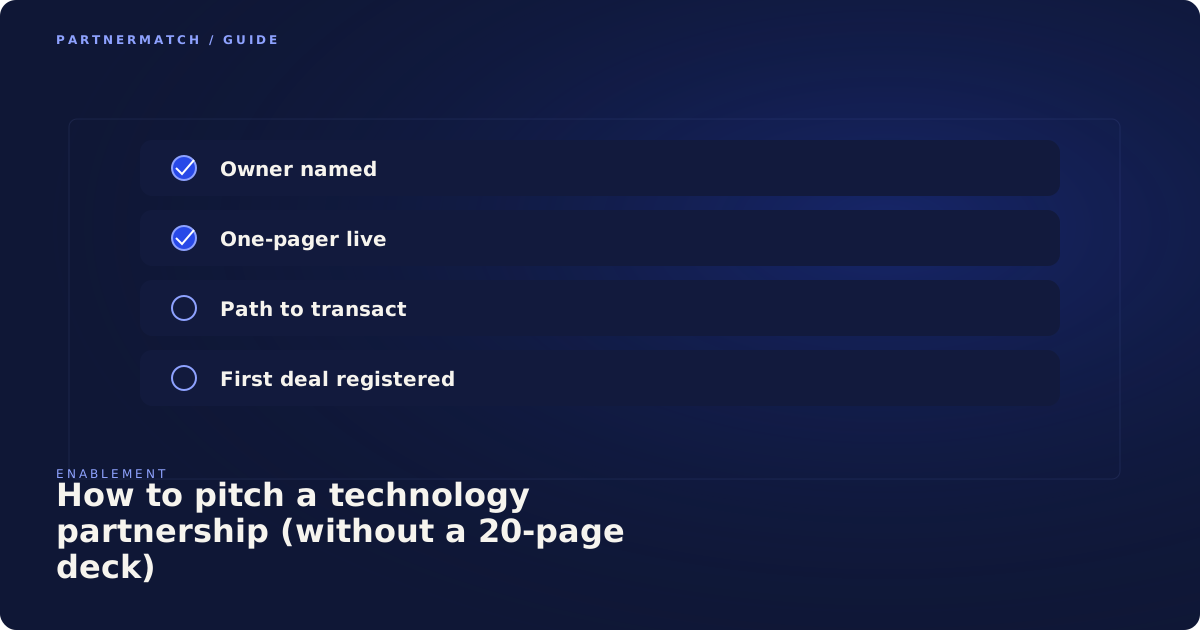
You asked for a meeting and attached a 20-page deck. The deck explains your product, your market, your team, and, on slide 17, that you would like to "explore a partnership." A partner manager who already has a full calendar will not hunt for slide 17. They will not reply. You will tell yourself they are busy. They are busy, and you gave them work.
A technology partnership pitch is not a fundraising pitch and it is not a sales demo. It is a short case that a shared customer has a problem neither of you fully solves, and that a small next step is worth 30 minutes. The partnership one-pager is the artifact. The opener is shared customers. The follow-up is a dated ask, not a drip of "just checking in."
This guide covers the opener, what to send and what to keep off the email, how the first conversation should run, and how to follow up without becoming a chase.
The 60-second version
If you only read one section, read this one:
- Lead with the shared customer, not your product. Name the overlap and the broken workflow in two sentences.
- The pitch is a one-pager plus a short note. A deck is for a meeting you already have, and often not even then.
- Write for their interest. Their customers, their gap, a next step they can forward. Not your roadmap.
- Send less. Note, one-pager, optional product URL. Not a data room.
- Ask for 30 minutes to test fit, not for a partnership. Small asks get replies.
- Follow up with new information, not guilt. A customer quote, a tighter scope, a named date. Then stop.
- A no is a result. A vague maybe is how quarters disappear.
Open with the shared customer, not your product
The person you are pitching is not buying your software. They are deciding whether a relationship helps their customers and their number. Open with the fact they cannot ignore: people they already serve are stuck between your products.
A usable opener has three parts:
- Who you both serve. Segment, not "companies like yours."
- The job that breaks. The manual export, the double entry, the deal that stalls without a connector.
- The evidence. A count of mutual customers, repeated requests, or a workflow you can describe without a demo.
Harvard Business Review's customer value propositions in business markets is blunt on this: a proposition that is not specific to the customer and the alternative is a slogan. "Better together" is a slogan. "Your mid-market accounts re-key invoices into our product every week" is a proposition.
If you do not have named overlap yet, do not fake it. Use a precise hypothetical you can stand behind: the segment you both publish as ICP, the handoff in the workflow, the public reason a buyer would need both. Then ask for a short call to test whether the overlap is real.
The joint value proposition is the full story. The pitch is the first paragraph of that story, aimed at a partner manager.
The one-pager is the pitch
If the note is the handshake, the one-pager is the object they forward. Build it so a colleague can understand the idea without you on the thread.
Keep the page to:
- A headline that names the joint outcome.
- The shared-customer hook with evidence.
- The partnership in one concrete line (what would connect, or what the referral path is).
- Three proof points (a result, a relevant customer pattern, a reason you can deliver).
- One ask: a 30-minute fit call.
- One name and one way to reply.
Do not turn the one-pager into a compressed deck. No team slide, market-size slide, or feature appendix. Those answers belong on the partner discovery call if they ask.
| Element | Belongs in the pitch | Belongs later, if asked |
|---|---|---|
| Shared customers and the broken job | Yes, first | Already said |
| One-line partnership | Yes | Scope document |
| Three proof points | Yes | Case write-up |
| Clear 30-minute ask | Yes | Calendar hold |
| Product tour | No | Discovery call, short |
| Company history | No | Almost never |
| Legal terms | No | After fit |
| 20-page deck | No | Only if they request a live walkthrough |
The test: would you forward this page to a busy colleague with "this is worth 30 minutes" and no extra paragraph. If you would have to explain it, rewrite it.
What to send, what not to send
The send is a short note, the one-pager, and at most one link that supports the hook. That is the whole packet.
Send
- A subject that names the shared job or the customer overlap, not "Partnership opportunity."
- Five to eight sentences. Hook, one-line partnership, proof, ask, availability.
- The one-pager as a PDF or a single page they can open without a login.
- Optional: a public URL that shows the product in the workflow you described.
Do not send
- A 20-page deck.
- Pricing, unless they are a reseller conversation you already qualified.
- A security questionnaire you filled out in advance to look prepared. It looks like homework.
- A customer list without permission.
- Three links "for context." They will open none of them.
- An NDA as the first attachment. You have not told them anything confidential yet.
| Send | Why | Hold |
|---|---|---|
| Short note | They can answer from the inbox | Long narrative |
| One-pager | Forwardable | Pitch deck |
| One proof URL | Optional backup | A folder of assets |
| Dated 30-minute ask | Easy yes | "Would love to explore" |
| Your calendar link, if they already replied | Reduces friction | Calendar link in the first cold note (often reads as presumptuous) |
If a warm introducer is sending on your behalf, give them four sentences they can paste, plus the one-pager. Do not make them write your pitch.
The first conversation is not the pitch again
When they say yes, do not replay the one-pager for 20 minutes. Use the time to qualify. The pitch earned the meeting. The meeting decides whether there is a partnership.
Run a tight partner discovery call: confirm the shared customer, ask who owns partnerships on their side, learn what a good partnership looks like to them, and leave with a dated next step or a clean no. Bring the one-pager as a shared object, not as slides you present.
If they ask for a product walkthrough, keep it inside the workflow you claimed. A general demo trains them to see a vendor, not a partner.
Follow-up that does not become a chase
Follow-up is where good pitches go to look needy. The rule is simple: every follow-up must add information or a clearer ask. "Just bumping this" is not information.
A sequence that respects a busy partner:
- Note plus one-pager.
- One follow-up, five to seven business days later, with one new fact (another customer request, a tighter one-line scope, a date you will be in their city).
- One last note that gives them an easy out and a door back: you will assume the timing is wrong, here is the page if a customer asks.
Then stop. Put them on a watch list. If a shared customer appears, you have a reason to write again. If not, you have your answer.
If they replied once and went quiet after the call, follow up on the next step you agreed. Quote the action: "You were going to introduce us to the platform PM by Friday. Still useful on our side." Nielsen Norman Group's work on trust and credibility online applies to the packet: specifics and restraint look like competence. Volume looks like a campaign.
Common mistakes, and the fix
Sending the company deck. The fix: write a one-pager for this partner. If a slide does not help them say yes to 30 minutes, it does not go.
Opening with your product story. The fix: first two sentences are their customers and the broken job. You come third.
Asking for a partnership in the first email. The fix: ask for a fit call. Partnership is the outcome of qualification, not the ask.
Attaching everything you might be asked. The fix: answer questions on the call. The packet should be easy to forward, not complete.
Following up weekly with no new information. The fix: two follow-ups with substance, then a clean close. Use customer evidence as the reason to restart later.
Pitching a motion you cannot run. The fix: only propose a path you can staff this quarter. A co-sell story with no sales process is how you lose the second meeting.
FAQ
Do I ever need a deck? Sometimes, if they ask for a live walkthrough with extra stakeholders. Even then, start from the one-pager and add only the slides the new people need.
What if I do not have mutual customers yet? Say that. Pitch the overlapping ICP, the workflow handoff, and why you want a short call to test overlap. Do not invent a customer count.
Should the founder send the pitch? If you are small, yes. A founder note plus a one-pager often clears a filter a generic alias will not. Once a motion exists, the owner of the motion should send.
How long should the email be? Short enough to answer on a phone. Five to eight sentences is plenty. The one-pager carries the rest.
What if they ask for a security review in the first reply? That is a buying process, not a partnership pitch. Thank them, ask who the partnership owner is, and do not fill a questionnaire until fit is real.
How is this different from sales outreach? Sales outreach sells your product to a buyer. This pitch sells a joint job to another company. Different reader, different proof, different ask.
When should I attach an NDA? When you are about to share something they cannot see publicly: named accounts, unreleased scope, commercial terms. Not in the first cold packet.
Further reading
- The partnership one-pager for the page that should replace the deck.
- The first partner call for what to do once the pitch books the meeting.
- Joint value proposition for the story the opener is compressing.
- How to source technology partners for who should receive the pitch in the first place.
- Harvard Business Review, Customer Value Propositions in Business Markets, on specificity versus slogans.
- Harvard Business Review, The B2B Elements of Value, on the kinds of value a partner manager might actually care about.
- Nielsen Norman Group, Trust and credibility online, on why specific, restrained claims get believed.
The short version
Pitch a technology partnership with a shared-customer opener, a one-pager, and a 30-minute fit ask. Do not send a 20-page deck. Write for the partner's customers and the job that breaks between your products. Send a short note, one page, and at most one proof link.
Use the meeting to qualify, not to replay the pitch. Follow up twice with new information, then stop. A clean no, or a dated next step, is success. A vague maybe with a large attachment is how the quarter stalls.
If you want help with pitching technology partnerships, that is exactly what a Partner Audit is for. We review your product, your partner book, and the commercial motions that can actually produce revenue.