Agent-ready SaaS: structuring your product for AI agents
An independent guide to making a SaaS product agent-ready. Clean data, stable IDs, tool-friendly actions, clear permissions, and an MCP surface an AI agent can use without breaking things.
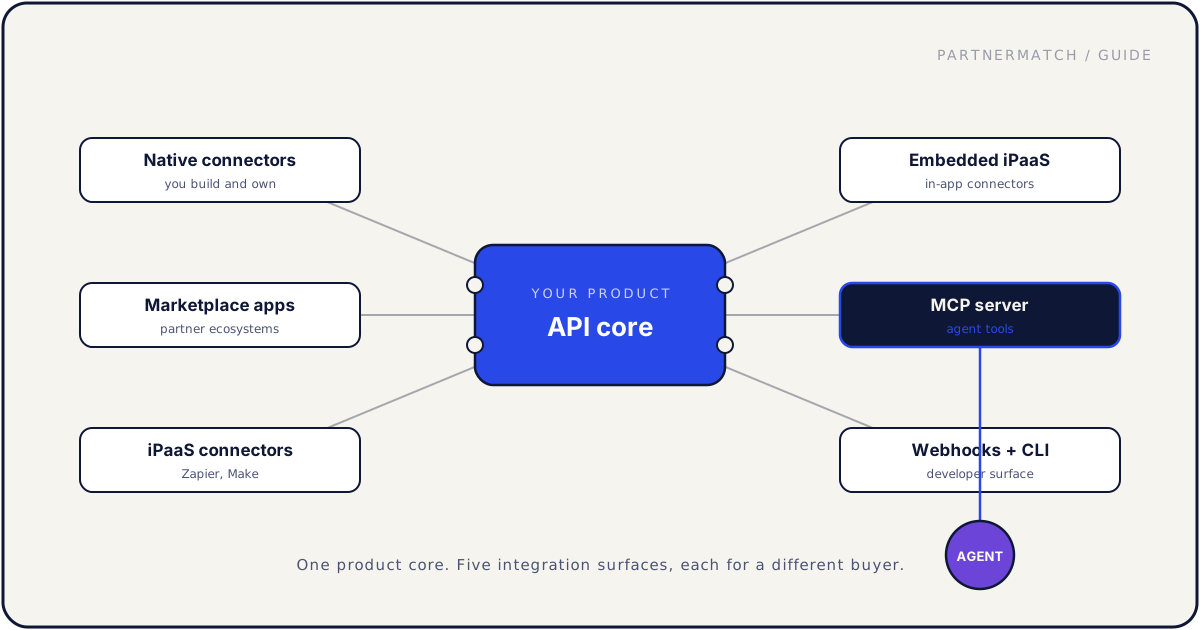
For a decade the question for a SaaS product was whether a person could use it. The screens, the onboarding, the empty states, all of it was tuned for a human who could read a label, infer a workflow, and recover from a confusing moment by clicking around until things made sense. An AI agent does none of that. It cannot infer your workflow from a clever layout, it cannot recover from an ambiguous record by squinting at it, and it cannot tell which of two similar-looking buttons is the safe one. It works from the structure underneath your product: the shape of your data, the stability of your identifiers, the clarity of your actions, and the boundaries of what it is allowed to do. Agent-ready is not a feature you bolt on. It is a property of how your product is built underneath the screens.
This is an independent guide to making a SaaS product agent-ready, written from the side of the team that builds and runs the product. The agent ecosystem is young and the standards are still settling, so treat the specifics here as the shape of the work rather than a fixed checklist; where a standard is relevant, like the Model Context Protocol, the current details live in the Model Context Protocol specification. What does not change is what agents need to work well: clean data they can interpret, stable IDs they can hold onto, actions designed as discrete jobs rather than UI flows, permissions that hold whoever is calling, and a deliberate surface, often an MCP server, that exposes the right slice of all of it. That is what this guide covers.
It pairs with our explainer on what MCP is, our guide to MCP for SaaS, and our piece on designing MCP tool definitions, since the tools you expose are only as good as the product structure behind them.
The 60-second version
- Agents read structure, not screens. Everything an agent does well depends on the data, IDs, and actions underneath your UI, not the UI itself.
- Clean data is the foundation. An agent cannot disambiguate a record a human would resolve at a glance, so consistent, well-shaped data is what lets it act correctly.
- Stable IDs are non-negotiable. An agent holds an ID across steps, so an identifier that changes or gets reused breaks the multi-step work agents are for.
- Design actions as jobs, not UI flows. A clean action does one thing with clear inputs and outputs. A wizard split across five screens is not something an agent can drive.
- Permissions must hold for whoever is calling. An agent acts on behalf of a user, so its access has to be scoped to that user's permissions, enforced server-side, every time.
- Expose a deliberate surface. An MCP server, or a clean API behind one, is how you give agents the right slice of your product on purpose, rather than letting them scrape the UI.
- Start with read, earn write. Reading data is low-risk and high-value; writing changes the world, so gate writes behind permissions and approvals before you open them up.
Why agent-readiness is a product property, not a connector
It is tempting to think of agent support as something you add at the edge: build an MCP server, expose some tools, done. But a connector can only expose what the product underneath it actually supports. If your data is inconsistent, the tools built on it will be unreliable no matter how cleanly they are defined. If your IDs are unstable, an agent holding one across a multi-step task will fail in ways the connector cannot fix. If your only "create order" path is a five-screen wizard with logic spread across the front end, there is no clean action for a tool to call. The connector is the last mile. The readiness is in the product.
This is why agent-readiness is worth treating as a structural property rather than a feature request. The same qualities that make a product agent-ready, clean data, stable identifiers, discrete actions, and enforced permissions, are qualities that make it easier to maintain, easier to integrate with conventionally, and easier to reason about. Work you do to make an agent reliable tends to pay off for your human users and your own engineers too, because it is mostly the work of making the product's structure honest and explicit rather than implicit in the UI.
The shift underway is real. As agents move from answering questions to taking actions in real systems, the products that are pleasant to operate through an agent will be the ones whose structure was already clean. The Model Context Protocol introduction frames the protocol as a standard way to connect models to the tools and data they need, and the value of that connection is bounded by how well-structured the tools and data are on your side. Getting the structure right is the part only you can do.
Step 1: clean data agents can interpret
An agent acts on your data, so the quality of your data sets the ceiling on how well the agent can act. A human looking at two customer records named "Acme" and "Acme Inc." infers they are probably the same company and moves on. An agent cannot make that leap safely; it either treats them as two customers and does the wrong thing, or it asks the user and breaks the flow. Clean, consistent data is what lets an agent interpret a record correctly without guessing, and guessing is exactly what you do not want an agent doing on your customers' behalf.
What clean, agent-friendly data looks like in practice:
- Consistent shapes. Records of the same type have the same fields populated the same way, so an agent that learned to read one customer can read them all. Sparse, inconsistent records force the agent to handle every case specially.
- Meaningful field names and values. A field called
statuswith values likeactiveandcancelledis readable; a field calledflag3with values0and2is not. The agent reasons over what the fields say. - Resolved duplicates. Duplicate or near-duplicate records are where agents do the wrong thing most often. The cleaner your records, the less an agent has to disambiguate.
- Explicit relationships. If an order belongs to a customer, the link should be explicit and followable, so an agent can move from one to the other without inferring the connection.
- Honest empties. A missing value should read as missing, not as a placeholder string or a stale default the agent will take literally.
You do not have to clean every record before exposing anything; that is a project with no end. But the data behind the actions you do expose to agents should be clean, because that is the data an agent will act on. Start with the slice you are opening up, get it consistent, and let the rest follow. The principle is narrow: an agent is only as reliable as the data it reads, so the data it reads has to be reliable.
Step 2: stable IDs an agent can hold onto
Agents are valuable because they do multi-step work: find the order, check its status, update it, notify the customer. Every step after the first depends on holding onto an identifier from a previous step, which means your identifiers have to be stable. An ID that changes, gets reused, or is not actually unique breaks the chain in the middle, and the agent ends up acting on the wrong record or none at all. Stable IDs are not a nice-to-have for agent work. They are the thing that makes multi-step tasks possible at all.
A few properties make an identifier dependable:
| Property | Why an agent needs it |
|---|---|
| Unique | The agent must address exactly one record, never two |
| Stable over time | An ID the agent stored in step one must still resolve in step four |
| Never reused | A recycled ID makes the agent act on the wrong record entirely |
| Opaque and explicit | A real ID field beats inferring identity from a name or position |
| Returned by every relevant tool | The agent can only hold an ID a tool actually gave it |
The last point is easy to miss. If your "create" action returns nothing but a success message, the agent has no handle to use in the next step; it has to go search for the thing it just created, which is slow and error-prone. A create action should return the ID of what it created, so the agent can pass that ID straight into the next call. This connects directly to tool design, which we cover in designing MCP tool definitions: a tool that returns a usable ID is a tool an agent can chain, and chaining is where agents earn their keep. Treat your IDs as a public contract the moment an agent can see them, because an agent will hold them across steps and across sessions.
Step 3: actions designed as jobs, not UI flows
Much of a typical SaaS product's logic lives in the front end, spread across the screens of a wizard: validation here, a derived value there, a confirmation step that quietly sets a flag. That is fine for a human clicking through, and useless to an agent, which has no screens to click. For an agent to take an action, that action has to exist as a discrete, callable job, with its inputs and its effects in one place, not scattered across a flow. Making your actions agent-ready often means pulling logic out of the UI and into a clean action the product can perform in one call.
What a tool-friendly action looks like:
- One job, clear inputs. The action does a single recognizable thing, like create an invoice, and takes the inputs that job needs, not a partial set the UI would top up from hidden state.
- Validation in the action, not the form. If a rule matters, the action enforces it, so an agent calling directly cannot bypass a check that only lived in the front end.
- A meaningful return. The action returns the result and an ID, so the agent knows it worked and can use what it created, rather than a bare success the agent cannot build on.
- No hidden multi-step state. An action that secretly depends on a previous screen having run is one an agent cannot perform. The job should be self-contained or its prerequisites should be explicit.
- Idempotency where it matters. For actions an agent might retry, supporting a safe retry, so a repeated call does not create a duplicate, protects against the way agents recover from errors.
This is the same separation that makes an API testable and a product maintainable: business logic belongs in the action layer, not the presentation layer. An agent simply makes the cost of mixing the two visible, because it can only reach the action layer. If the only way to create an order is through the UI, the honest fix is to build a real "create order" action and have the UI call it too, which leaves you with a cleaner product and an agent-ready one at the same time.
Step 4: permissions that hold for whoever is calling
An agent acts on behalf of someone, and the single most important safety property of an agent-ready product is that the agent gets exactly the access that person has, no more. An agent calling your product is not a trusted internal service; it is a caller acting for a specific user, and your permission model has to scope it to that user's rights and enforce that scope on the server, every call, regardless of what the agent asks for. The failure mode here is the worst kind: an agent that, through a confused request or a malicious prompt, reaches data or actions the user behind it was never allowed to touch.
A few principles keep agent access safe:
- Enforce permissions server-side, always. Never rely on the agent, or the tool definition, to respect a boundary. The server checks the caller's rights on every action, because the agent is not a trusted enforcer.
- Scope to the acting user. The agent inherits the permissions of the user it acts for. If that user cannot see another team's data in the UI, the agent must not see it through a tool either.
- Least privilege by default. Expose the narrowest access that does the job. An agent that only needs to read orders should not hold credentials that can delete them.
- Separate read from write. Reading is low-risk; writing changes the world. Gate write actions more tightly, and consider a human approval step for the consequential ones.
- Log what the agent did. An audit trail of which agent took which action on whose behalf is what lets you investigate, reassure customers, and catch misuse.
The security perspective here is not optional, because an agent expands the ways your product can be driven, and some of those ways are adversarial. Prompt injection, where instructions hidden in data try to make an agent act against the user's interest, is a real concern, and the defense is partly a permission model that does not let the agent exceed the user no matter what it is told. The OWASP API Security Project is a solid independent reference for the underlying risks of exposing actions, and we cover the agent-specific controls, scopes, approvals, and guardrails, in securing an MCP server. Permissions are where agent-readiness and trust meet, and getting them right is what lets you say yes to agents without saying yes to risk.
Step 5: expose a deliberate MCP surface
With clean data, stable IDs, tool-friendly actions, and enforced permissions in place, the last step is to expose them on purpose, through a surface designed for agents rather than left for them to scrape. For many products that surface is a Model Context Protocol server: a defined set of tools, each mapping to one of your clean actions, with typed inputs and honest descriptions, sitting behind your permission model. The point of a deliberate surface is that you decide what agents can do, rather than discovering after the fact what they figured out how to do to your UI.
A deliberate surface has a few characteristics:
- A scoped set of tools. Expose the jobs that matter, not a mechanical mirror of every endpoint. A small, sharp surface is more usable and easier to secure than an exhaustive one.
- Tools that map to clean actions. Each tool calls one of the discrete actions from step three, so the surface is reliable because the actions underneath it are.
- Honest, typed definitions. Names, descriptions, and schemas written so an agent picks the right tool and calls it correctly, which we detail in designing MCP tool definitions.
- Permissions enforced behind it. The surface is a front door, not a bypass. Every tool runs through the same server-side checks as the rest of your product.
- Read first, write deliberately. Open the read tools that deliver value at low risk, and add write tools as you build confidence and the guardrails to match.
This is the same staged approach we recommend in MCP for SaaS: start with a small, valuable, low-risk surface, learn from how agents use it, and expand deliberately. The surface is where all the earlier work becomes usable, but it is only as good as that work. A polished MCP server over messy data and leaky permissions is a fast way to expose problems to agents at scale. A modest server over clean structure is something agents can use well, which is the entire goal of being agent-ready.
Common mistakes, and the fix
Treating agent support as a connector you bolt on. The fix: treat it as a product property. A connector can only expose what the product underneath supports, so the readiness work is in the data, IDs, actions, and permissions, not the edge.
Exposing inconsistent or duplicated data to agents. The fix: clean the slice of data behind the actions you expose, with consistent shapes, meaningful values, and resolved duplicates. An agent cannot disambiguate a record a human would resolve at a glance.
Unstable or non-returned IDs. The fix: make identifiers unique, stable, and never reused, and have every create action return the ID it created. An agent holds IDs across steps, so an ID that shifts breaks the multi-step work agents are for.
Locking actions inside UI flows. The fix: build discrete, callable actions with their validation and effects in one place, and have the UI call them too. An agent has no screens to click, so logic spread across a wizard is logic it cannot reach.
Trusting the agent to respect permissions. The fix: enforce permissions server-side on every call, scoped to the acting user, with least privilege and an audit trail. The agent is a caller acting for a user, not a trusted enforcer.
Opening write actions before you are ready. The fix: start with read tools that deliver value at low risk, and gate writes behind tighter permissions and, where consequential, a human approval step. Reading is safe; writing changes the world.
FAQ
What does "agent-ready" actually mean for a SaaS product? It means the structure underneath your product, its data, identifiers, actions, and permissions, is clean and explicit enough that an AI agent can read and act on it reliably, rather than depending on a human-tuned UI it cannot use. An agent-ready product exposes discrete actions with stable IDs over consistent data, enforces permissions server-side for whoever the agent acts on behalf of, and surfaces the right slice of all that through a deliberate interface like an MCP server.
Do I need an MCP server to be agent-ready, or is a good API enough? A clean, well-structured API is most of the work, because the data, IDs, actions, and permissions live there, and an MCP server is one good way to present that to agents specifically. The protocol gives agents a standard way to discover and call your tools, which lowers friction compared to every agent learning your bespoke API. But the readiness is in the structure; the MCP surface exposes it. A solid API behind a thin MCP server is a common and reasonable shape.
Why are stable IDs such a big deal for agents? Because agents do multi-step work, and every step after the first depends on holding an identifier from a previous one. If an ID changes between steps, gets reused for a different record, or is not actually unique, the agent acts on the wrong thing or loses the thread entirely. Stable, unique, never-reused IDs, returned by the actions that create or fetch records, are what make a chain of steps possible, which is exactly what agents are for.
How do I keep an agent from doing something the user is not allowed to do? Enforce permissions on the server for every action, scoped to the user the agent is acting on behalf of, and never rely on the agent or the tool definition to respect a boundary. The agent inherits the user's rights and nothing more, write actions are gated more tightly than reads, consequential actions can require human approval, and everything is logged. The principle is that the agent can never exceed the user, no matter what it is asked to do.
Should I start with read access or write access? Read first. Reading data is low-risk and immediately useful, letting an agent answer questions and gather context without changing anything, so it is the right place to build confidence and see how agents use your surface. Write actions change the world and carry real blast radius, so open them deliberately, behind tight permissions and, for the consequential ones, a human approval step. Earning write access in stages is safer than opening everything at once.
Does the work to be agent-ready help anything besides agents? Yes, and that is part of why it is worth doing. Clean data, stable IDs, discrete actions with their logic out of the UI, and enforced server-side permissions are the same qualities that make a product easier to integrate with conventionally, easier to test, and easier for your own engineers to reason about. Agents just make the cost of messy structure visible, because they cannot paper over it with a clever UI the way a human can.
Further reading
- Model Context Protocol introduction for how the protocol connects models to tools and data.
- Model Context Protocol specification for the authoritative, current details of the standard.
- JSON Schema reference for typing the inputs of the actions you expose to agents.
- OWASP API Security Project for the security risks of exposing actions, which an agent surface amplifies.
- OWASP Top Ten for the broader application security context any agent-facing product sits in.
The short version
Agent-readiness is a property of how your product is built underneath the screens, not a connector you add at the edge, because a connector can only expose what the structure beneath it supports. Clean the data behind the actions you expose, since an agent cannot disambiguate a record the way a human glances and resolves, and inconsistent or duplicated data is where agents do the wrong thing. Make identifiers unique, stable, and never reused, and have create actions return them, because agents hold IDs across the multi-step tasks they are valuable for. Design actions as discrete jobs with their validation and effects in one place rather than logic spread across a UI flow an agent cannot click through. Enforce permissions server-side for whoever the agent acts on behalf of, with least privilege and an audit trail, so the agent can never exceed the user no matter what it is told. Then expose a deliberate surface, often an MCP server, that maps a scoped set of honest, typed tools to those clean actions, starting with read and earning write. Do that work and an agent can operate your product as reliably as a careful user, which is what being agent-ready means.
If you want help making your product something agents can operate safely, a Partner Audit reviews your data, your actions, your permissions, and your agent-facing surface, then hands you a concrete plan for what to clean up and what to expose.